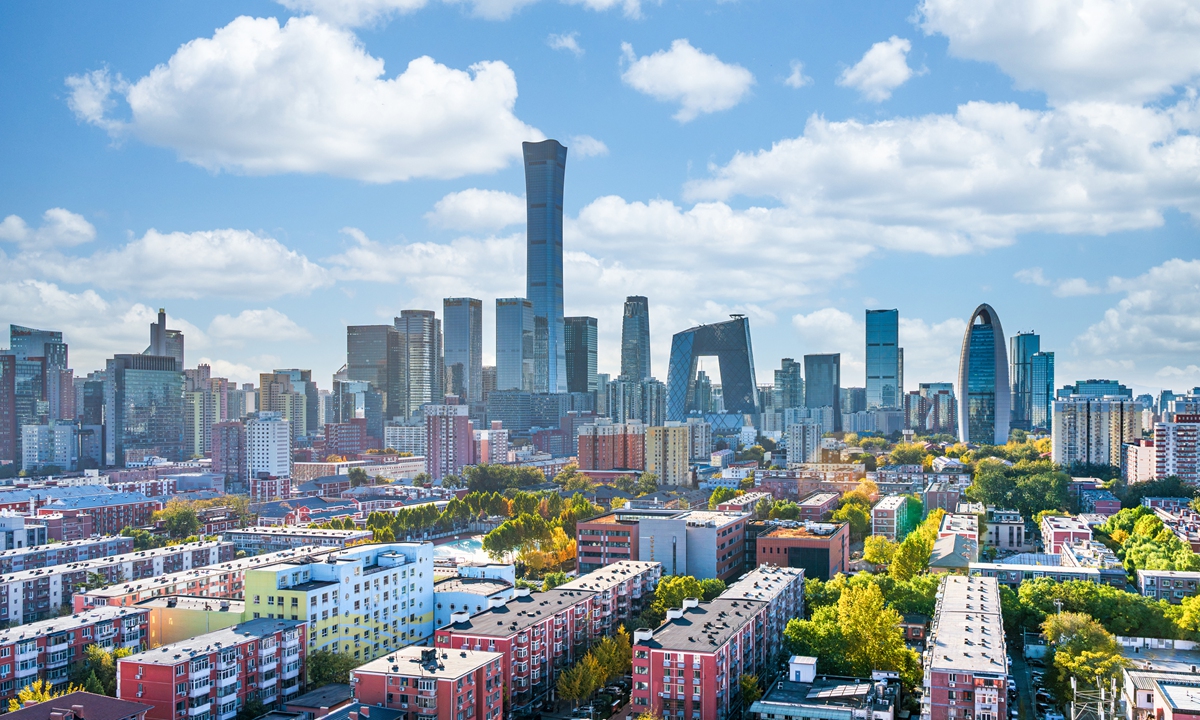
The CBD area of Beijing, China Photo: VCG
The Political Bureau of the Communist Party of China (CPC) Central Committee analyzed and studied the current economic situation and made arrangements for economic work in the second half (H2) of this year at a meeting held in Beijing on Thursday, the Xinhua News Agency reported.
Xi Jinping, general secretary of the CPC Central Committee, presided over the meeting, which also decided that the fifth plenary session of the 20th CPC Central Committee will be held in Beijing in October, Xinhua reported.
The meeting noted that since the beginning of this year, China's economy has shown a trend characterized by new growth drivers and improving economic structure. It emphasized the need to attach great importance to the challenges in economic operations, maintain confidence, meet difficulties head-on, and make good use of various opportunities and advantages to promote steady and sustained high-quality development.
The meeting, which set the tone for China's economic work in the second half of the year, drew wide attention from foreign media as observers looked for fresh policy signals on how the world's second-largest economy will further address challenges and consolidate its growth momentum.
Thursday's meeting played an important role in guiding China's economic operation by reviewing economic performance in the first half of the year and setting the tone for economic policies for the rest of the year, Li Changan, a professor at the Academy of China Open Economy Studies at the University of International Business and Economics, told the Global Times on Thursday, noting that the meeting sent a strong signal that China will continue to strengthen policy support for the economy in the latter part of the year.
Greater efforts
To do a good job in economic work in the second half of the year, it is imperative to adhere to the general principle of pursuing progress while ensuring stability, the meeting emphasized, urging efforts to accelerate the transition from old growth drivers to new ones and effectively implement a more proactive fiscal policy and an appropriately accommodative monetary policy, according to Xinhua.
Pragmatic and effective incremental policies will be timely introduced, the meeting said, urging intensified efforts to step up counter-cyclical adjustments, expand domestic demand and optimize supply, effectively safeguard and improve people's wellbeing, and enhance development momentum and boost social vitality, so as to promote sustained innovation-driven, high-quality and sound economic development, ensuring a good start to the 15th Five-Year Plan period (2026-2030).
The meeting's emphasis on a more proactive fiscal policy and a moderately loose monetary policy underscores the country's focus on targeted and effective macroeconomic regulation, Li said.
By expanding domestic demand, optimizing supply and stimulating market vitality, China aims to inject new momentum into high-quality economic development, the expert said.
Also, Thursday's meeting called for efforts to advance the planning and development of six major infrastructure networks, strengthen long-term and stable support for basic research, deeply implement the AI Plus Initiative, foster new forms for the smart economy, and improve the governance system for artificial intelligence.
"The meeting's deployment of measures on the future industries, highlighted by AI, reflects the growing emphasis on integration of technological innovation and industrial innovation. By cultivating new quality productive forces, China is laying a solid foundation for long-term economic growth," Hu Qimu, a professor at the Maritime Silk Road Institute of Huaqiao University, told the Global Times on Thursday.
Global attention
Thursday's meeting has drawn widespread attention from foreign media. Many are closely watching what measures the world's second-largest economy will introduce to further boost economic growth amid world uncertainties.
Reuters highlighted the meeting's policy signals with the headline "China's top leaders pledge incremental measures to support economy," focusing on the measures expected to be introduced to shore up economic growth.
Bloomberg also followed the meeting closely, eyeing the implementation of existing policies. It noted that "policymakers pledged to speed up the pace of public spending and the use of funds raised through government bonds, a step widely expected by economists." The report further analyzed what additional measures might be rolled out.
The Wall Street Journal focused on the scale of policy support and whether China would introduce stronger stimulus measures.
The extensive coverage by major foreign media highlights the global market's attention to the world's second-largest economy, which has been an important contributor and stabilizer to global economic growth.
Chinese industry analysts believed that specific measures are expected to be rolled out gradually in the follow-up.
Specifically, Wang Qing, chief macroeconomic analyst at Golden Credit Rating International, said in a research note sent to the Global Times on Thursday that the meeting's call to "strengthen counter-cyclical adjustments" indicates that macro policies are likely to place greater emphasis on supporting growth in the coming period.
The meeting also called for "fully leveraging the effectiveness of existing policies and promptly planning and introducing practical and effective incremental policies."
Golden Credit Rating International said that they expect the policy rollout to follow a two-step approach. In the short term, the focus will be on accelerating fiscal spending, speeding up the issuance and use of government bonds, and advancing the implementation of 800 billion yuan in new policy-based financial instruments to help stabilize investment, said Wang.
After fully leveraging the effectiveness of these existing policies, we expect that a number of practical and effective incremental measures could be introduced around the end of the third quarter, said Wang.
Despite mounting external uncertainties, China's economy achieved a growth rate of 4.7 percent in the first half of the year, according to the data released by the National Bureau of Statistics released on July 15, laying a solid foundation for meeting the annual economic and social development targets, while providing strong support for making a good start and opening a new chapter in the 15th Five-Year Plan (2026-30).
On July 8, the International Monetary Fund (IMF) released an update to its World Economic Outlook, lowering its forecast for global economic growth in 2026 by 0.1 percentage point to 3 percent, while raising its growth forecast for China's economy by 0.2 percentage point to 4.6 percent.
Hu said that the contrasting adjustments, with one forecast lowered and the other raised, reflect both the complex and challenging environment facing the global economic recovery and the resilience and potential of the Chinese economy.
Against the backdrop of rising world challenges, China is strengthening its own stability by expanding domestic demand, while supporting the global economy through high-quality growth and high-level opening-up. "This structural arrangement will help China better withstand the shocks brought by changes in the external environment," said Hu.
As more policy measures are introduced, China's economy is expected to maintain its steady recovery momentum. At the same time, China's economic performance will inject greater stability into global economic development, said Hu.