PLA to mark 99th anniversary with equipment leap, combat readiness amid complex security landscape
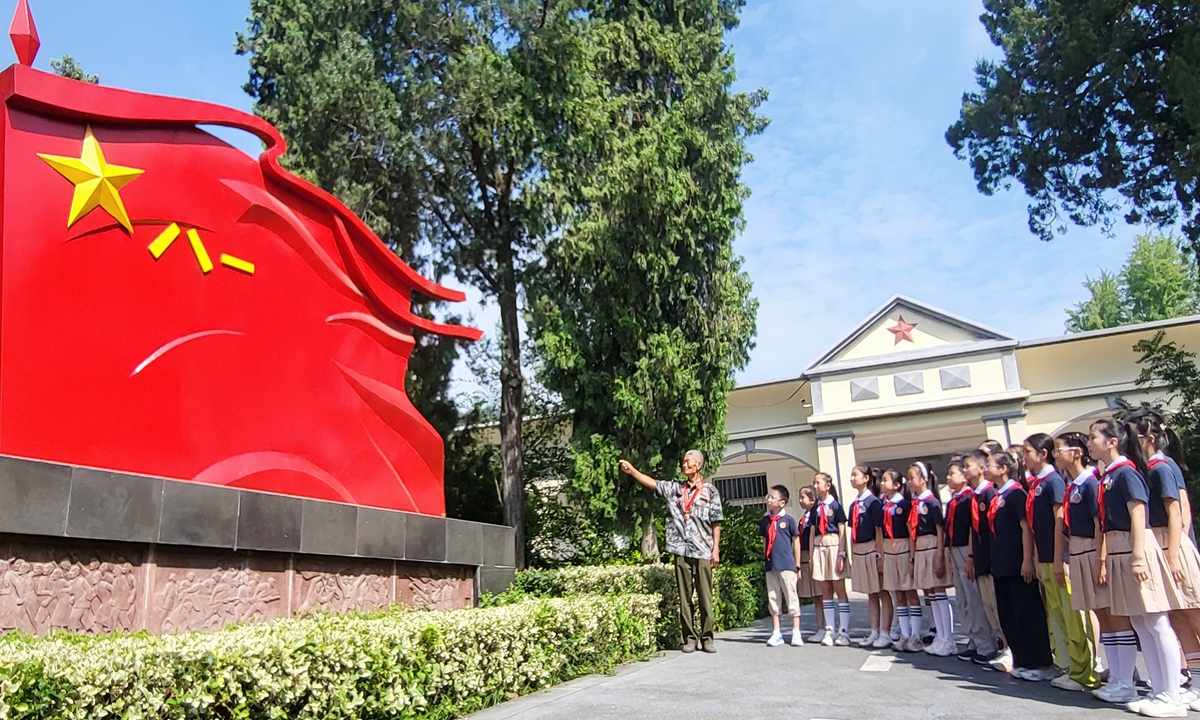
Chinese Young Pioneers from a primary school listen to a veteran recount stories of the Chinese People's Liberation Army flag at a military veteran sanatorium in Guanyun county, Lianyungang, East China's Jiangsu Province on July 31, 2026. Photo: VCG
In a gripping beach-assault drill, packs of robotic wolves, each hefting shoulder-fired rocket launchers, surged over sand berms, spraying grit skyward as they stormed the shoreline.This is one of the adrenaline-pumping scenes from the ongoing promotional documentary "Zhisheng" (Victory), released in celebration of China's Army Day in 2026. As of press time, the series has unveiled new footage including the launch of tactical missiles from the Type 191 long-range rocket artillery, the firing of decoy flares from the Type 076 amphibious assault ship, and live-fire strikes by the KVD002 reconnaissance-strike integrated unmanned aerial vehicle.
August 1, 2026 marks the 99th anniversary of the founding of the Chinese People's Liberation Army (PLA). This year's Army Day holds special significance as it falls during the critical year toward achieving the PLA's centenary goals. According to official reports, reaching the PLA centenary goals and speeding up the building of world-class armed forces are strategic imperatives in China's efforts to build a modern socialist country in all respects.
When presiding over a group study session of the Political Bureau of the Communist Party of China Central Committee on Thursday, Xi Jinping, general secretary of the Communist Party of China (CPC) Central Committee, urged efforts to strengthen political guidance and deepen innovation-driven development to advance the high-quality modernization of national defense and the armed forces, the Xinhua News Agency reported on Friday.
Xi urged efforts to fulfill the goals for the centenary of the People's Liberation Army in 2027 and make "decisive progress" in basically realizing the modernization of national defense and the armed forces.
This, he said, will provide strong strategic support for advancing the cause of building a great country and achieving national rejuvenation on all fronts through Chinese modernization.
Experts noted that over the past year, against the backdrop of a complex security environment surrounding China and ongoing global security upheavals, including the Ukraine crisis and tensions in the Middle East, the PLA has closely focused on combat readiness as its core mission. It has completed a series of key tasks, including the iteration of new-quality equipment, all-domain combat training and deepening military reforms.
While forging capabilities, the PLA has remained committed to its mission of safeguarding national sovereignty, security and development interests as well as regional and world peace, which represents the best answer the PLA can offer to the people of China and the world, experts said.
Equipment modernization as core pillar
Over the past year, new weaponry and equipment across all branches of the PLA have been unveiled and fielded in large numbers.
At the V-Day military parade on September 3, 2025, PLA Army equipment represented by the Type 100 tank and Type 100 support combat vehicle signaled that the Army has fully entered the era of intelligent, informationized warfare - integrating firepower and information.
Four types of YJ-series supersonic and hypersonic anti-ship missiles demonstrated that naval platforms, including surface ships, submarines and aircraft, can not only break through island chains but also extend China's maritime defense line to farther seas.
Multiple high-energy laser and high-power microwave weapons were displayed in response to emerging threats such as low-slow-small drones.
In addition, China officially debuted its nuclear triad capability for the first time, along with the DF-5C intercontinental ballistic missile, which has global strike coverage.
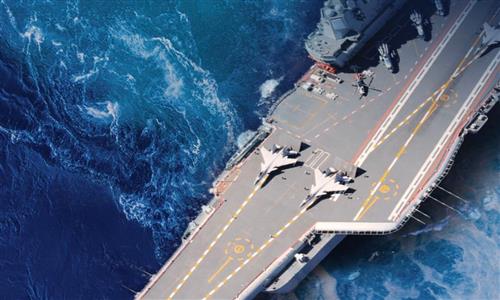
In November, China's third aircraft carrier, the Fujian, was officially commissioned. Equipped with electromagnetic catapult technology for the first time, the Fujian can carry not only the J-35 stealth fighter but also the KJ-600 carrier-borne early warning aircraft, significantly enhancing the carrier strike group's situational awareness and operational range.
These key milestones demonstrate a shift in China's equipment development from "following" and "running alongside" to "leading in certain areas," which is a transition toward independent innovation and system-of-systems confrontation, with core technologies now fully under independent control, Zhang Junshe, a Chinese military affairs expert, told the Global Times.
Equipment development now serves system-of-systems operations, providing strong material support for safeguarding national sovereignty, security and development interests, and marking the entry of national defense and military modernization into a new phase of systemization, intelligence and all-domain capabilities, Zhang said.
Zhang emphasized that at sea, the generational leap in aircraft carrier and amphibious capabilities reflects the PLA Navy's transition from a near-sea defense force to a far-sea defense force. In the air, China's development of new-generation fighter jets has achieved a lead in certain areas, establishing a first-mover advantage in the next-generation air combat system.
Zhang said the Navy's integrated combat system and far-sea deployment capabilities are likely to be further enhanced. The Type 076 amphibious assault ship Sichuan, which has completed multiple sea trials, may soon be formally commissioned. As the world's first amphibious assault ship equipped with electromagnetic catapults and a twin-island design, it could form a high-low mix with existing carrier groups and play a significant role in far-sea offense and defense and island operations.
Progress on the long-expected sixth-generation fighter jets, which have been reported spotted conducting test flights since late 2024, is also worth watching. Under modern development concepts such as open architecture, rapid development and low-rate initial production, small-batch delivery and pilot training exploration may not be out of reach, Zhang supposed.
Chinese military expert Wang Yunfei told the Global Times that if China will unveil new-type nuclear-powered submarines is also worth anticipating.
Another point of interest is whether information on a fourth, potentially nuclear-powered, aircraft carrier will be publicly disclosed. Currently, all related information comes from social media and foreign media speculation, with no official announcement, Wang said. The Fujian's information was released in advance before its commissioning, and whether a similar approach will be taken for the fourth carrier warrants attention.
The development of a new type of long-range strategic bomber is also worth monitoring, Wang said. He noted that this bomber, allegedly called the H-20, has long been in development, and given China's equipment development rhythm, next year could be significant.
Combat readiness through training, cooperation
Over the past year, the PLA has focused on core strategic directions including the Taiwan Straits, the South China Sea and the Western Pacific, conducting routine combat-oriented training, deepening international security cooperation and comprehensively enhancing its military response capabilities, Zhang said.
These included the PLA Eastern Theater Command's "Justice Mission 2025" joint exercise, the Liaoning carrier group's far-sea trainings, the submarine-launched strategic missile test in early July, China-Russia joint strategic air patrols, naval exercises and joint maritime patrols.
These exercises and trainings featured a high degree of combat realism, testing, validating and training various technical and tactical procedures. They deterred separatist forces and external intervention, firmly safeguarded national sovereignty and territorial integrity, and maintained maritime air superiority in the Taiwan Straits, the South China Sea, the East China Sea and the Western Pacific. Notably, the submarine-launched strategic missile test demonstrated China's credible secondary nuclear strike capability, reinforcing its reliable nuclear deterrence, Chinese military expert Wang Yunfei said.
Defensive in nature
The socialist system of China, the strategic decision to follow the path of peaceful development, the independent foreign policy of peace, and the best of cultural traditions - considering peace and harmony as fundamentals - determine that China will pursue a national defense policy that is defensive in nature, according to a white paper titled "China's National Defense in the New Era" released by China's State Council Information Office in 2019.
Zhang said that in the new era, the PLA's military development consistently adheres to the core position of China's defensive national defense policy - a fundamental characteristic that distinguishes China's military development from hegemonic expansion of certain countries.
Meanwhile, over the past year, officers and soldiers across all services have stepped up in disaster relief, overseas peacekeeping and international humanitarian assistance, demonstrating through their actions the role of a force for peace and benevolence, Zhang said.
An October 2025 commentary in the PLA Daily noted that a strong nation must have a strong military, and only a strong military can ensure national security. Today, we are closer to the goal of the rejuvenation of the Chinese nation than at any time in history, and we need to build a strong national defense and a powerful military more than ever.
But the centenary goal is not the end. Under a series of strategic plans and deployments to accelerate national defense and military modernization, the PLA's goals and missions for the new era have formed a new "three-step" strategic arrangement - from 2027 to 2035, and onward to the middle of this century. The development of the Chinese military is worth watching, Wang said.
RELATED ARTICLES