International brands like Apple, adidas, L'Oréal, Coca-Cola report robust quarterly earnings in China
Competing in Chinese market sharpens global companies: experts
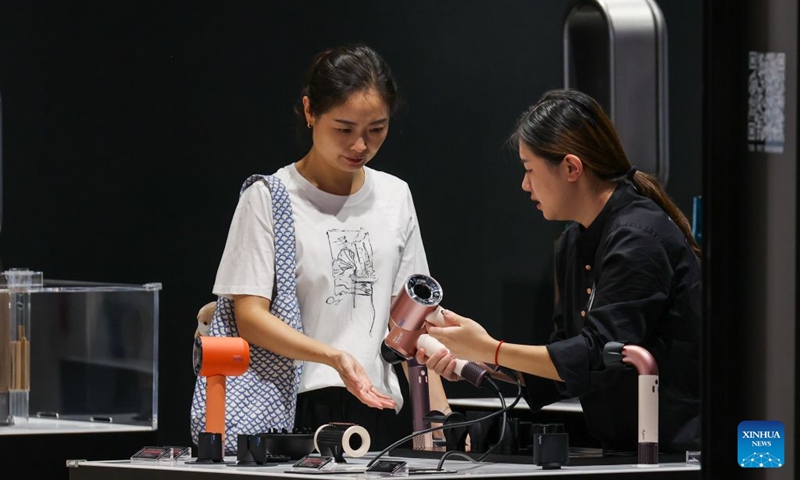
A woman shops at the Haikou International Duty Free Shopping Complex in Haikou, south China's Hainan Province, July 18, 2026. Hainan is experiencing a surge in duty-free shopping during this summer season. It is reported that in the first six months of this year, offshore duty-free sales totaled 19.92 billion yuan (about 2.93 billion U.S. dollars), involving 15.966 million duty-free items and 2.793 million shoppers, registering year-on-year growth of 18.8%, 7.3% and 12.6% respectively. (Xinhua/Yang Guanyu)
Global brands including Coca-Cola, adidas, Apple and L'Oréal reported double-digit or near double-digit gains in China in their latest quarterly earnings, making the Chinese market a major driver of their businesses.
Analysts said that Chinese consumer market resilience has not changed, offering these international companies more room for growth.
Coca-Cola said that second-quarter revenues rose by 7 percent to $13.38 billion and net income rose by 17 percent to $4.438 billion. Global unit case volume grew 5 percent, led by China, India, the US and Brazil, with Asia Pacific up by 8 percent, according to a statement sent to the Global Times.
Sports brand adidas posted record quarterly sales on July 30, with currency-neutral revenues up by 14 percent to 6.7 billion euros ($7.73 billion) in euro terms. Currency-neutral sales in Greater China rose 15 percent in the quarter and 16 percent in the first half.
Apple reported revenue of $109.4 billion for its fiscal third quarter which ended June 27, up by 16 percent. Greater China region revenue rose by 22 percent to reach $18.816 billion. CEO Tim Cook told CNBC that the iPhone set a June-quarter record in the Greater China region and the Mac its best quarter ever there.
Cosmetic brand L'Oréal reported record first-half sales of 23.77 billion euros, up by 6.8 percent, with North Asia region the biggest growth contributor for its Professional Products division on double-digit growth in China.
Zhang Yi, CEO of iiMedia Research noted that global brands need to localize at the market's speed. "Today's winners were themselves under pressure a few years ago, he noted, forced to adapt to sugar-free drinks, new social platforms and the expansion of young consumers born after 2000," Zhang said.
Some companies credited localization than market size. Coca-Cola's statement said that it reformulated its US-origin Sprite + Tea with a lemon-forward profile for Chinese consumers. Swire Coca-Cola brought green and smart production bases in Kunshan and Guangzhou online in May, with combined investment of 3.25 billion yuan ($481.39 million). Adidas said that many lifestyle apparel products are now designed and sourced locally.
Adidas CEO Bjørn Gulden said that the policy of sourcing and developing locally was paying off, enabling it to achieve "extremely strong" 15 percent sales growth in Greater China region.
"Foreign companies can no longer treat China simply as a contract factory — their sensitivity to the market would be far from sufficient," Zhang said. China should become an R&D source for these companies, he said.
China drew 402.14 billion yuan in foreign investment in the first half of 2026, with 31,617 new foreign-invested enterprises established, up 5.3 percent, China's Ministry of Commerce said.
Li Yong, an executive council member of the China Society for WTO Studies, called the shift an evolving trend, citing Chinese market capacity "very hard for other economies to replicate or match."
However, a few traditional automakers including BMW and Mercedes-Benz reported sharp business declines in China — a contrast that analysts said reflects growing auto market competition.
Li attributed the gap to the pace of tech transformation. China listed electric vehicles as a "development direction in its auto planning" as early as 2010, he noted, but for many traditional carmakers, giving up an advantage built over the past decades to embrace EV is "genuinely a difficult choice." Legacy strength, he said, can itself become a "burden in transition."
Zhang cautioned against generalizing. "Not all carmakers are doing badly — Tesla has performed well in China," he said, adding that BYD, Geely and the Huawei-enabled auto ecosystem have done well. Li said that Volkswagen and General Motors, now moving toward EVs, "still have a chance to rise again in Chinese market."
For the analysts, competition intensity is part of the appeal. "In the past, overseas brands could walk in and carve out a profit almost automatically. That no longer works — you need stronger innovation and deeper consumer insight," Zhang said.
Joe Ngai, McKinsey's Greater China region chair, told Fortune in June that despite talk of "de-risking", there is no other massive market like China to be found. He called the country "the world's toughest gym," which trains hyper-competitive companies.
RELATED ARTICLES