Draw the sword! China will not allow anyone to run amok at its doorstep: Global Times editorial
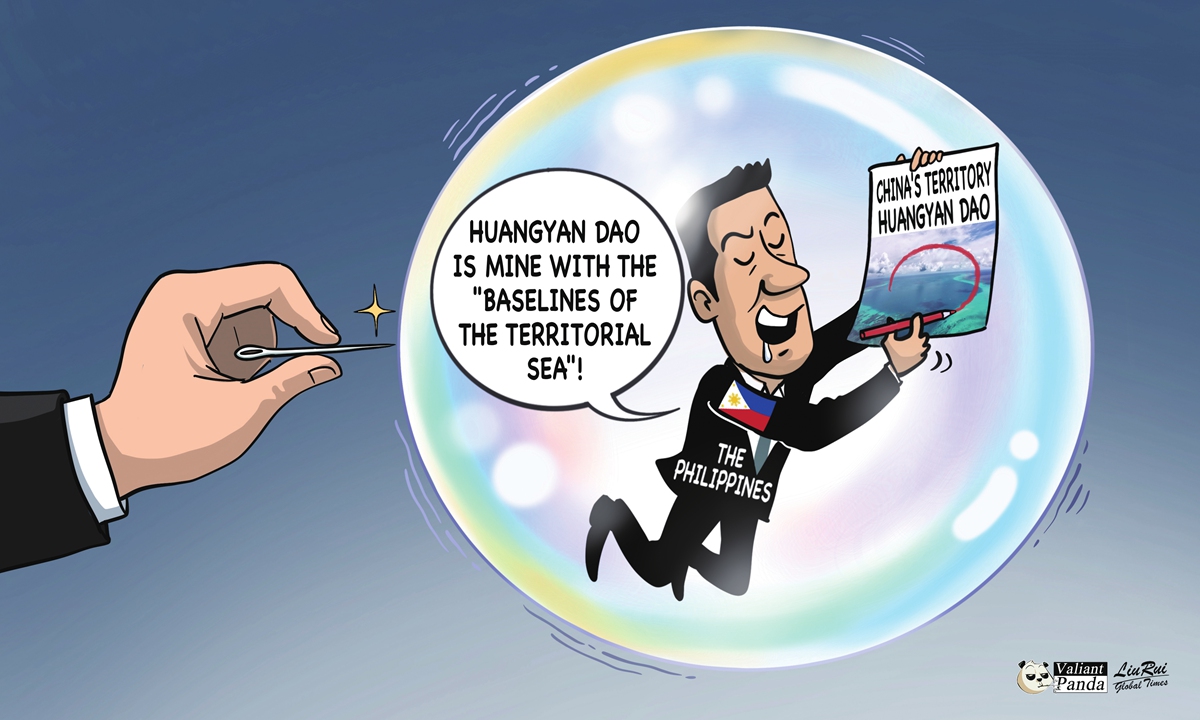
Illustration: Liu Rui/GT
From joint exercise and CCG law-enforcement operations to the issuance of measures for nature reserve management, China fired three "arrows" in defense of its sovereignty over Huangyan Dao on August 1, leaving no room for ambiguity in response to the Philippines' provocative and unlawful actions. Anyone seeking to stir up trouble in the South China Sea and test our red lines should not blame us for responding firmly.
On August 1, the Army Day, China took three major actions regarding Huangyan Dao, which cannot be characterized merely as "symbolic gestures." These actions represent the latest response to the Philippines' provocative and unlawful actions.
First, the Chinese PLA Southern Theater Command conducted a joint naval-air training exercise focusing on multiple realistic training subjects in the territorial sea and airspace of China's Huangyan Dao and its surrounding areas. The exercise held on the Army Day was not only a military action, but also a strategic declaration, sending a clear message again to all: Huangyan Dao is Chinese territory, and the Chinese military has the capability to carry out any necessary operations in its own territorial waters and airspace. From reconnaissance and early warning to deterrence patrols, maritime and air control, and joint strikes, every key exercise item was designed around real combat scenarios. The exercise demonstrated that the theater command forces maintain a constant state of high alert, ready to fight at any moment and certain to win once engaged, while resolutely safeguarding every inch of the motherland's maritime territory.
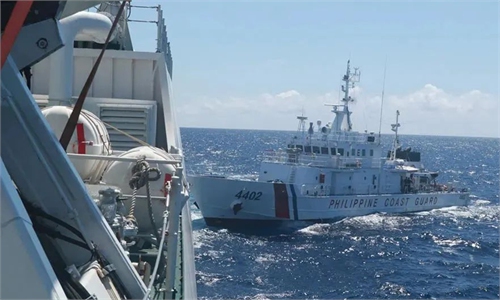
Second, China Coast Guard (CCG) on Saturday conducted drills on rights-protection law enforcement, as well as management and control in the waters near China's Huangyan Dao. The drills focused on operations such as visit, board, search and seizure (VBSS), interdiction of forced entry, and forced towing. These may seem like just a few words, but in maritime law enforcement, "VBSS" means legally boarding vessels and detaining those involved in violations; "interdiction of forced entry" means preventing intruders from entering; and "forced towing" means removing vessels that violate regulations. These operations are all based on extensive practical experience. Put simply, every step of law enforcement has been thoroughly rehearsed - anyone who comes to cause trouble will face a well-prepared response.
On the same day, the Ministry of Natural Resources, the National Forestry and Grassland Administration, the China Coast Guard, and the Hainan provincial government jointly issued the management measures for the Huangyan Dao National Nature Reserve. The document specifies the establishment of a routine patrol system and the handling of violations in accordance with the law. It calls for strict protection of coral reefs and marine ecosystems, while prohibiting destructive activities such as illegal fishing and mining. This fully demonstrates China's commitment as a responsible major country. What China is safeguarding is not only its own territory, but also the ecological environment of the South China Sea - a blue home shared by humanity.
Some foreign media outlets have described these moves as a "series of countermeasures" by China in response to the Philippines' announcement of so-called "territorial sea baselines" around Huangyan Dao. Such descriptions are only partially accurate. China not only has the resolve and capability to take firm countermeasures, but has also remained committed to environmental governance in the waters surrounding Huangyan Dao, establishing a nature reserve and putting in place supporting legal documents. The essence of China's move is to fulfill the responsibilities and obligations conferred upon us under international law, while also implementing the actions called for in the Declaration on the Conduct of Parties in the South China Sea.
On July 31, the Ministry of Foreign Affairs made it clear: The Philippines' delimitation of the so-called "baselines of the territorial sea" of China's territory of Huangyan Dao is a grave infringement upon China's territorial sovereignty and a serious violation of international law. It is illegal, null and void.
China's series of actions on August 1 was a direct and precise response once again. With a training exercise, CCG law-enforcement operations, and management measures for the Huangyan Dao National Nature Reserve all launched simultaneously, there is no room for any ambiguity over provocations.
What is absurd about the so-called "baselines of the territorial sea"? China was the first to discover and name Huangyan Dao and has continuously, peacefully, and effectively exercised sovereignty and jurisdiction over it. The territorial boundaries of the Philippines are defined by a series of international treaties, and Huangyan Dao has never been included in them. You are in no position to delimitate "baselines of the territorial sea" around an island that has never belonged to you. If a neighboring resident barged into my home, drew a line on the ground with chalk, and attempted to claim everything within that line as their own, is that not outright theft?
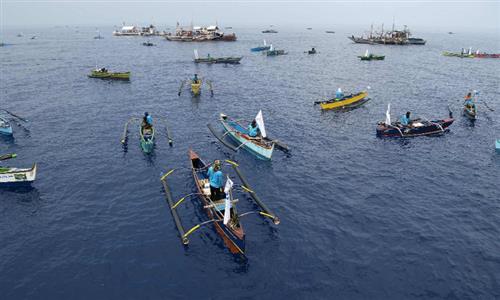
What the Philippines has done amounts to worthless drawings. The absurdities the Philippines has engaged in over the years go far beyond this delimitation. The Philippines unilaterally initiated the so-called illegal "South China Sea arbitration," introduced the so-called "Maritime Zones Act," arbitrarily defined the so-called "baselines of the territorial sea," sent a warship to deliberately run aground on Ren'ai Jiao and incited fishing boats to force their way into the lagoon of Huangyan Dao for illegal operations... However, after a series of "combined strikes," all it has achieved is to turn itself into a "regional troublemaker," with nothing gained. The facts have proven that any attempt to muddy the waters on the South China Sea issue is doomed to fail. China has already taken and will continue to take strong and effective measures to strengthen control and safeguard its rights and interests.
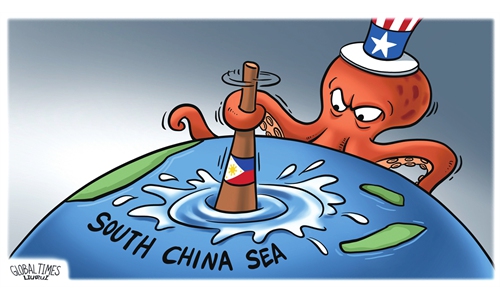
This also sends a warning signal to the US and other countries outside the region. Some countries are always fond of invoking "international rules," yet those truly undermining the rules are precisely the forces that incite the Philippines to make reckless moves and create frictions. China's joint training exercises also send a clear message to the international community: China is determined to safeguard its sovereignty, security and strategic interests, while preventing relevant extraregional forces from making erroneous assumptions that "China may compromise" or that they can build their own strategic interests on the basis of harming China's interests.
Actions regarding Huangyan Dao have sent a very clear message: China will not allow anyone to run amok at its doorstep. China has always advocated for resolving disputes through dialogue and consultation, but this does not mean it will tolerate any provocations. Anyone seeking to stir up trouble in the South China Sea and test our red lines should not blame us for responding firmly. The moral high ground is on China's side, as is its strength. The three "arrows" taken on August 1 have clearly put these two "sides" - morality and strength - on the table. Those who continue to distort right and wrong, portray themselves as victims, or assist in wrongdoing are simply pretending to be blind.
RELATED ARTICLES