US-Japan joint intervention to prop up the yen, driven by US utilitarian calculus, falls short of resolving long-term depreciation: experts
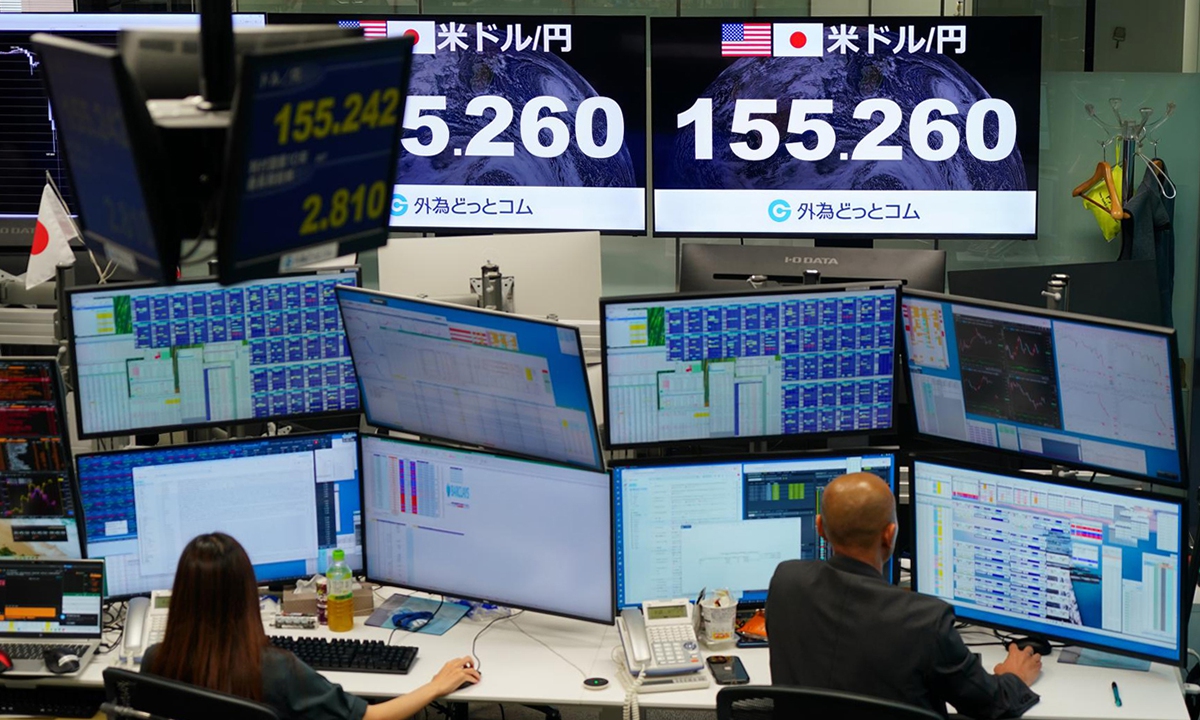
An electronic board displays the Japanese yen's exchange rate against the U.S. dollar in Minato Ward, Tokyo, Japan, on August 3, 2026. Photo: VCG
Japan and the US on Monday confirmed coordinated foreign exchange intervention to prop up the yen after the currency tumbled to a nearly 40-year low. However, economists pointed out that Washington's participation stems entirely from its own economic interests, adding that the joint action is unlikely to fundamentally reverse the yen's long-term depreciation trend over the medium and long term.
Japan's Finance Ministry intervened on Friday in coordination with the US Treasury department, Japanese finance minister Satsuki Katayama said on Monday, FT reported.
"This joint action. . . countered excessive volatility and disorderly movements in the Japanese yen in recent months," she said in a statement. "We will not hesitate to conduct further joint intervention."
US Treasury Secretary Scott Bessent also confirmed the coordinated action in a statement, claiming, "Friday's coordinated foreign exchange actions countered disorderly yen movements," CNBC reported.
"Treasury remains attentive and in close communication with our counterparts at MOF (Ministry of Finance) and BOJ (Bank of Japan). We will not hesitate to participate in further joint intervention," Bessent said in a post on X.
Bessent also noted that "the FIMA Repo Facility is an important backstop. We should encourage it to be upsized in the coming months."
The FIMA repo facility, introduced in 2020 to steady markets during the COVID-19 pandemic, allows Japan to raise dollar liquidity without outright sales of US Treasuries, potentially easing funding pressures on Tokyo for intervention, Reuters reported.
Utilitarian calculus
According to US media reports, US President Donald Trump said on Sunday night: "We have a good relationship with Japan . . . they have a weakening yen, and they wanted a little bit of help, and we're always there for Japan. Japan's been very good to us, with the exception, of course, of Pearl Harbor."
Asked what the US gained from the move, he added: "Financial benefit. It's also good for the world economy."
Experts pointed out that Trump's remarks lays bare the transactional logic of the US administration's approach to alliances: Assistance is no free obligation, and every act of financial support must be measured for returns. The US‑Japan alliance is increasingly turning into a blatant quid‑pro‑quo deal.
This was the first Japan-US joint currency intervention since 2011. On that occasion, US and other G7 members sold the yen after its value surged following the earthquake and tsunami that struck Japan.
Compared with the move in 2011, the latest coordination is driven by US unilateral interests' calculation. It demonstrates Washington's purely utilitarian mind-set. Its cooperation with Japan is about anything but the so-called bilateral "friendship," Chinese analysts believed.
A critical aim of US intervention is to stabilize the US Treasury market, Zhao Qingming, a veteran financial expert told the Global Times on Monday.
If Japan were to conduct forex intervention on its own, it would have to draw down its dollar reserves, the bulk of which are held in the form of US Treasury bonds. Any outright sale of these securities to raise dollars for intervention would deal a blow to the US Treasury market, sending ripple effects across the broader US financial system, including the stock market, and triggering adverse volatility, Zhao said.
As of the end of May, Treasury data showed Japan held $1.14 trillion of Treasuries, the most of any foreign nation and second only to the Fed itself. Tapping the FIMA facility might allow Japan to raise funds for yen purchases without having to sell its Treasury holdings outright. Selling Treasuries could also further push up bond yields that rose after the US central bank held interest rates steady last week, Reuters reported.
At the same time, excessive yen depreciation has begun to hurt US interests. A sharply weaker yen will boost Japan's export price edge and likely trigger a greater influx of Japanese goods into the US market, Zhao said.
Japan exports in June grew at their fastest pace since November 2022, rising 19.3 percent from a year earlier, partly powered by a weak yen, CNBC reported in July.
Through this intervention, the US may also hope to curb its imports from Japan, Zhou Mi, a researcher at the Chinese Academy of International Trade and Economic Cooperation, told the Global Times on Monday.
In comparison, Japan bears obvious costs from the intervention, Zhou said.
"A stronger yen will place greater pressure on its exports to the US and other global markets. Currency appreciation pushes up export costs and erodes the price competitiveness of Japanese goods," Zhou noted.
Temporary relief, persistent strain
Following Katayama's comments on Monday, the yen strengthened by more than 1 per cent against the dollar to ¥155.50 before paring gains, with traders watching closely for signs of further intervention, the Financial Times reported.
Whether the intervention can stabilize the yen hinges on market sentiment. If investors view the US-Japan intervention as going against market rules, market capital will far outweigh governmental forces, Zhou noted. He said that the yen may remain under pressure, and the intervention could even backfire. Some funds will chase arbitrage opportunities and amplify the downward momentum, keeping the yen in a depreciation trend.
Ma Wei, a research fellow with the Institute of American Studies under the Chinese Academy of Social Sciences, told the Global Times that the joint intervention can deliver obvious short-term results, but its effectiveness will be limited in the medium and long run.
The root cause lies in the persistently wide interest rate gap between the US and Japan. Japan's policy rate stands at around 1 percent, compared with over 3.5 percent in the US. Meanwhile, the Japanese government keeps expanding fiscal spending and cutting taxes. Investors therefore remain skeptical about Japan's fiscal health and its ability to raise interest rates, Ma said.
While the Fed kept rates unchanged in July, markets anticipate renewed US hikes within six months. The joint intervention is thus unlikely to reverse the yen's long-term depreciation, Ma noted.
Strategists say the coordinated intervention between Japan and the US increases the risk for anyone betting against the currency, Bloomberg reported.
What remains unclear is the framework for US involvement. Markets still do not know the conditions that would trigger further participation, or whether this was a one-off response to disorderly moves. More fundamentally, yen weakness reflects persistent concerns over Japan's monetary and fiscal policy settings. Unless those underlying issues are addressed, intervention alone is unlikely to deliver a sustained reversal, said Rong Ren Goh, a fixed income portfolio manager at Eastspring Investments, according to Bloomberg.
RELATED ARTICLES