ARTS / ART
China’s ancient murals and rock carvings under summer siege: Conservationists race to protect centuries-old heritage
Conservationists race against time to protect heritage from heat
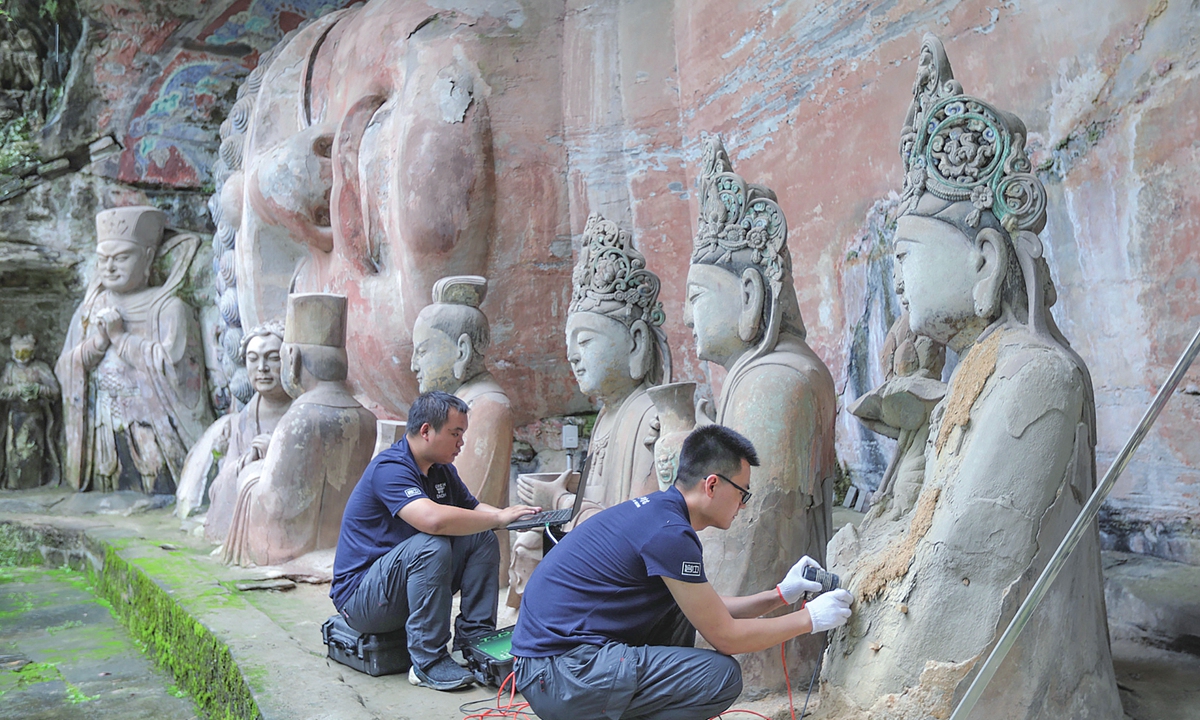
Conservators carry out testing on the Buddha statues at the Dazu Rock Carvings site in Chongqing Municipality on June 29, 2019. Photo: VCG
Temperatures have been climbing across China in recent days, from north to south and from east to west, with red and orange heat warnings issued one after another, according to the National Meteorological Center. The summer heat is not only being felt by people. At Yongle Palace in Ruicheng county, North China's Shanxi Province, first built during the Yuan Dynasty (1279-1368), conservation specialist Bai Yongqin keeps a close watch on a different set of numbers - tiny shifts in temperature and humidity that could quietly affect the centuries-old murals and ancient structures he has spent decades protecting.For over 20 years, Bai has worked on the daily monitoring, restoration and preventive protection of Yongle Palace's ancient buildings and murals.
"Conservation is not about waiting until a cultural relic develops serious problems before repairing it. It is about identifying risks before changes become irreversible and intervening as early as possible," Bai told the Global Times.
For cultural relics that have survived for centuries, he said, many threats are not visible immediately. Yet gradual shifts in temperature, humidity and other environmental conditions can build up over time and eventually affect their long-term preservation.
With rising temperatures and humidity, Bai's work grows increasingly challenging. For centuries-old murals, a real threat lies not just in heat, but the chain reaction triggered by high temperatures, humidity and fluctuations between day and night.
"High temperatures accelerate the aging of the heritage's pigment layers, causing organic binding materials to become brittle and making pigments more prone to powdering and fading. Humidity, meanwhile, can cause the mud-based ground layer beneath the murals to swell and soften," Bai said.
According to Bai, high temperatures can also accelerate the migration of salts within the ground layer, causing salt efflorescence and whitening. Higher humidity, meanwhile, can encourage mold growth, while water vapor can cause soluble salts to repeatedly dissolve and crystallize, placing additional pressure on the pigment layers.
"Repeated temperature changes can cause the pigment layers, ground layers and wall substrates to expand and contract at different rates. Over time, this repeated stretching and pulling can create tiny cracks, which may gradually develop into larger cracks or even localized flaking and detachment," he added.
For Bai and his team, summer is therefore a race against time and temperature.
"The murals exist as part of the ancient buildings, so we cannot focus only on the murals themselves," Bai said. "The safety of the roofs, walls and wooden structures is the foundation for preserving the murals over the long term."
The conservation of the buildings and the murals must therefore be carried out as an integrated effort.
"Conservation and restoration work should be guided by scientific research and follow the principle of minimal intervention, aiming to preserve the historical information embedded in the relics rather than over-restoring or beautifying them," Bai noted.
For the murals at Yongle Palace, this means prioritizing preventive conservation and intervening only when necessary to stabilize damaged areas and slow further deterioration.
Zhou Xueying, a deputy director of the Institute of Eastern Architecture at Nanjing University, told the Global Times that in recent years, as the popularity of Shanxi's cultural tourism continues to grow, being fueled in part by the success of the Chinese AAA game Black Myth: Wukong, more and more visitors have flocked to Yongle Palace. He noted that growing public interest also underscores the importance of safeguarding cultural heritage for the long term.
"If we focus only on enjoying the murals today, what will remain for future generations 50 or 100 years from now - once the colors have mostly faded?" he said. Such concerns are why conservationists like Bai continue to monitor changes and take preventive measures to protect the murals for future generations. The same efforts are being made at other cultural heritage sites across China.
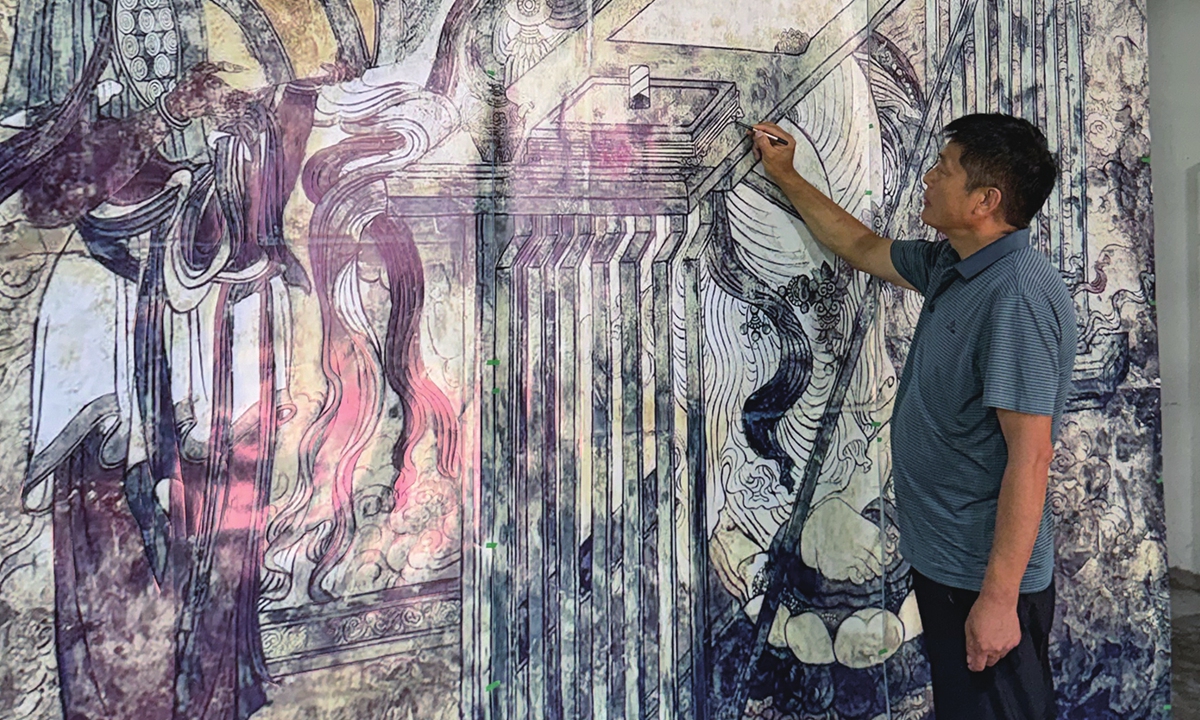
Conservation expert Bai Yongqin explores a mural in North China's Shanxi Province. Photo: Courtesy of Bai Yongqin
Sheltering relicsAt the Dazu Rock Carvings site in Southwest China's Chongqing Municipality, Chen Huili, a research fellow of the Academy of Dazu Rock Carvings, has spent years dealing with changes brought by the natural environment.
Unlike the murals at Yongle Palace, which are housed inside ancient halls, many of the Dazu Rock Carvings are exposed to the outdoors for long periods. Summer heat, repeated cycles of wetting and drying, and extreme rainstorms can all pose new risks to the stone relics.
Chen told the Global Times that prolonged high temperatures can alter the moisture content inside the rock, potentially causing existing cracks to expand. During extreme rainstorms, strong winds and heavy rainfall can also erode the stone surfaces and cause localized sections in structurally unstable areas to flake or detach.
"Extreme weather is more common in summer, so the most important thing is to strengthen monitoring and inspections," she said.
As part of routine conservation work, staff closely monitor changes on the surfaces of the carvings. If they discover expanding cracks or areas showing signs of instability, they promptly take measures such as providing support and reinforcement, intervening before deterioration can progress further.
"Cultural relics also need a 'home' that shields them from wind and rain," Chen said. The Dazu Rock Carvings site has put up protective shelters and covered walkways to lessen the effects of sun, wind and rain on the ancient stone carvings.
From the murals of Yongle Palace to the rock carvings of Dazu, cultural heritage conservation is not about a single restoration project, a heat wave or a rainstorm. It is decades- or even centuries-long commitment.
Behind every preserved color and structure let the quiet, unwavering efforts of those who dedicate themselves to safeguarding these treasures.
RELATED ARTICLES