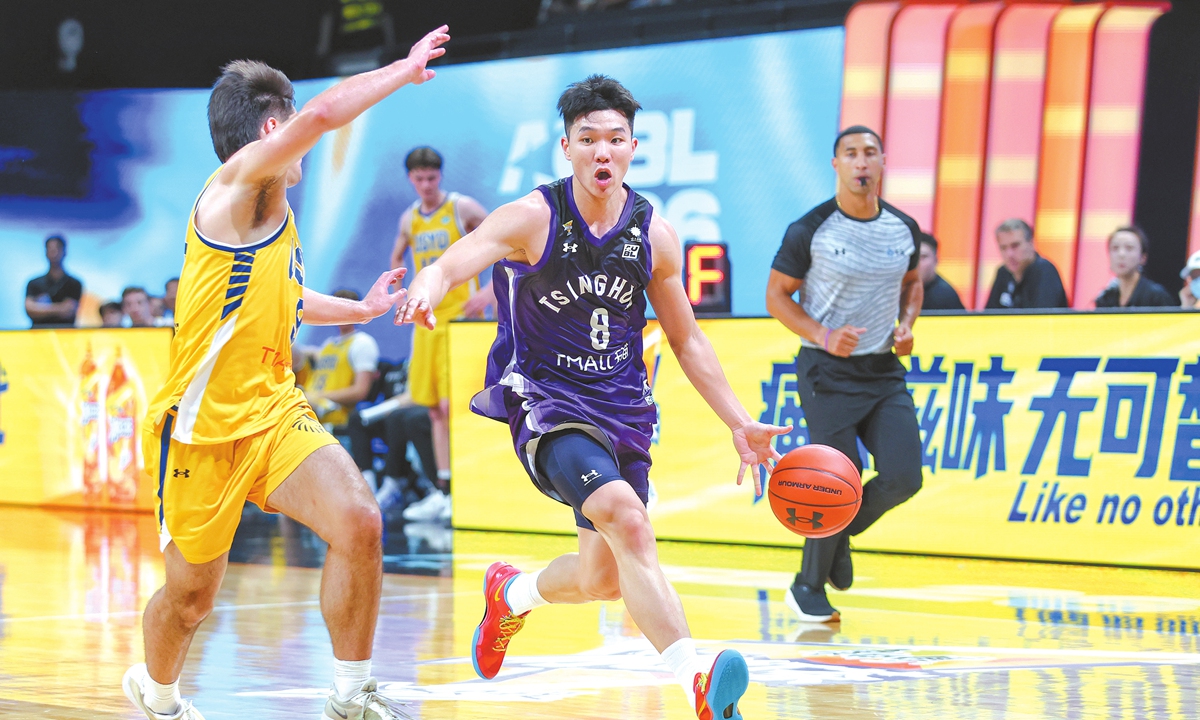
Shi Kui of Tsinghua University (right) dribbles the ball against a University of Sydney player during the Asian University Basketball League opener on August 2, 2026 in Hangzhou, East China's Zhejiang Province. Photo: Cui Meng/GT
As this year's Asian University Basketball League (AUBL) enters the knockout stage after three days of competition in Hangzhou of East China's Zhejiang Province, attention beyond the race for the championship has also risen.The league has expanded to 12 teams for its 2026 tournament, bringing together universities from China, Japan, South Korea, Australia, etc.
More importantly, AUBL has announced plans to launch a home-and-away regular season for the 2026-27 campaign starting this November, moving beyond the centralized tournament format used during its first two seasons.
For AUBL CEO Li Jintian, however, expanding the competition is only part of the mission. The larger ambition is to create a lasting university basketball culture across Asia.
"We want to build a competition platform among Asian universities. It doesn't belong to a single market but belongs to Asia," Li told the Global Times in an exclusive interview.
Building an Asian platform
As AUBL has grown, comparisons with the US National Collegiate Athletic Association (NCAA) have become inevitable.
Backed by investors and basketball figures such as Chinese basketball legend Yao Ming and Brooklyn Nets owner Joe Tsai, the league has often been described as an attempt to build an "Asian NCAA."
Li, however, rejects the comparison as an end goal.
Li said, rather than replicating the US model, Asia should go its own way as it already possesses many of the ingredients needed for a successful collegiate sports ecosystem, including internationally renowned universities, influential alumni communities and societies that place a high value on education.
What has been lacking, he argues, is a platform connecting those institutions through meaningful international competition.
"For a long time, many strong university teams in Asia developed within their own domestic systems. They had limited opportunities to compete internationally," Li said. "If players always stay inside their comfort zone, it is very difficult to improve."
That philosophy is reflected in this year's field, which includes regional powerhouses such as Korea University, winner of five consecutive South Korean U-League championships, and Japan's Hakuoh University, one of the country's leading collegiate basketball programs.
Greg Stolt, AUBL's senior vice president who previously spent more than 15 years with the NBA helping develop basketball programs in China, said the league's significance extends beyond creating another tournament.
"Our vision is to make college basketball relevant and important in people's minds in Asia," Stolt told the Global Times. "We see a huge opportunity to fill the void and make college basketball interesting and important for students, alumni and basketball lovers."
Beyond the tournament
The value of cross-border competition is already becoming evident on the court.
Teams from different basketball cultures bring contrasting styles of play, exposing players and coaches to tactical approaches, different levels of physicality and coaching philosophies that domestic leagues alone cannot provide.
Former NBA and CBA player Clarence Weems said that experience is one of AUBL's greatest strengths. "A tournament like this doesn't just help promote basketball, it also raises the level of competition," Weems told the Global Times.
"When you play against someone who may be better than you, you learn from them. You pick up new ideas, new habits and different ways of playing. Seeing what others do well pushes everyone to improve."
The league has already produced an early example of that impact.
2025's Finals MVP Sung Hsin-hao of Chengchi University was selected first overall in the 2026 CBA Draft, becoming one of the first players to use AUBL as a platform to attract wider attention from professional clubs.
Li said the tournament gave both scouts and fans an opportunity to discover talent that previously remained largely within domestic university competitions.
"These players received much greater attention after AUBL. Professional clubs and fans discovered that there were outstanding young players competing at the university level across Asia," he said.
Still, Li insists producing professional athletes is not the league's primary objective.
Back to campuses
That philosophy is reflected in AUBL's next stage of development.
Beginning with the 2026-27 season, the league plans to introduce a home-and-away regular season before concluding with a centralized postseason tournament. Sixteen universities are expected to participate.
The transition will inevitably bring logistical challenges, from travel costs to academic schedules. Yet Li said the benefits far outweigh the difficulties.
"The biggest significance of home-and-away games is that they bring the competition back onto the campus," he said.
Unlike neutral venues, university arenas filled with classmates, faculty members and alumni can create an atmosphere that strengthens both school identity and campus culture, something Li sees as essential for the long-term development of collegiate basketball in Asia.
Ultimately, he said, the discussion goes beyond basketball itself.
Across much of Asia, many talented young athletes gradually abandon competitive sports as academic pressure increases. Some families still regard basketball as worthwhile only if it leads to a professional career.
"I don't think basketball and university education should be a single-choice question," Li said. "We want to provide a bigger platform for student-athletes who want to pursue both higher education and high-level basketball."
When asked how he would define success, Li did not mention television ratings, sponsorship revenue or the number of professional players AUBL produces. Instead, he spoke about children.
"I hope AUBL can help more families and more children avoid giving up basketball after the age of 12," he said. "Whether they become professional players isn't the most important thing. If basketball can help them become better people, then AUBL will already have fulfilled its purpose."
RELATED ARTICLES