IN-DEPTH / IN-DEPTH
Why does this mega-project on Yarlung Zangbo River make way for fish?
A visit to first major hydropower station in Xizang
By , Fan Wei and Pang Yue Published: Aug 04, 2026 09:30 PM

Editor's Note:
"Building an ecological civilization concerns the well-being of the people and the future of the nation."
Chinese President Xi Jinping, also general secretary of the Communist Party of China (CPC) Central Committee and chairman of the Central Military Commission, pointed out: "Respecting, adapting to, and protecting nature is essential for building China into a modern socialist country in all respects."
As outlined in the 15th Five-Year Plan (2026-2030) for national economic and social development, securing major breakthroughs in strategic tasks of overall importance to Chinese modernization and making major new progress in the Beautiful China Initiative are set as key objectives.
The Global Times is launching a series of articles titled "BeautifulChinaING." From the perspectives of the beauty of nature, the beauty of system and the beauty of lifestyle, the series uses both Chinese and international cases as entry points. Through field reporting and video storytelling, it explores how green development has become a defining feature of Chinese modernization while showcasing China's role as a responsible major country providing global public goods.
In this installment, we turn our focus to the Qinghai-Xizang Plateau, where engineers, scientists and conservationists are working together to explore a new balance between hydropower development and ecological protection, ensuring the free migration of rare fish species in the Yarlung Zangbo River.
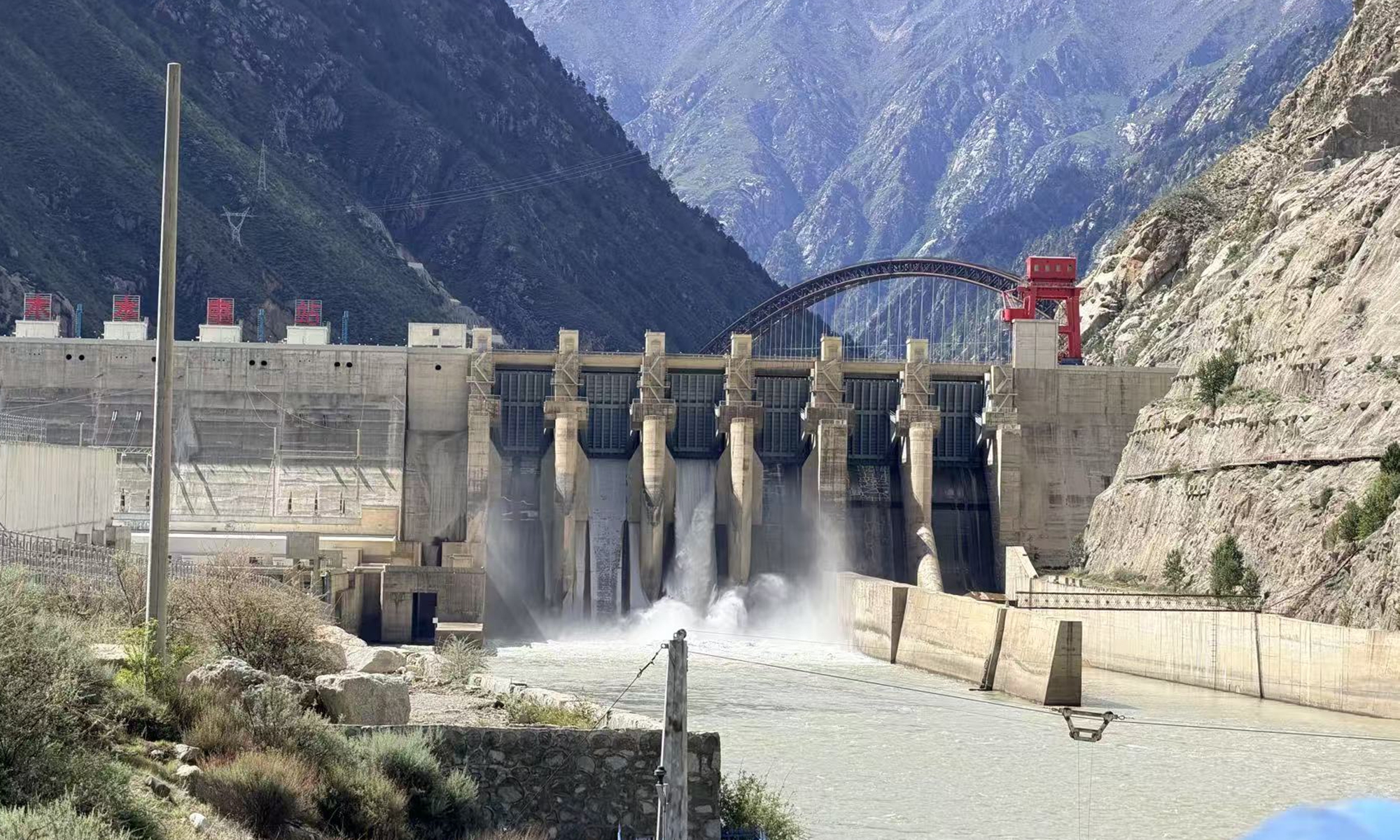
In the deep canyon in the middle reaches of the Yarlung Zangbo River, a hydropower station about 400 meters long and more than 100 meters high has released the tremendous force of the upstream river water. As the dam opened to discharge floodwaters, the surging water dropped by more than 60 meters, providing a solution to nearly 26 percent of electricity demand in Southwest China's Xizang Autonomous Region. This mega hydropower station, known as the Huaneng Zangmu Hydropower Station, ended the history of Xizang region relying on diesel for large-scale power supply.
Standing in front of the dam, design engineer Zhang Lianming was filled with pride. For him, this hydropower station not only benefits people's livelihoods, but also carries a special mission: in order to help the fish move freely between the upstream and downstream sections of the dam, a fishway was designed beside this mega-project. Since the hydropower station began operation in 2015, the fishway has helped about 570,000 fish "swim upstream."
"The environment means well-being, the green mountains mean beauty and blue sky also represents happiness." Zhang said in an interview with the Global Times, adding that when he saw that this water conservancy project not only delivers "green electricity" to thousands of households, but also makes the surrounding mountains greener, waters clearer, and fish and birds gather in the area, he has increasingly felt the meaning of this saying.
Swim back happily
Sun Chao, who is in charge of the Zangmu Hydropower Station, often goes to the fishway monitoring room to check the records of fish "crossing" the dam. When he sees fish successfully migrating back upstream through the glass curtain wall, a smile spreads across his face. "We feel about fish the same way fishing enthusiasts do," Sun said. "The difference is that their happiness comes from catching fish, while ours comes from seeing fish swim back."
Xizang region is an important ecological security barrier for the country and is also known as a "gene bank of species." Its natural environment is unique, highly sensitive and fragile - a fact clearly reflected in the fish populations of the Yarlung Zangbo River. The seven fish species that pass through the fishway at the station are unique. Two of these species, the black-spotted catfish and the Lhasa schizothoracin, are protected as nationally second-class protected animals.
"Preventing hydropower stations from becoming barriers to the free movement of rare fish has special ecological significance," Zhang said. When a dam blocks a river, the channels through which fish communicate are also cut off. Their living environment becomes more fragmented, which is detrimental to the integrity of aquatic ecosystems and to genetic exchange among fish populations.
However, fish native to the Yarlung Zangbo River are not typical migratory species; some are only semi-migratory. Once a hydropower station is built, they may simply adapt to their new surroundings and no longer return to their birthplace, Zhang pointed out.
The characteristics of fish in Yarlung Zangbo River made the design engineer realize that ensuring unobstructed fish migration had to be a key objective of the station. Only in this way could the fish mate freely, preserving the genetic strength of the river's rare fish populations.
Moreover, to help ensure that the Yarlung Zangbo River is filled with more high-quality fish species, a stock enhancement and release project for breeding rare fish seedlings from the river has also been implemented at the Zangmu Hydropower Station.
"The project has continued for 12 years, and so far, 1.97 million fish have been released," Sun calculated. "The construction of this large-scale fast-flowing fish stock enhancement and release station cost 48 million yuan ($7.10 million), the construction of the fishway cost about 360 million yuan ($53.27 million), and annual fry-breeding costs are nearly 7 million yuan ($1.04 million)."
"This hydropower station not only provides energy security, but also continues to invest heavily in taking on the vital responsibility of protecting the ecology of the plateau," he stressed.
'Leap over the dragon gate'
At the station, which stands more than 100 meters high, it is already difficult for an ordinary person to climb from the foot of the dam to the top. For fish in the Yarlung Zangbo River, swimming upstream across it is an even greater challenge. Relying on ingenious design, the builders have helped the fish successfully "leap over the dragon gate."
From the outside, the station's fishway looks no different from an ordinary diversion canal. The zigzagging artificial channel resembles a "hanging river," connecting the upstream and downstream sides of the dam. But a closer look reveals many hidden features inside: cement walls are arranged in alternating patterns to create a winding waterway effect.
According to Zhang, the fishway consists of an inlet, an open-channel section crossing the dam, an outlet, and an observation and research room. Inside the open channel are fishway pools with a gradient of 2 percent. Every time the fishway rises 10 meters, a rest pool is provided for the fish, with the water speed in the pool controlled between 0.9 and 1.2 meters per second. A water-supply branch pipe is installed at the inlet, along with a flow-regulating valve, to create the optimal flow speed for attracting fish.
"Fish enjoy the sensory stimulation brought by flowing water, and suitable water flow can attract them into the fishway," said Zhang. In his view, the key to the fishway's success lies in respecting the fish's natural instincts.
During the research and development process, members of the design team traveled to the US and Canada to learn from mature fishway projects.
During their research, they found that most fish in overseas rivers are carnivorous migratory fish, which are stronger and can migrate in rivers with steeper gradients. As a result, fishways overseas generally have a larger lifting angle, which means they can be built over a shorter distance.
In the Yarlung Zangbo River, however, the fish are mostly cold-water species with slow growth cycles and weaker swimming ability. Therefore, fishways built in the river need a smaller lifting angle.
This entire cross-disciplinary study of the ecology and behavior of fish in the Yarlung Zangbo River was compiled by the dam design team into a monograph. The project also won first prize in the 2023 Science and Technology Award in Xizang.
"When the fishway at Zangmu Hydropower Station was completed, it was the highest-altitude and largest fish-passage ecological and environmental protection project in China, breaking the long-standing convention that fish passes would no longer be considered for dams over 40 meters high," Zhang said.
He believes the successful application of the fishway in Zangmu station has very important guiding significance for the future construction of fishways at high-altitude hydropower stations and for the protection of rare aquatic organisms, and it also plays a positive role in protecting fragile ecological environment in Xizang.
'Fish face recognition'
Now, the fishway at Zangmu station has not only become a "distribution hub" for fish in the Yarlung Zangbo River, but also a "research station" for monitoring the river's ecological condition.
In the fishway observation room, a smart monitoring system works like an "electronic toll station" on a highway, constantly and accurately collecting information on migrating fish as they pass through.
"The fact that 570,000 fish have passed upstream through the fishway is backed by data," said Yang Xiaocheng, director of the safety and environmental protection department at the station. He specially showed Global Times reporters video footage recorded by the station on a day in May, in which large numbers of fish were seen racing upstream along the fishway toward the dam.
The scene was truly spectacular. "Every year from March to June is the spawning season for fish in the Yarlung Zangbo River, and it is also the peak period for migration."
Since the station began operation, visualizing and quantifying changes in ecosystem in the Yarlung Zangbo River has been an important task for the station.
"At first, we assigned staff on fixed duty," Yang said. Later, an AI system developed based on years of footage from the fishway was put into operation. According to the introduction, this system uses optical and sonar technologies to identify key features of migrating fish, such as fin characteristics and swimming posture, thereby recognizing and recording the fish's "identity information," with an accuracy rate of 95 percent, according to Yang.
In addition, this "fish face recognition" system also records information such as migration time and fishway water temperature. By combining and analyzing these data, it evaluates the effectiveness of the fishway under different conditions. These data are also shared with domestic research institutions for studies on fish behavior, and are eventually fed back to other hydropower stations in China.
In recent years, tagged fish released in previous years have been found in the section where the Nyang River and the Yarlung Zangbo River meet, about 200 kilometers downstream of the Zangmu Hydropower Station. This fully proves that the fry artificially released by the station have successfully adapted to the wild environment.
"From the monitoring results, the fish population in the middle reaches of the Yarlung Zangbo is very stable, and has not decreased, because of the construction of the hydropower station. On the contrary, the aquatic ecology and animal-plant life in the entire middle gorge section of the Yarlung Zangbo River have shown positive changes," Yang said.
At the same time, monitoring has shown that animals that live alongside water, such as otters and mergansers, are appearing more and more around the Zangmu Hydropower Station.
Harmony between humans and water, and coexistence among all things, is not impossible. Such a beautiful picture of ecological civilization is taking shape on the Yarlung Zangbo River, Zhang added.
"Building an ecological civilization concerns the well-being of the people and the future of the nation."
Chinese President Xi Jinping, also general secretary of the Communist Party of China (CPC) Central Committee and chairman of the Central Military Commission, pointed out: "Respecting, adapting to, and protecting nature is essential for building China into a modern socialist country in all respects."
As outlined in the 15th Five-Year Plan (2026-2030) for national economic and social development, securing major breakthroughs in strategic tasks of overall importance to Chinese modernization and making major new progress in the Beautiful China Initiative are set as key objectives.
The Global Times is launching a series of articles titled "BeautifulChinaING." From the perspectives of the beauty of nature, the beauty of system and the beauty of lifestyle, the series uses both Chinese and international cases as entry points. Through field reporting and video storytelling, it explores how green development has become a defining feature of Chinese modernization while showcasing China's role as a responsible major country providing global public goods.
In this installment, we turn our focus to the Qinghai-Xizang Plateau, where engineers, scientists and conservationists are working together to explore a new balance between hydropower development and ecological protection, ensuring the free migration of rare fish species in the Yarlung Zangbo River.
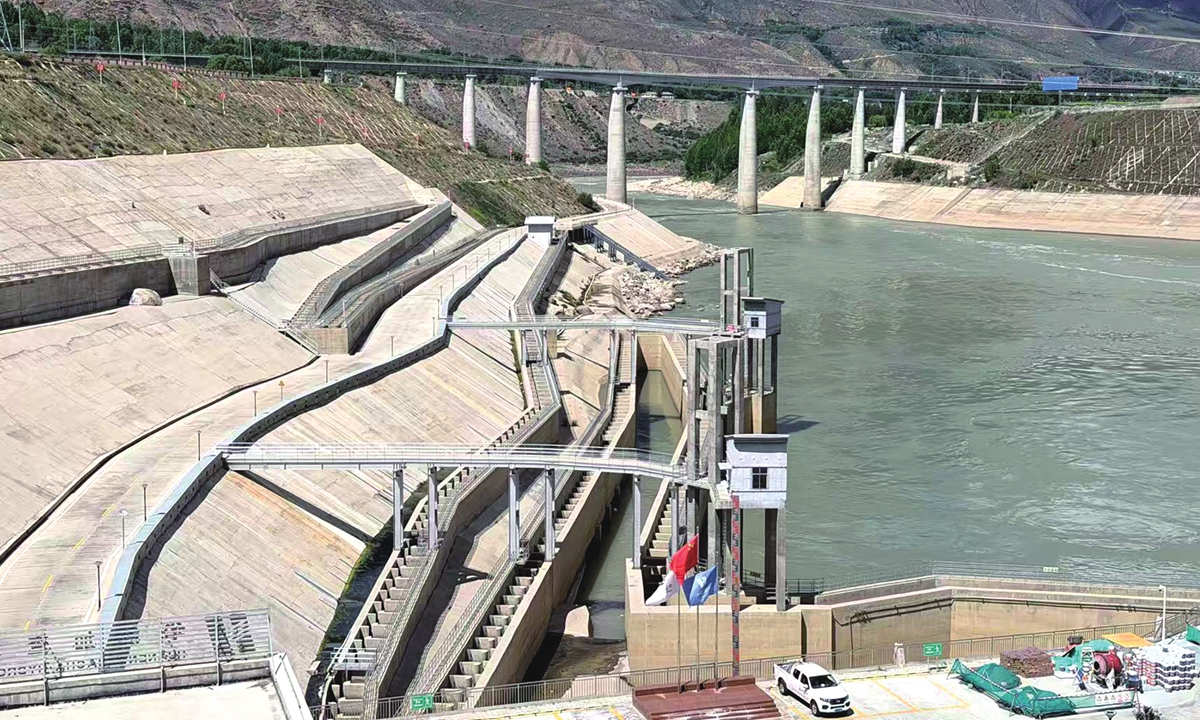
The fishway at Zangmu Hydropower Station in Shannan, Xizang Photo: Cao Siqi/GT
In the deep canyon in the middle reaches of the Yarlung Zangbo River, a hydropower station about 400 meters long and more than 100 meters high has released the tremendous force of the upstream river water. As the dam opened to discharge floodwaters, the surging water dropped by more than 60 meters, providing a solution to nearly 26 percent of electricity demand in Southwest China's Xizang Autonomous Region. This mega hydropower station, known as the Huaneng Zangmu Hydropower Station, ended the history of Xizang region relying on diesel for large-scale power supply.
Standing in front of the dam, design engineer Zhang Lianming was filled with pride. For him, this hydropower station not only benefits people's livelihoods, but also carries a special mission: in order to help the fish move freely between the upstream and downstream sections of the dam, a fishway was designed beside this mega-project. Since the hydropower station began operation in 2015, the fishway has helped about 570,000 fish "swim upstream."
"The environment means well-being, the green mountains mean beauty and blue sky also represents happiness." Zhang said in an interview with the Global Times, adding that when he saw that this water conservancy project not only delivers "green electricity" to thousands of households, but also makes the surrounding mountains greener, waters clearer, and fish and birds gather in the area, he has increasingly felt the meaning of this saying.
Swim back happily
Sun Chao, who is in charge of the Zangmu Hydropower Station, often goes to the fishway monitoring room to check the records of fish "crossing" the dam. When he sees fish successfully migrating back upstream through the glass curtain wall, a smile spreads across his face. "We feel about fish the same way fishing enthusiasts do," Sun said. "The difference is that their happiness comes from catching fish, while ours comes from seeing fish swim back."
Xizang region is an important ecological security barrier for the country and is also known as a "gene bank of species." Its natural environment is unique, highly sensitive and fragile - a fact clearly reflected in the fish populations of the Yarlung Zangbo River. The seven fish species that pass through the fishway at the station are unique. Two of these species, the black-spotted catfish and the Lhasa schizothoracin, are protected as nationally second-class protected animals.
"Preventing hydropower stations from becoming barriers to the free movement of rare fish has special ecological significance," Zhang said. When a dam blocks a river, the channels through which fish communicate are also cut off. Their living environment becomes more fragmented, which is detrimental to the integrity of aquatic ecosystems and to genetic exchange among fish populations.
However, fish native to the Yarlung Zangbo River are not typical migratory species; some are only semi-migratory. Once a hydropower station is built, they may simply adapt to their new surroundings and no longer return to their birthplace, Zhang pointed out.
The characteristics of fish in Yarlung Zangbo River made the design engineer realize that ensuring unobstructed fish migration had to be a key objective of the station. Only in this way could the fish mate freely, preserving the genetic strength of the river's rare fish populations.
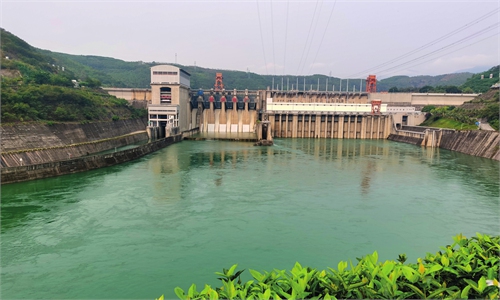
Zangmu Hydropower Station in Shannan, Xizang Photo: Cao Siqi/GT
Moreover, to help ensure that the Yarlung Zangbo River is filled with more high-quality fish species, a stock enhancement and release project for breeding rare fish seedlings from the river has also been implemented at the Zangmu Hydropower Station.
"The project has continued for 12 years, and so far, 1.97 million fish have been released," Sun calculated. "The construction of this large-scale fast-flowing fish stock enhancement and release station cost 48 million yuan ($7.10 million), the construction of the fishway cost about 360 million yuan ($53.27 million), and annual fry-breeding costs are nearly 7 million yuan ($1.04 million)."
"This hydropower station not only provides energy security, but also continues to invest heavily in taking on the vital responsibility of protecting the ecology of the plateau," he stressed.
'Leap over the dragon gate'
At the station, which stands more than 100 meters high, it is already difficult for an ordinary person to climb from the foot of the dam to the top. For fish in the Yarlung Zangbo River, swimming upstream across it is an even greater challenge. Relying on ingenious design, the builders have helped the fish successfully "leap over the dragon gate."
From the outside, the station's fishway looks no different from an ordinary diversion canal. The zigzagging artificial channel resembles a "hanging river," connecting the upstream and downstream sides of the dam. But a closer look reveals many hidden features inside: cement walls are arranged in alternating patterns to create a winding waterway effect.
According to Zhang, the fishway consists of an inlet, an open-channel section crossing the dam, an outlet, and an observation and research room. Inside the open channel are fishway pools with a gradient of 2 percent. Every time the fishway rises 10 meters, a rest pool is provided for the fish, with the water speed in the pool controlled between 0.9 and 1.2 meters per second. A water-supply branch pipe is installed at the inlet, along with a flow-regulating valve, to create the optimal flow speed for attracting fish.
"Fish enjoy the sensory stimulation brought by flowing water, and suitable water flow can attract them into the fishway," said Zhang. In his view, the key to the fishway's success lies in respecting the fish's natural instincts.
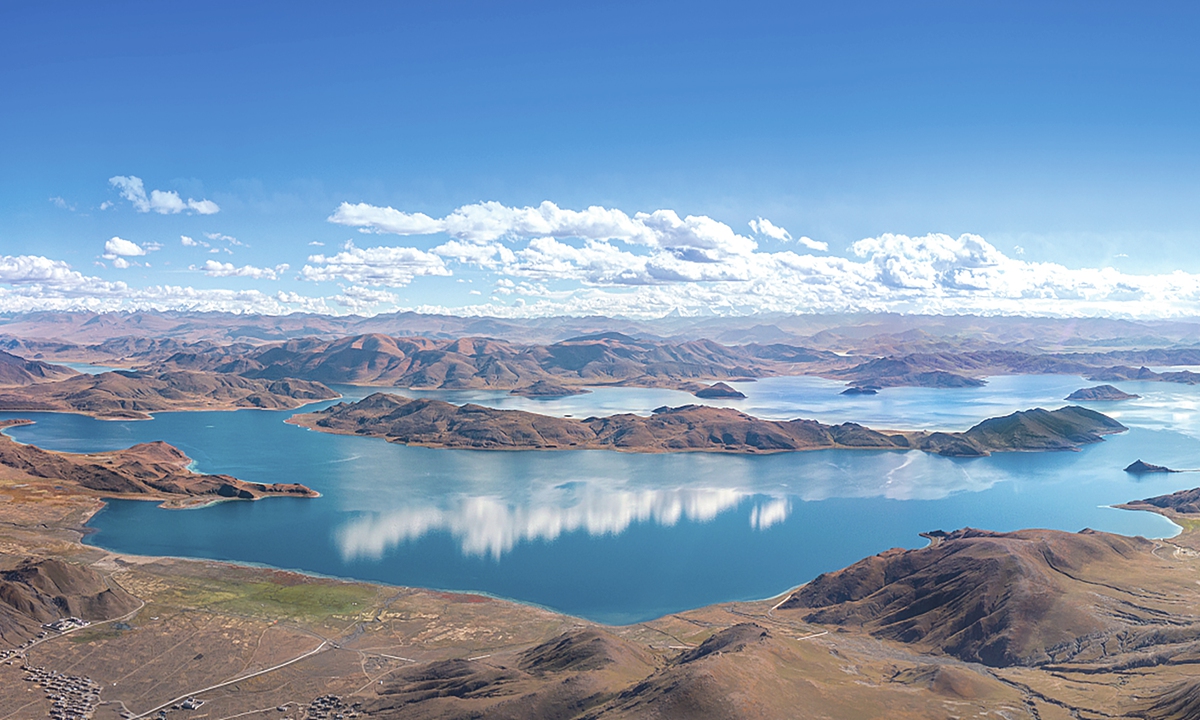
The scenery of Shannan, Southwest China's Xizang Autonomous Region Photo: VCG
To this end, the design team built a scale-model fishway and captured fish from the river to conduct multiple flow-velocity tests. After six years of repeated experiments, the team finally determined that an inlet flow velocity of 0.92 to 1.2 meters per second was the "comfort zone" for the upstream migration of fish.During the research and development process, members of the design team traveled to the US and Canada to learn from mature fishway projects.
During their research, they found that most fish in overseas rivers are carnivorous migratory fish, which are stronger and can migrate in rivers with steeper gradients. As a result, fishways overseas generally have a larger lifting angle, which means they can be built over a shorter distance.
In the Yarlung Zangbo River, however, the fish are mostly cold-water species with slow growth cycles and weaker swimming ability. Therefore, fishways built in the river need a smaller lifting angle.
This entire cross-disciplinary study of the ecology and behavior of fish in the Yarlung Zangbo River was compiled by the dam design team into a monograph. The project also won first prize in the 2023 Science and Technology Award in Xizang.
"When the fishway at Zangmu Hydropower Station was completed, it was the highest-altitude and largest fish-passage ecological and environmental protection project in China, breaking the long-standing convention that fish passes would no longer be considered for dams over 40 meters high," Zhang said.
He believes the successful application of the fishway in Zangmu station has very important guiding significance for the future construction of fishways at high-altitude hydropower stations and for the protection of rare aquatic organisms, and it also plays a positive role in protecting fragile ecological environment in Xizang.
'Fish face recognition'
Now, the fishway at Zangmu station has not only become a "distribution hub" for fish in the Yarlung Zangbo River, but also a "research station" for monitoring the river's ecological condition.
In the fishway observation room, a smart monitoring system works like an "electronic toll station" on a highway, constantly and accurately collecting information on migrating fish as they pass through.
"The fact that 570,000 fish have passed upstream through the fishway is backed by data," said Yang Xiaocheng, director of the safety and environmental protection department at the station. He specially showed Global Times reporters video footage recorded by the station on a day in May, in which large numbers of fish were seen racing upstream along the fishway toward the dam.
The scene was truly spectacular. "Every year from March to June is the spawning season for fish in the Yarlung Zangbo River, and it is also the peak period for migration."
Since the station began operation, visualizing and quantifying changes in ecosystem in the Yarlung Zangbo River has been an important task for the station.
"At first, we assigned staff on fixed duty," Yang said. Later, an AI system developed based on years of footage from the fishway was put into operation. According to the introduction, this system uses optical and sonar technologies to identify key features of migrating fish, such as fin characteristics and swimming posture, thereby recognizing and recording the fish's "identity information," with an accuracy rate of 95 percent, according to Yang.
In addition, this "fish face recognition" system also records information such as migration time and fishway water temperature. By combining and analyzing these data, it evaluates the effectiveness of the fishway under different conditions. These data are also shared with domestic research institutions for studies on fish behavior, and are eventually fed back to other hydropower stations in China.
In recent years, tagged fish released in previous years have been found in the section where the Nyang River and the Yarlung Zangbo River meet, about 200 kilometers downstream of the Zangmu Hydropower Station. This fully proves that the fry artificially released by the station have successfully adapted to the wild environment.
"From the monitoring results, the fish population in the middle reaches of the Yarlung Zangbo is very stable, and has not decreased, because of the construction of the hydropower station. On the contrary, the aquatic ecology and animal-plant life in the entire middle gorge section of the Yarlung Zangbo River have shown positive changes," Yang said.
At the same time, monitoring has shown that animals that live alongside water, such as otters and mergansers, are appearing more and more around the Zangmu Hydropower Station.
Harmony between humans and water, and coexistence among all things, is not impossible. Such a beautiful picture of ecological civilization is taking shape on the Yarlung Zangbo River, Zhang added.
RELATED ARTICLES