Chinese tech giants widen AI talent hunt as industry shifts from model breakthroughs to real-world use
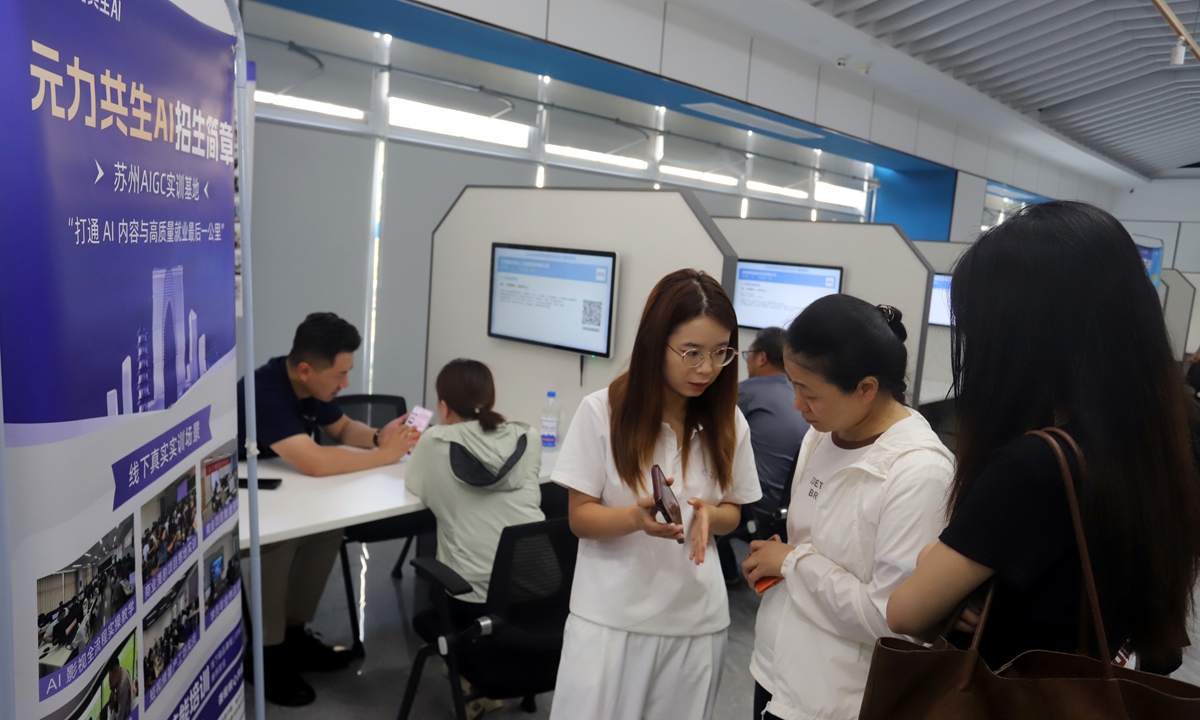
A job seeker talks with a recruiter from an artificial intelligence company at a job fair for college graduates in Suzhou, East China's Jiangsu Province, on August 1, 2026. Photo: VCG
China's biggest technology companies are putting multidisciplinary artificial intelligence (AI) talent at the center of their 2027 graduate recruitment, with AI-related positions accounting for more than 80 percent of openings at Alibaba and more than 90 percent at Baidu, as rapid advances in large-language models and AI agents accelerate commercial deployment.
The latest recruitment drives by companies including Alibaba, ByteDance, JD.com and Baidu show that the talent race is widening beyond top algorithm researchers. Companies are increasingly seeking people who can combine AI expertise with engineering, product development or industry knowledge and turn technological advances into products that solve real-world problems, industry analysts said.
Alibaba, China's e-commerce and cloud-computing giant, on Wednesday opened applications for its 2027 graduate recruitment program, offering positions across more than 10 job categories at 13 business groups and companies, including Alibaba Cloud, Taobao and Tmall Group, Alibaba International, its Qwen units, chip designer T-Head and digital mapping platform Amap, according to Alibaba's official campus recruitment website.
Beyond the scale of the intake, Alibaba is placing particular emphasis on candidates who can combine AI expertise with product knowledge and practical business applications. AI-related positions account for 80 percent of the openings, which span job categories, including algorithms, research and development, chip design and product development, according to GMW.cn, a website affiliated with the Guangming Daily.
ByteDance, the Chinese technology company behind TikTok and Douyin, launched its 2027 graduate recruitment on Monday, with technology and product positions accounting for more than 70 percent of the total. While algorithm vacancies continued to increase, the company introduced roles including AI full-stack engineer and AI agent developer for the first time, according to Jiemian News.
Product vacancies increased 20 percent year-on-year, with more than half focused on AI products, the report said. The figures suggest that ByteDance is expanding recruitment beyond core AI research to accelerate the development of AI-powered products, analysts said.
The same trend is evident at Chinese e-commerce giant JD.com, which also launched its 2027 graduate recruitment recently, offering positions in technology, products, retail procurement, logistics, operations, healthcare and other areas, according to the official WeChat account of JD Recruitment.
A JD.com recruitment official said in a media interview in June that the rapid development of Chinese large-language models and AI agents had changed hiring requirements. The company continues to recruit language and multimodal model researchers while expanding hiring in AI infrastructure, computing-resource scheduling and agent development.
Search-engine and AI company Baidu moved earlier, launching its 2027 graduate recruitment program on July 9. AI-related positions account for more than 90 percent of the openings, spanning large-language models, AI agents, multimodal systems, AI infrastructure and autonomous driving, according to the China Youth Daily.
Baidu is offering 74 specialized positions across technology, product, government and enterprise services, sales and corporate functions. The openings cover frontier fields including large-language models, AI agents, multimodal systems, AI infrastructure and autonomous driving, with a focus on candidates who combine AI expertise with a broader range of skills, according to the report.
The scale and breadth of these recruitment drives mark a sharp reversal from several years ago, when some technology companies were cutting costs and slowing recruitment, veteran technology industry analyst Liu Dingding told the Global Times. "When a major technological opportunity emerges, technology giants are usually the first to vote with recruitment and investment," he said.
Companies are now committing funding, computing power and business resources while competing for scarce AI specialists with high salaries, equity and other incentives, Liu said. AI is also shortening traditional career paths, allowing young researchers who solve critical problems to demonstrate their value and rise more quickly.
As China's AI drive moves from model breakthroughs to large-scale deployment, this recruitment push is helping build a multilayered talent pipeline spanning frontier researchers, cross-disciplinary professionals and industry specialists. Those capable of connecting AI with products and industries will increasingly shape corporate competitiveness and the opportunities available to a new generation entering the workforce, Liu said.
Job postings in the AI industry rose 12.4 percent year-on-year in the second quarter of 2026, while demand for AI engineers jumped 21.8 percent. The demand-to-supply ratio for AI engineers stood at 2.24, meaning there were more than two vacancies for every job seeker, the Global Times learned from Zhaopin, a leading Chinese online recruitment platform.
RELATED ARTICLES