ARTS / CULTURE & LEISURE
Beijing commercial rockets race toward reusable future with maiden flights looming
By Published: Aug 06, 2026 09:25 PM

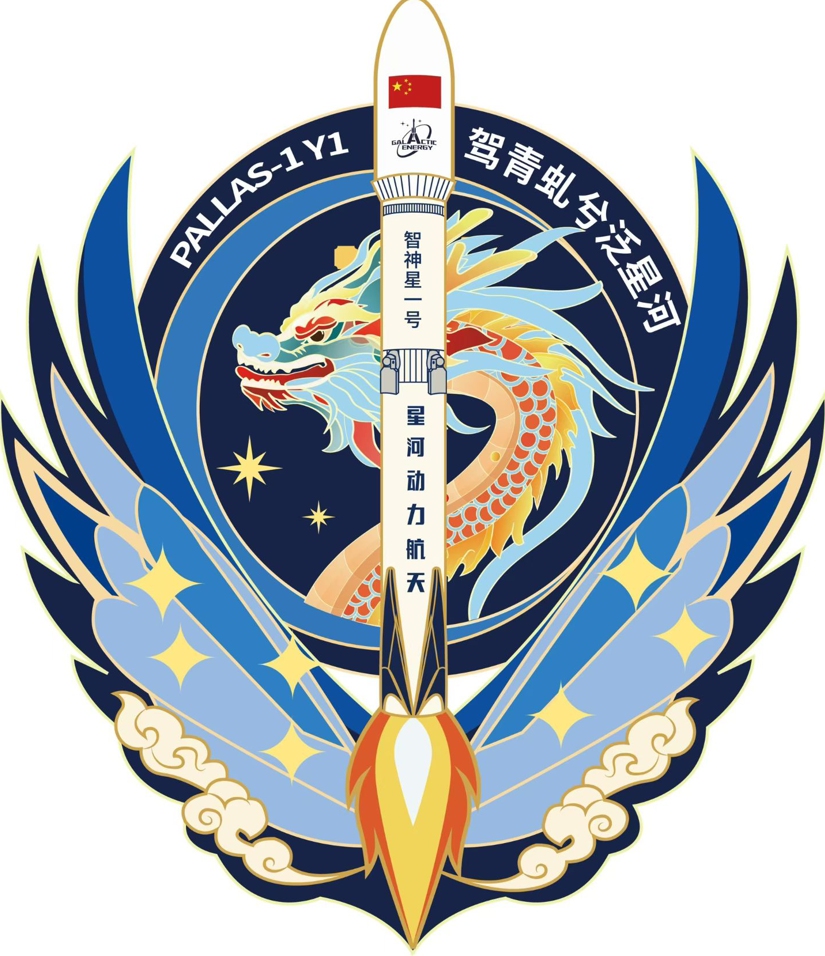
Logo of Pallas-1 Photo: Courtesy of Galactic Energy
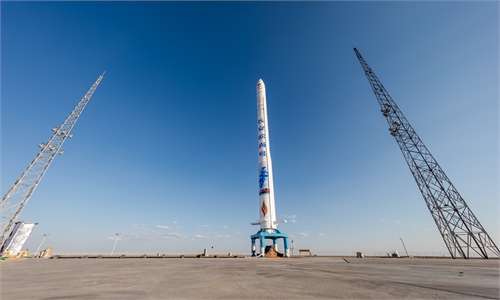
A large number of new-generation commercial rockets developed in Beijing are moving closer to maiden flights, scheduled as early as within this year, as private aerospace companies accelerate their efforts to achieve reusable launch capabilities and build low-cost, high-frequency space transportation systems, the Beijing Daily reported Thursday.As Chinese commercial aerospace company Galactic Energy recently unveiled the mission logo for its Pallas-1, or the Zhishenxing-1, launch vehicle, it announced that the rocket's maiden flight will be carried out at an appropriate time in the near future.
According to plans released by Beijing-based commercial aerospace companies, multiple "Beijing-made rockets" are scheduled to conduct maiden flight verification missions in 2026, with reusable rocket technology becoming a major focus, per the Beijing Daily report.
Designed as a reusable liquid launch vehicle, Pallas-1 is mainly aimed at the large satellite launch and satellite constellation deployment markets. The rocket will begin its mission from Galactic Energy's independently built facility at the Dongfeng Commercial Aerospace Innovation Test Zone in northwestern China, where the company will complete testing, propellant filling and launch preparation operations, according to Galactic Energy on Thursday.
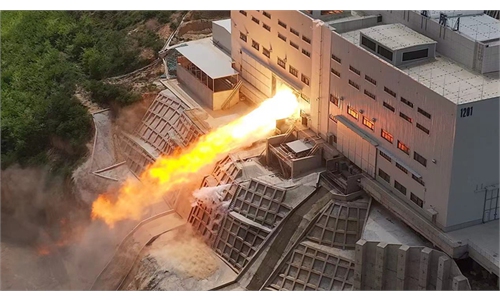
The rocket's core power system, the Cangqiong-50 reusable liquid oxygen-kerosene engine, was independently developed by Galactic Energy and has completed more than 20,000 seconds of hot-fire testing. Pallas-1 is designed for at least 25 reuses, with its first stage powered by seven Cangqiong-50 engines operating in parallel. The rocket has a maximum low Earth orbit payload capacity of 7 tons and is designed to support vertical landing recovery and repeated flights, per the company.
Reusable rockets are widely seen as a key technology for reducing launch costs and supporting the rapidly expanding demand for low Earth orbit satellite constellations. In Beijing, a number of commercial aerospace companies are competing to develop reusable launch vehicles that could eventually serve as "space shuttles" between Earth ground and orbit.
LandSpace's reusable liquid oxygen-methane rocket Zhuque-3 completed its maiden orbital flight successfully in late 2025 and verified key technologies. The reusable Zhuque-3 Y2 vehicle has completed all ground static-fire tests and entered preparations for its next flight test.
Orienspace's Gravity-2 reusable large liquid launch vehicle is undergoing final ground testing ahead of its maiden flight, which is scheduled in the fourth quarter of 2026. The rocket is designed with a low Earth orbit payload capacity of 21.5 tons.
Space Pioneer is advancing verification and joint testing of its Yuanxingzhe-1 (YXZ-1) rocket, while i-Space's Hyperbola-3 reusable rocket has completed full-cycle ground verification of offshore recovery and landing technologies and is expected to conduct its maiden flight around the end of 2026.
Meanwhile, CAS Space's reusable Lihong-2 vehicle is being developed as a platform for verifying key recovery and reuse technologies, as well as conducting microgravity experiments. The vehicle is scheduled to complete its maiden flight and 100-kilometer-class recovery verification test in 2026.
Wang Yingcheng, executive vice president of the CAS Space Innovation Research Institute, told the Global Times that the upcoming maiden flight of Lihong-2 will carry a space pharmaceutical payload consisting of a fully automated space protein crystallization device.
The flight will also carry an unattended robotic system to verify the robot's operational performance and stability in typical space environments, including microgravity and high vacuum conditions, Wang told the Global Times.
The rapid development of reusable rockets is also being supported by the capital city's efforts to establish a comprehensive commercial aerospace ecosystem. The city has introduced targeted support policies, established key laboratories and launched measures such as launch insurance subsidies to encourage innovation.
As China's first common research and manufacturing base for commercial aerospace, Beijing's "Rocket Street," located in the capital city's Daxing district, provides supporting facilities and platforms to help companies reduce testing costs and shorten technology validation cycles.
RELATED ARTICLES