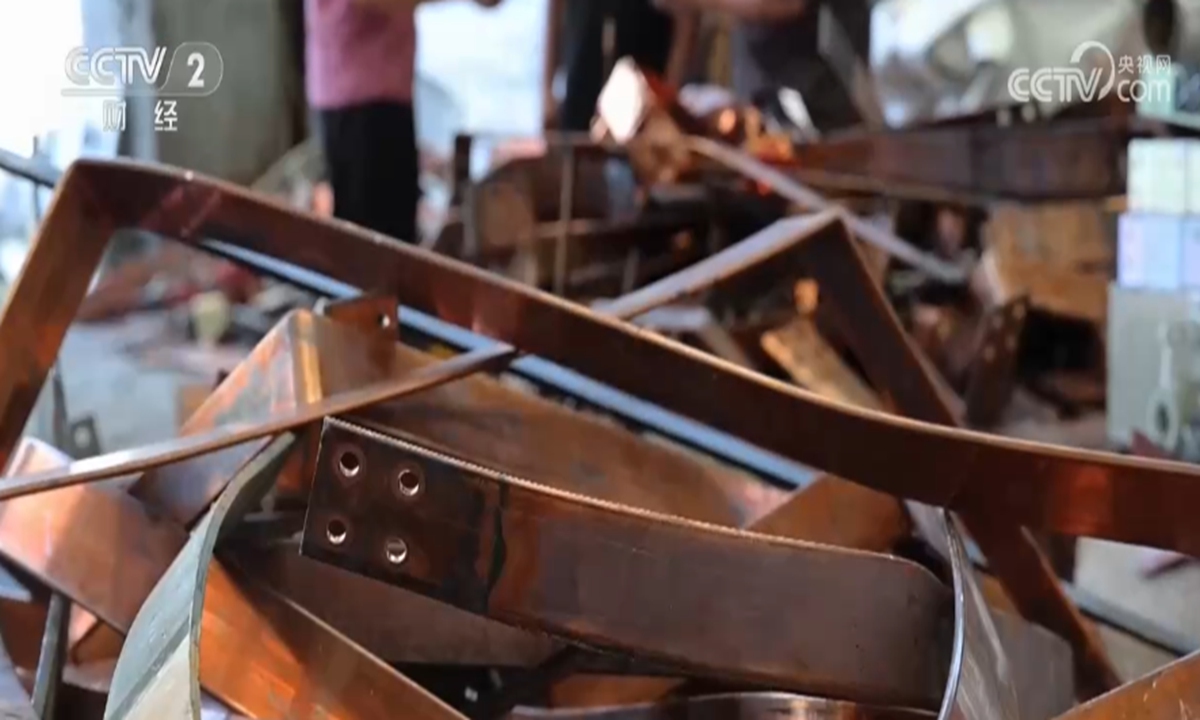
Metal waste Photo: Screenshot from CCTV News
A recent rule issued by US authorities has thrust certain used critical minerals into the spotlight of the key raw materials supply chain.
The US Commerce Department said recently it will block exports of tungsten scrap and battery waste, part of a push to boost the domestic recycling industry and critical mineral production, Reuters reported.
Against the backdrop of intensifying global competition over critical minerals and new-energy supply chains, the US' move to bring battery and tungsten waste onto its export control list may look like a step to shore up supply chains, but it lays bare a deep-seated dilemma: when a country begins to erect barriers for its waste, it is a clear sign that it has run out of better solutions to fix its supply gaps.
US manufacturers are now just months away from a January 1, 2027, deadline under federal regulations to stop purchasing minerals from China, Reuters reported. The stakes are high especially for tungsten. The US has not commercially mined tungsten since 2015, and global supply remains dominated by Chinese production and exports.
Tungsten is a heavy metal used in everything from military armor and ammunition to precision tools in car plants, and battery waste is a growing alternative source of lithium, cobalt, nickel and other materials.
Despite the strategic value of these waste materials, simply hoarding them through administrative intervention will not yield the supply chain security Washington seeks. Such material must be refined and processed before re-entering industrial production, yet the US apparently lacks sufficient capacity to absorb the waste materials that will be banned from exports.
North American battery recyclers have already been running into financial trouble. Massachusetts-based start-up Ascend Elements Inc filed for bankruptcy in April, while Li-Cycle Holding Corp sought bankruptcy protection last year, Bloomberg reported.
What makes the new rule even more illogical is that exemptions may be granted if the materials are exported for processing or refining and then returned to the US. It lays bare Washington's continuing reliance on global processing capacity. This prompts a fundamental question: aside from higher logistics costs, administrative approval delays and trade frictions, what tangible boost to domestic supply can this export restriction genuinely deliver?
Furthermore, the new export controls deal a direct blow to economies that have long relied on US waste material flows. By cutting off these supplies, Washington is not reducing dependence on China; it is disrupting the global recycling networks on which other economies depend. This signals a troubling shift: as nations increasingly stockpile scrap as a strategic reserve, the mutual trust underpinning international resource circulation inevitably weakens, leaving global supply chains to absorb the ensuing costs.
Looking at the bigger picture, the more urgently the US tries to shake off its reliance on China, the more deeply that reliance reveals itself. For the US to build a fully alternative supply chain would require massive amounts of investment and face daunting hurdles in technology, costs and industrial supporting infrastructure. Locking scrap inside national borders will never create a mass industrial ecosystem.
More importantly, the resilience and security of critical mineral supply chains can never be achieved through erecting export controls. The technological advantages, cost competitiveness and scale strengths that China has built up over decades in tungsten and battery material processing cannot be easily bypassed by a single administrative ban.
Supply chain security is a sophisticated systematic project built on long-term infrastructure accumulation, continuous technological research and development investment, and an open and competitive market environment. Short-term trade barriers and export controls will never provide a shortcut to long-term supply chain security.
RELATED ARTICLES