Shenzhen’s Huaqiangbei drives China’s AI export boom: AI glasses, drones and robots surge with 8,000 daily overseas buyers
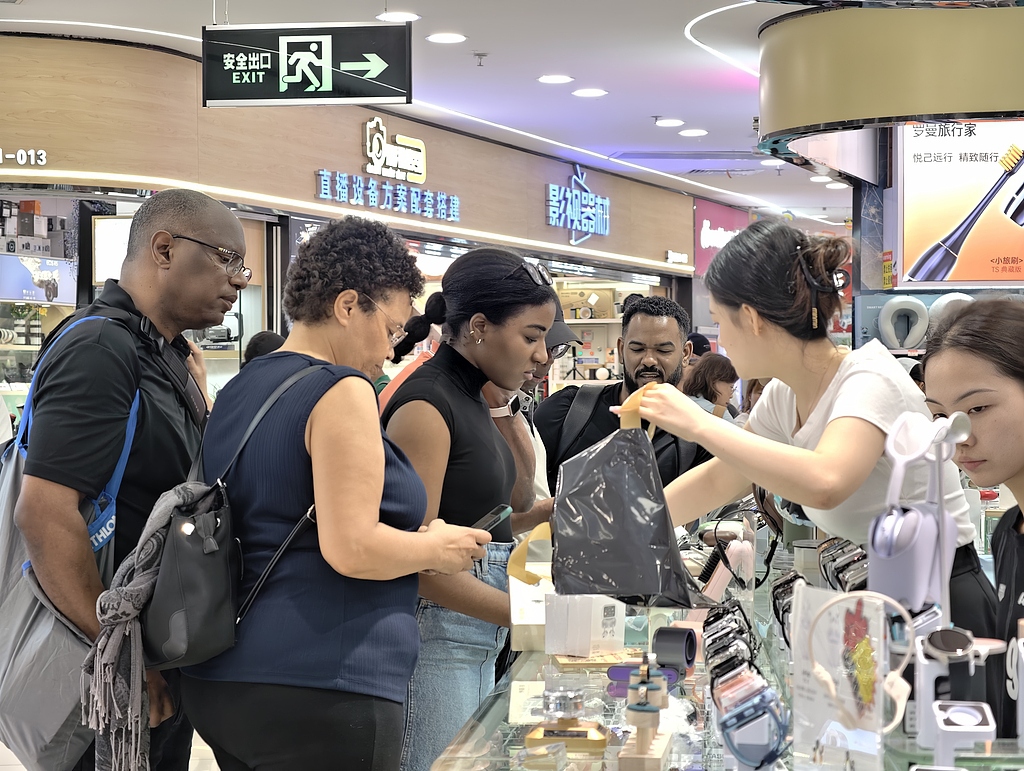
Foreign tourists browse and shop along Shenzhen Huaqiangbei Commercial Street on April 20, 2025. Photo: VCG
China's robust industrial chain and rapid iterative innovation have propelled its artificial intelligence (AI) hardware sector into a global leadership position, with Shenzhen's Huaqiangbei — the world's premier electronics hub — emerging as the core gateway for Chinese intelligent products to go global.
Fueled by booming overseas market demand, the iconic industrial district is witnessing an unprecedented cross-border procurement frenzy this summer, as swarms of international buyers flock to source, test and place orders for cutting-edge AI gadgets, local merchants told the Global Times.
Huaqiangbei's overseas trading vitality has hit new highs throughout 2026, with nearly 8,000 foreign purchasers visiting the commercial zone on a daily basis. Official data from the Huaqiangbei sub-district authority shows that AI-related products have become the absolute mainstream of the local electronics industry, accounting for 61 percent of all electronics transactions as of July, a surge from 41 percent in 2025.
From January to July, total sales of local AI hardware products jumped more than 55 percent year-on-year. Specifically, AI glasses sales doubled, while drone and robot sales rose 60 to 70 percent, according to the subdistrict.
More than 60 percent of local store owners have pivoted to AI hardware operations, and consumer inquiries for intelligent products have tripled, fully demonstrating the district's strong industrial resilience and global market competitiveness.
Zhan Shigang, product manager at brain‑wave wearable‑device maker Shenzhen Macrotellect, told the Global Times that overseas clients make up 60 percent of the company's customer base.
"Overseas buyers have highly customized requirements. Thanks to the region's clustered supply‑chain resources, we can finish everything from circuit‑board production to finished prototypes within one week," Zhan said.
Yang Chaohua, CEO of AI box manufacturer Three-Body Intelligent Technology, noted that his firm receives five to six batches of overseas orders every day. "Domestically developed AI hardware is priced at only one-third of equivalent foreign products. Supported by mature industrial chains and rapid product iteration capabilities, our cost-efficient and high-performance intelligent gadgets are gaining escalating popularity across global markets," Yang said.
Interactive AI plush toys have become a breakout summer hit among overseas young consumers. Equipped with facial recognition, memory storage and autonomous interactive functions, these smart toys can actively communicate and respond to users, evolving from passive playthings into personalized emotional companions.
Zhang Tao, head of Tuya Smart's AI audio‑and‑video division, a tech‑service provider that integrates AI features for toy manufacturers, said that the company's AI‑driven companion‑toy business achieved robust growth in the first half of 2026, with overseas revenue soaring several‑fold.
"China established an early lead in the R&D and manufacturing of AI-powered smart toys. We're seeing many European and American brands turn to Chinese suppliers to source mature technical solutions, or directly outsource production of finished products to them," Zhang told the Global Times on Thursday.
Huaqiangbei's industrial agility reflects the broader competitiveness of China's AI manufacturing sector. Efficient supply chain collaboration cuts production costs and delivers superior cost performance for global markets. Meanwhile, the industry's flexible iteration capabilities allow rapid product customization and innovation, perfectly catering to diverse overseas market needs, Wang Peng, an associate research fellow at the Beijing Academy of Social Sciences, told the Global Times on Thursday.
Shenzhen Customs data shows the city's imports and exports of high-tech products reached 1.7 trillion yuan ($252 billion) the first half of 2026, ranking first nationwide and contributing more than 60 percent of the city's total foreign trade growth. The trade value of AI-related products exceeded 1 trillion yuan, with a year-on-year increase of more than 50 percent, according to China Media Group.
RELATED ARTICLES