The US wants ‘domestic substitution’ too? Better carefully make three calculations first: Global Times editorial
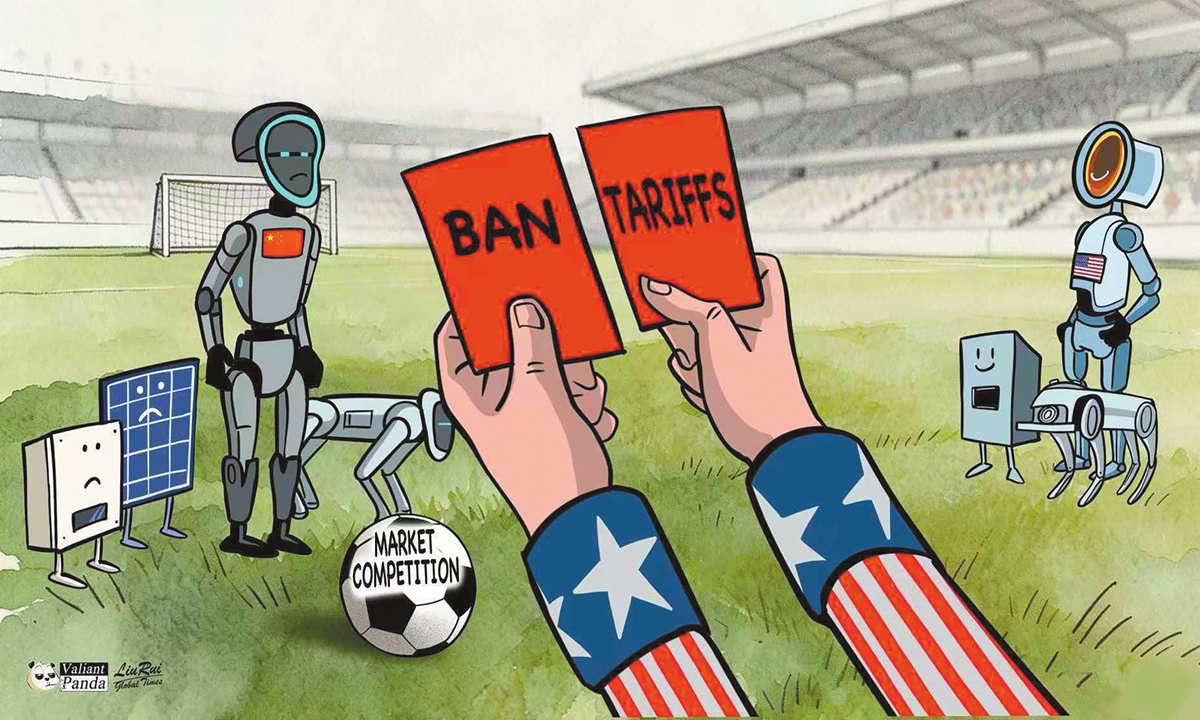
Illustration: Liu Rui/GT
The US' drive for "domestic substitution" is an attempt to reshape a supply chain that "excludes China," and is essentially protectionism and unilateral bullying. It should not only avoid underestimating China's determination and ability to respond, but also carefully calculate three costs: the energy transition one, the AI infrastructure one, and the innovation one.
Recently, three US import-control policy moves have come under the spotlight: Washington is preparing to announce a minimum 15 percent tariff and a series of price floors on products made from polysilicon; the US Federal Communications Commission (FCC) has been reported to be considering banning Chinese-made optical transceivers from entering the US market; and at the end of July, the FCC had already issued import restrictions on foreign-made inverters and advanced robotics equipment. All three policy moves target high-tech sectors where China holds clear competitive advantages. What exactly is the US trying to do? Is it attempting to follow China's path of pursuing "domestic substitution"?
The logic behind "domestic substitution" in China and the US is fundamentally different. China's pursuit of "domestic substitution" stems from external challenges, including attempts to cut off access to key technologies, and internal demands for high-quality development. Its approach is to rely on self-reliance and independent innovation to achieve breakthroughs in key technologies and lay a solid foundation for broader opening-up and cooperation. The US' approach is quite the opposite. It is to artificially create "small yard, high fences," seeking to reshape a supply chain that "excludes China" through tariffs, pricing manipulation and market-access restrictions.
This is essentially protectionism, an abuse of state power to suppress Chinese technology companies, and a typical example of market distortion and unilateral bullying under the guise of "decoupling or chain-severing." As the Chinese Ministry of Commerce's measures on Wednesday clearly showed, if the US insists on moving in this direction, China's countermeasures will not be absent.
If Washington continues down this path of "domestic substitution," it should not only avoid underestimating China's determination and ability to respond, but also carefully calculate three costs.
The first cost is the energy transition. China accounts for more than 80 percent of global capacity across several major segments of the photovoltaic manufacturing chain, while the US still lacks upstream production capacity that can provide a "seamless replacement." The US' planned measures would not only cover polysilicon, but could also extend to wafers, cells and modules. Meanwhile, the US has discussed a temporary offset program designed to insulate domestic manufacturers currently reliant on imported material from the levies, indicating that the tariffs would first hit the US' own industrial supply chains. If a form of "industrial security" must be maintained through more expensive energy, slower deployment and greater subsidies, does it truly enhance security or does it create new vulnerabilities?
The second cost is the AI infrastructure. Some estimates suggest that Chinese manufacturers will account for around 56 percent of global outsourced optical transceiver production capacity in 2026. Major Chinese suppliers serving the North American market alone are estimated to make up roughly 46 percent of that capacity. Industry insiders agree that the US cannot realistically achieve domestic substitution in this sector in the near term. Some analysts even argue that a comprehensive ban would almost amount to directly bringing the construction of AI data centers in the US to a standstill. Moreover, Chinese optical modules integrate components sourced from multiple countries. If China's manufacturing capacity is cut out of the equation, it would disrupt global industrial and supply chains - and the US would not be spared.
The third cost is innovation. The US' restrictions on certain advanced robotic equipment made in China could deprive US domestic startups and researchers of cost-effective experimental platforms. A competitive industrial base cannot be built simply by excluding foreign products. On the contrary, doing so risks depriving domestic firms of the incentives to compare, learn, and iterate. The US' experience with consumer drones is a case in point: despite years of restrictions on Chinese drones, it has yet to develop a complete and cost-competitive consumer drone ecosystem of its own.
There is little doubt that forcing a "decoupling" from China's competitive industries will ultimately impose costs on American businesses and consumers. Some analysts argue that Washington's pursuit of "domestic substitution" is driven more by political calculations than economic ones - accepting far greater damage to itself in the hope of hurting its competitor. Yet China's innovation momentum is not something that can be halted by such tactics. With a market of more than 1.4 billion people, a comprehensive industrial system, and sustained investment in talent development and research and development, China has already crossed a critical threshold in indigenous innovation. External forces can hardly reverse the course of our development.
In fact, frontier sectors such as AI, robotics, and clean energy hold enormous potential for innovation. China and the US can - and should - expand exchanges and cooperation, build a more open, stable, and predictable economic and trade framework, and build "a constructive China-US relationship of strategic stability" that enables both countries to accomplish more for themselves and for the world. This is a calculation Washington would do well to get right.
RELATED ARTICLES