Australia, Vietnam expand cooperation during To Lam visit; media’s China-targeting framing ignores Hanoi’s strategic autonomy: expert
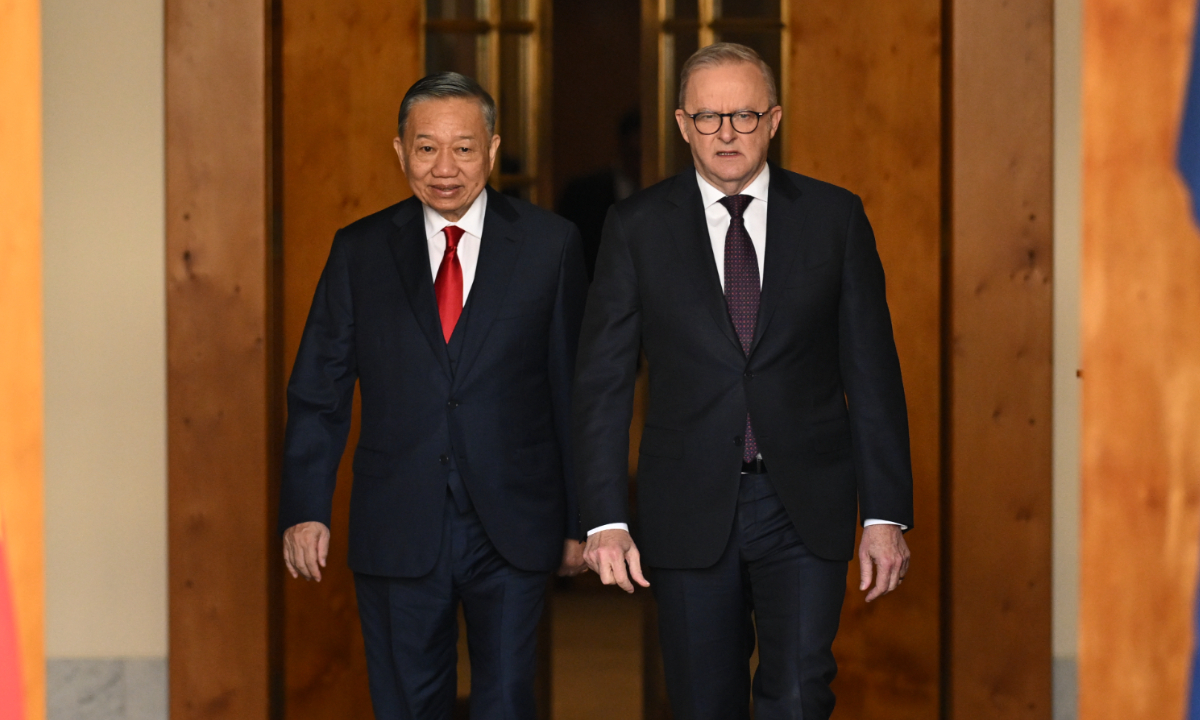
Australian Prime Minister Anthony Albanese (R) and President of Vietnam To Lam arrive for a joint press statement at Parliament House in Canberra, Australia, on August 11, 2026. Photo: VCG
Vietnamese President To Lam and Australian Prime Minister Anthony Albanese pledged on Tuesday to broaden cooperation across major areas including defense, maritime and border security, agriculture, energy and minerals during Lam's visit to Australia.
Although neither the joint statement nor the joint media statement issued during the visit mentioned China, some media outlets framed the expanded cooperation as a joint effort to counter Beijing. A Chinese expert said such narratives repackage normal bilateral engagement through the lens of the so-called "China threat" narrative while disregarding Vietnam's strategic autonomy.
The joint statement between Vietnam and Australia outlined bilateral cooperation in major areas, including deepening political, defense, security and justice cooperation, enhancing economic engagement, strengthening climate, environment and energy cooperation, and reinforcing regional and international cooperation.
The outcomes included memorandums of understanding on cooperation and the resumption of market access for Australian kangaroo and deer meat in Vietnam, demonstrating that the visit covered a wide range of economic, security and regional issues.
Despite the broad agenda, The Straits Times portrayed the two countries' stronger military ties as being "in [a] nod to China." It described their expanded military cooperation as part of efforts to "face down Beijing's expanding reach in the Pacific and the South China Sea," and said Lam's visit came as the two countries "chafe against a growing military build-up by China in the region."
Bloomberg likewise linked the cooperation to China, claiming that "Australia and Vietnam have expanded maritime-security cooperation in recent years as they confront increasing Chinese 'aggression' in the South China Sea."
Australia has sought in recent years to embed itself more deeply in the regional maritime-security architecture through partnerships with Southeast Asian countries, and its latest cooperation with Vietnam is consistent with that trend, Chen Hong, director of the Australian Studies Center at East China Normal University, told the Global Times on Tuesday.
However, this does not mean Vietnam is inviting Australia to involve itself in the South China Sea or join in efforts to contain China, Chen said. He described some media's framing as the latest example of agenda-setting that exploits regional issues, including the South China Sea, to view Australia-Vietnam cooperation through lens of countering China.
On the South China Sea, the joint statement said: "Leaders expressed concern about the situation in the South China Sea and re-emphasized the importance of upholding peace, security, stability, freedom of navigation and overflight."
"They reiterated the importance of the full and effective implementation of the 2002 Declaration on the Conduct of the Parties in the South China Sea in its entirety. They noted that any Code of Conduct on the South China Sea must be effective, substantive, in accordance with international law, particularly the UNCLOS, and not affect the enjoyment of the rights of any state under international law."
China has also consistently expressed support for international law and the Declaration on the Conduct of the Parties in the South China Sea, while stressing the importance of managing differences, advancing cooperation and safeguarding regional peace and stability, Chen said.
Attempts to tie Australia-Vietnam cooperation to a "China threat" narrative seek to create the impression that regional countries are forming a united front to balance China, he noted.
Such framing not only smears China but also erases Vietnam's strategic autonomy, Chen said. Vietnam can safeguard its maritime interests and develop relations with Australia while attaching great importance to its ties with China, and these objectives are not contradictory.
Interpreting Australia-Vietnam defense cooperation as being directed against China reflects Cold War-style bloc thinking and seeks to securitize China-related issues, Chen said, adding that attempts to portray regional cooperation as part of a strategy to contain China warrant vigilance.
RELATED ARTICLES