Qingdao becomes Asia-Pacific’s sole Boeing 777 freighter conversion hub, with first production line set to start operation in September
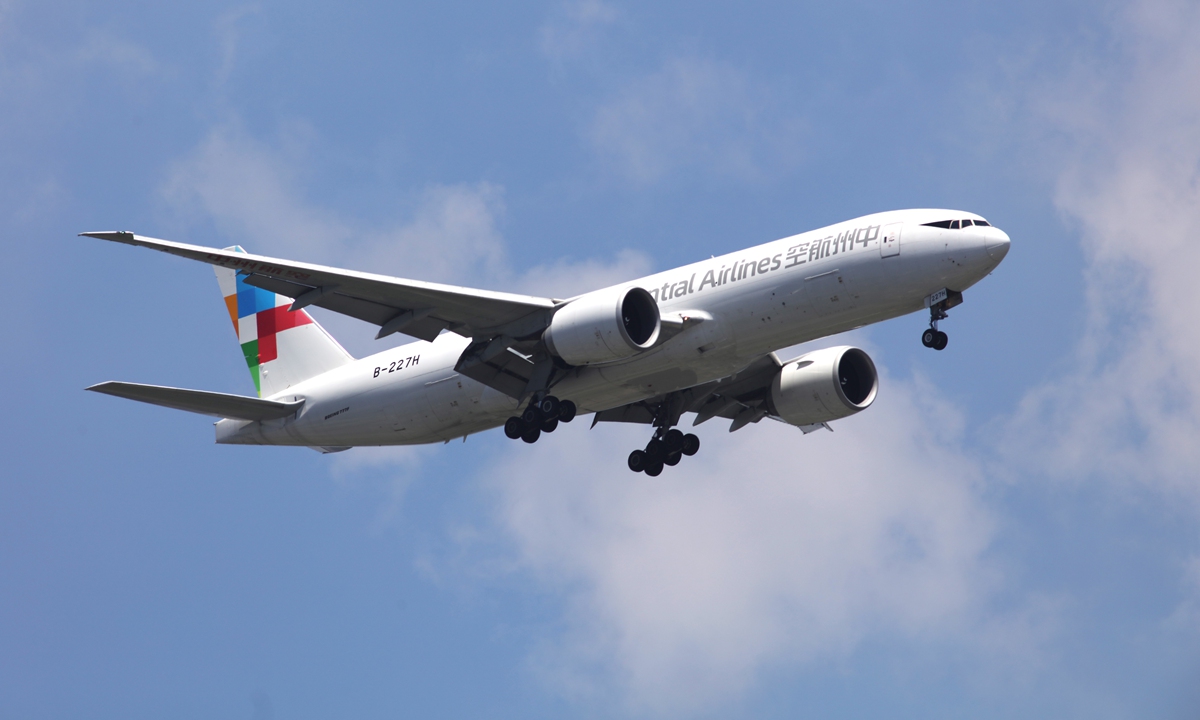
A Central Airlines Boeing 777-200LRF freighter approaches Shanghai Hongqiao International Airport on July 29, 2026. Photo: VCG
US-based Mammoth Freighters decided to establish China's first Boeing 777 wide-body passenger-to-freighter conversion production line in Qingdao, East China's Shandong Province, making the city the world's third and the Asia-Pacific's only Boeing 777 conversion hub.
A Chinese expert said that the arrangement reflects the latest win-win outcome between China and the US in the aviation sector, which will help Mammoth expand in the Asia-Pacific market and improve its global production layout, while also providing an important opportunity for China's aviation maintenance industry to enhance its full industrial chain.
According to the Shandong Provincial Department of Transportation on Tuesday, the Texas-based company reached a strategic partnership with Taikoo (Shandong) Aircraft Engineering Co to establish two P2F conversion lines in Qingdao, with the first scheduled to begin operations in September this year and the second expected to come online in 2027.
The conversion line will effectively fill a technological gap in China's aviation maintenance industry. It will also complete the full industrial chain in Shandong — ranging from aircraft maintenance and conversion to cargo operations and support — providing strong backing for the high-quality development of the province's aviation maintenance sector, the department noted.
Mammoth Freighters is a specialized company focused on the design and development of wide-body P2F conversions. According to the company's plan, it will operate a total of nine P2F conversion lines worldwide: five in Fort Worth, Texas; two in Manchester, the UK; and two in Qingdao.
Global air cargo capacity is undergoing accelerated upgrades, driving concentrated demand for wide-body freighter conversions. Compared with newly manufactured freighters, P2F conversions offer decisive advantages. A brand-new Boeing 777 freighter has a list price exceeding $185 million and a delivery lead time of approximately three to five years, whereas a converted freighter costs only about half as much and can be delivered in as little as six months. This makes P2F conversion the most economical and efficient way for global air cargo operators to expand capacity at present.
"By placing its only Asia-Pacific production capacity in Qingdao, the US company has demonstrated its trust in the Chinese market and China's wide-body aircraft conversion capabilities," Wang Ya'nan, editor-in-chief of Beijing-based Aerospace Knowledge magazine, told the Global Times on Tuesday.
Wang noted that the conversion line requires sufficient industrial and technological support, the ability to recruit qualified technical personnel, and the capacity to meet cost and operational requirements. China's overall manufacturing strength has already reached the corresponding level.
Some specialized parts and components may be considered for production in China in the future, in order to ensure supply-chain stability and economic efficiency. China's strong industrial manufacturing capability can support the production of these components, and locating the supply chain in China can maintain stable operations and high efficiency, Wang added.
For China, the new cooperation allows observation of and learning about the wide-body aircraft conversion process, production-line operational experience, and market performance, while also accumulating experience for the development of a large-aircraft family and freighter conversions. "Therefore, this is a mutually beneficial and rational outcome for both sides," the expert said.
RELATED ARTICLES