Photo released on August 9, 2026 shows tourists from Jamaica interacting with a humanoid robot at the world's first robot 6S store in Longgang District, Shenzhen, South China's Guangdong Province, on August 4. Photo: Xinhua
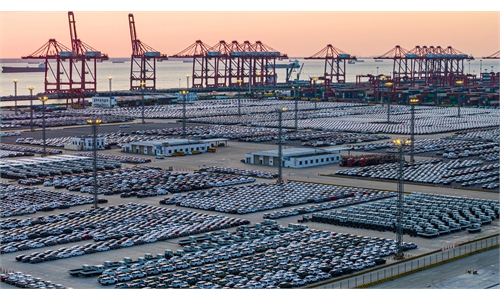
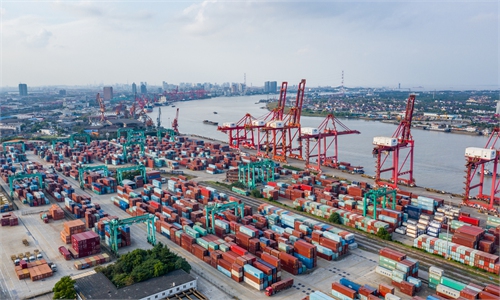
The foreign trade of South China's Guangdong Province, the country's manufacturing and transportation hub, stood at 6.49 trillion yuan ($960 billion) in the first seven months of the year, rising 20.5 percent year-on-year and accounting for 21.6 percent of China's total foreign trade, according to the Guangdong branch of the General Administration of Customs.Guangdong accounted for 24.9 percent of the country's foreign trade growth, with its trade remaining the largest among all provincial-level regions.
Guangdong's exports and imports both recorded double-digit growth in the first seven months of the year.
One highlight from the latest customs data was Guangdong's strong trade performance in high-tech manufacturing, including the "new three" products.
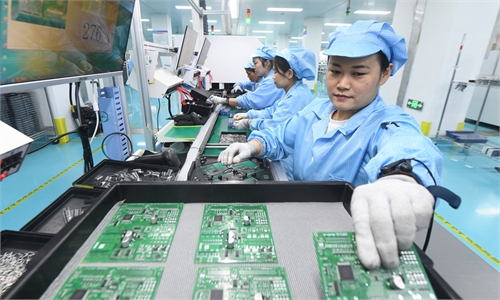
In the first seven months, Guangdong exported 2.68 trillion yuan worth of mechanical and electrical products, up 15.1 percent year-on-year, with their share of total exports rising 2.6 percentage points to 70.5 percent, according to the customs data.
Integrated circuits stood out, with exports reaching 320.09 billion yuan, up 58 percent year-on-year.
Exports of high-tech and emerging products also showed robust growth, with lithium battery exports growing 40.3 percent year-on-year, electric vehicle exports rising 29.8 percent, drone exports increasing 23.7 percent, and 3D printer exports surging 120 percent.
Despite a complex global trade environment, Guangdong saw robust foreign trade growth in the first seven months, reflecting the resilience of the region's complete industrial and supply chains and strong manufacturing base, Hu Qimu, a professor at the Maritime Silk Road Institute of Huaqiao University, told the Global Times on Wednesday.
Moreover, the rapid export growth of high-tech and emerging products showed that the province's trade structure has been shifting from labor-intensive to more technology-intensive and higher-value-added products, with industrial upgrading translating into new export competitiveness, Hu said.
On the import side, robust production and consumption continued to drive demand, with imports maintaining relatively rapid growth for five consecutive months. In July alone, Guangdong's imports reached 423.46 billion yuan, up 40.7 percent year-on-year, marking the fifth straight month of growth above 30 percent
Driven by strong demand from the AI supply chain, Guangdong imported 1.07 trillion yuan worth of integrated circuits in the first seven months, up 48.6 percent year-on-year and accounting for 39.6 percent of the province's total imports.
It wasn't just the export sector that performed strongly. The customs data shows that there was much faster growth in imports than exports, which Hu said reflected active manufacturing and industrial chain demand in Guangdong.
"With the rapid development of the global artificial intelligence industry and continued overseas restocking, Guangdong's competitive industries, including electronics and semiconductors, are expected to benefit further," the expert said.
ASEAN remained Guangdong's largest trading partner, with bilateral trade reaching 1.02 trillion yuan, up 14.2 percent year-on-year. Trade with South Korea grew 44.3 percent, while trade with Africa rose 19.8 percent, India 16.5 percent and Australia 33.2 percent, according to customs data.
The rapid growth in Guangdong's trade with a wider range of markets reflected the increasing diversification of its trading partners, said Hu, noting that "as trade protectionism and barriers rise in the world, a more diversified market presence can help reduce external risks and strengthen the resilience and growth potential of Guangdong's and China's foreign trade."
RELATED ARTICLES