Decaying US Pacific military facilities, carrier staff mental health woes expose Washington’s ambitions outstripping capacity: Chinese expert
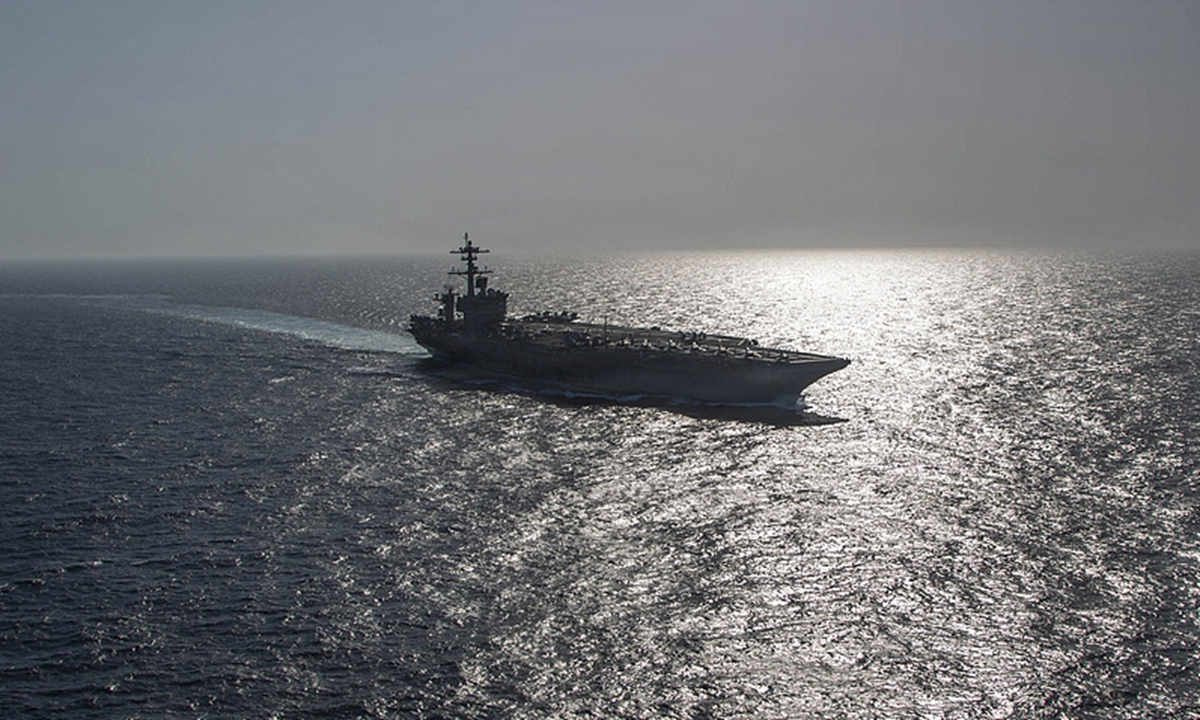
This US Navy handout photo released on May 12, 2026, by US Central Command Public Affairs shows the Nimitz-class aircraft carrier USS Abraham Lincoln sailing in the Arabian Sea on May 8, 2026. Photo: VCG
From recent reports on corroding buildings and falling ceilings at US military facilities across the Pacific to an intensifying mental health crisis aboard the USS Abraham Lincoln, a Chinese military affair expert observed that behind this situation lie US strategic ambitions that have outpaced Washington's capacity to sustain its force structure, contributing to mounting problems across the US military.According to a Bloomberg report on Thursday, the Pentagon inspector general warned that US military facilities across the Pacific are in a worrying state of decay.
Corrosion and holes in buildings, falling ceilings and the presence of mold and asbestos were among the problems identified through inspections of 11 US facilities across the region and relayed to a dozen senior Defense Department officials in an emergency management advisory this month, per the report.
In the advisory, the inspector general "identified concerns related to other critical infrastructure, such as water and housing infrastructure, supporting missions" across the US Pacific Command. Although the water and housing infrastructure is not directly related to "mission critical" combat capabilities, "it is critical to support" servicemembers in the region, Bloomberg reported.
Unnamed Pentagon officials explained the "severe degradation" by noting that "many of the buildings date back to the 1970s" and citing environmental conditions such as earthquakes and tsunamis, as well as personnel and funding shortages, according to the report.
At the same time, another Bloomberg report on Wednesday noted that military families and members of Congress are sounding the alarm about an intensifying mental health crisis onboard the USS Abraham Lincoln, as its 5,000 sailors and marines endure a record-breaking deployment at sea tied to the war with Iran.
The US military newspaper, Stars and Stripes, reported on August 11 that family members and sailors said months at sea with "no end in sight" to a grueling Middle East deployment have intensified worries about mental health and the risk of self harm aboard the USS Abraham Lincoln.
Interviews with active duty sailors and family members, along with dozens of public social media comments and posts by crew members, describe sailors struggling with exhaustion and declining morale, including reports of suicidal thoughts and at least one instance in which a crew member was prevented from jumping overboard.
The concerns come during an unusually demanding deployment - Lincoln sailors have supported 40 days of continuous combat operations in the US 5th Fleet area of operations and logged 250 consecutive days at sea, according to Navy officials.
The report cited a case in which a spouse tearfully told officials that she received a message from her husband saying "he hopes he doesn't wake up tomorrow."
With the US defense budget stretched across multiple areas, funding for facility upgrades and modernization remains limited, while the high operational tempo of these facilities has also contributed to their deterioration, Song Zhongping, a Chinese military affairs expert, told the Global Times.
The same issue applies to aircraft carriers. US aircraft carrier crews often spend extended periods at sea to maintain the US' global deployment strategy, leading to intense operational demands and contributing to a range of psychological and personnel-related problems, Song noted.
The expert further said that the US lacks the resources to replace aging carriers with new ones at the pace required by that strategy, placing additional strain on both the fleet and its crews.
In April, there was a flurry of public criticism over dire conditions onboard the carrier. Photos emerged of poor-quality and rationed food, and there were reports of water shortages, moldy showers and broken laundry machines, according to Bloomberg.
"The situation reflects a broader structural problem that the US pursues a global military strategy that exceeds its available resources. Its strategic ambitions have outpaced its capacity to sustain the force structure required to support them, contributing to mounting problems across the US military," Song added.
RELATED ARTICLES