ARTS / CULTURE & LEISURE
Deep respect for study and fair access to education give grassroots youth chance to rise
Faith in learning


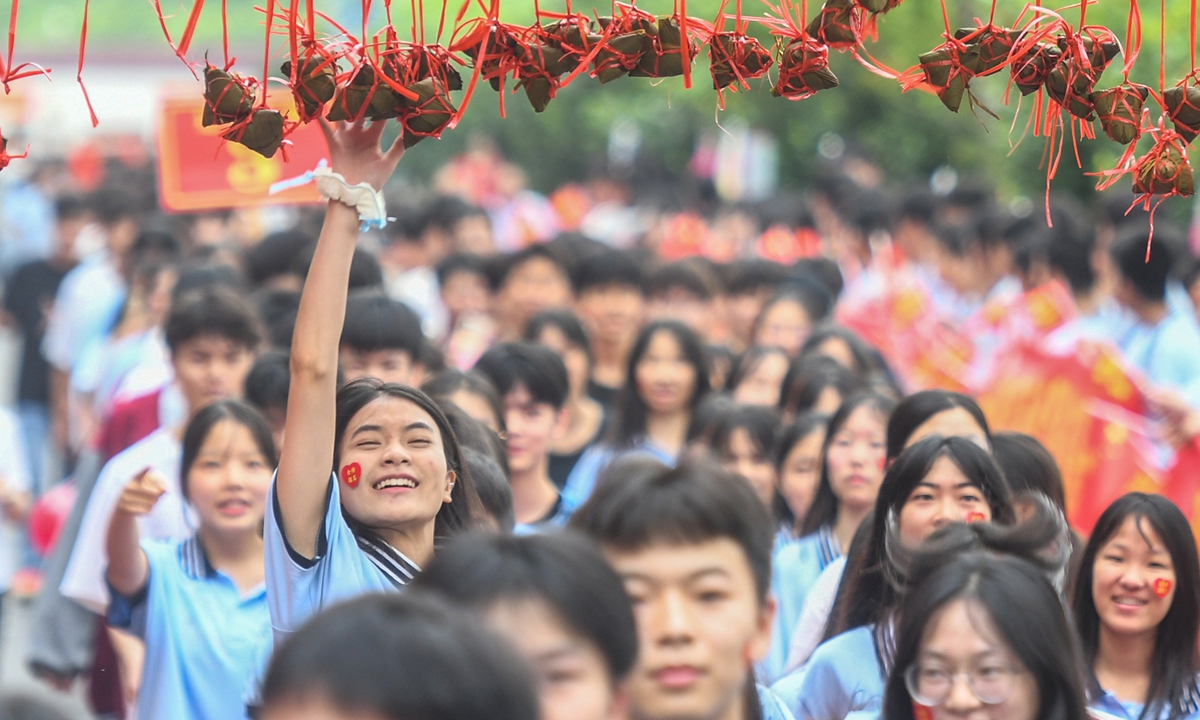
A student touches zongzi, symbolizing "success in the gaokao" in Yongzhou, Central China's Hunan Province. Photo: VCG
When Li Yanbin's 18-year-old daughter Li Yutong was admitted to Peking University's Chinese language and literature program through this year's gaokao, the national college entrance exam, her village in Jieyang, South China's Guangdong Province threw open the heavy middle gate of its ancestral hall - an entrance ordinarily locked and reserved for only the most momentous clan events - and welcomed her with pounding drums, leaping lions and a ceremony.
Meanwhile, in a village in Pingdingshan, Central China's Henan Province, a farmer's courtyard had no drums or red carpet, only 28 award certificates pasted on weathered walls, telling another story of chasing dreams at China's top universities. After receiving her admission letter to study medicine at Tsinghua University this year, Han Yaping stepped into the spotlight, showing people the determination to break through and change fate that lies within her family's humble home.
They are only two of thousands of new admissions to the top universities this year. Both come from ordinary backgrounds, and both have gained entry to China's most prestigious universities, raising one question for today: How is the long tradition of valuing education in China still vibrant?
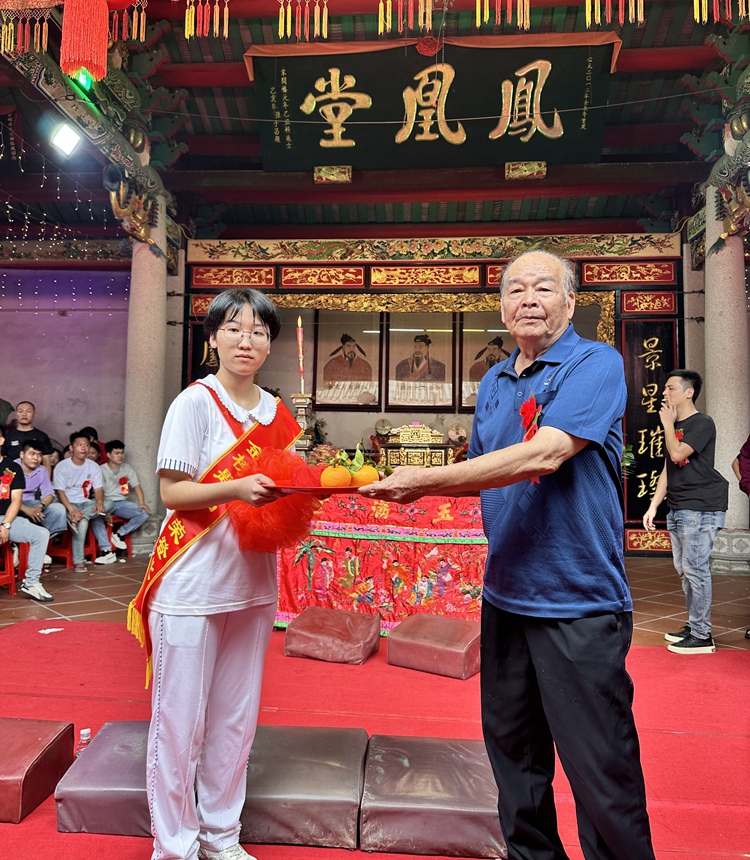
An elder clansman presents Li Yutong with a clan scholarship in recognition of her admission to Peking University in Jieyang, South China's Guangdong Province, on July 20, 2026. Photo: Courtesy of Li Yanbin
Family faith
Escorted by two national-level intangible cultural heritage troupes - a Chaozhou big drum and gong ensemble and a Jieyang green lion dance team - Li, draped in a red "Golden Title" sash, was led along a red carpet into the hall. Clan elders lit incense, bowed and read a memorial to the ancestors, formally reporting the good news. The rite lasted nearly two hours, and a plaque reading "Scholarly Family" was later carried to Li's home.
What moved her father most was that the main door of the ancestral hall, usually kept tightly shut, was opened for his daughter at that special moment. "Our ancestral hall has three doors. The main door is never used by clan members in daily life and is only opened for important celebrations," he told the Global Times. During the ritual, offerings were fully prepared, and people of all ages from the clan stood solemnly, burned incense, bowed in respect, and recited a special prayer written for this occasion to inform their ancestors of Li Yutong's admission.
For local clans, admission to one of China's top universities is regarded as a modern echo of ancient imperial examination glory, an honor that brings prestige to one's ancestors and unites the entire lineage.
This emphasis on education goes far beyond ceremonial celebrations. According to Li Yanbin, nearly every village in the area has organizations such as education foundations or societies supported by respected elders and local businesspeople, creating a systematic scholarship and financial aid system. His daughter, for example, was rewarded whenever she returned home with outstanding exam results, from primary school through high school.
Li Yanbin said that what was more important than the material rewards was the encouragement and inheritance of spirit his daughter received. "Those respected elders from the village who went out into the world know the hardships of lacking education. They established scholarships not just to reward children, but to pass down the value of learning from generation to generation," he said.
Chen Haizhong, a cultural scholar from the Chaoshan region, sees the tradition anchored in the core Chinese values of loyalty, filial piety and righteousness. "Clan activities constantly educate the young to love the nation, their hometown and their family. Those with greater ability go out to serve the country; those of ordinary ability serve their villages. This is the simplest, most universal aspiration of ordinary Chinese people," he told the Global Times.
Bedrock of social fairness
The celebration prepared for Li's daughter was a way to let local children see that ordinary people can go far with knowledge. Still, this belief needs strong support from reality. If children from poorer families couldn't change their lives through education, the village's faith in the power of learning would lose its foundation.
Zhang Yiwu, a professor at Peking University, told the Global Times that, unlike in some countries where students take on big loans and heavy financial pressure to go to university, China has a comprehensive financial aid system with both government support and traditional emphasis on education. Even students from poorer families can get support, and those admitted to top universities receive extra help. This system is a positive force that ensures no student is left behind and guarantees fairness at the start of education, he said.
The story of Han Yaping, a new Tsinghua University student from Henan Province, shows that Chinese education sets no limits on background: Ordinary students who work hard will see results.
According to media reports, Han's mother suffers from severe arthritis and her father supports the family of four through farming and odd jobs. The family can offer little material help, and Han never attended any tutoring classes. Because of her family's situation, the school waived all her fees from junior high through high school. The village arranged government aid for the family, and Han earned scholarships with her top grades, handing every award to her parents to support the family.
Zhang noted that cases like Han's prove knowledge truly can change lives in China. A humble family is no longer a roadblock to learning, and the gaokao acts as an anchor of fairness, putting all students on the same starting line regardless of wealth. This kind of fairness is at the heart of a modern society and gives ordinary young people a real chance to shape their own future through effort.
The journeys of these two girls in different parts of China show two aspects of today's education system, experts said. On one side, the villages see educational success as a point of collective pride for millennia; on the other, countless young people from modest homes work hard to break through, proving that education remains an open and fair path for ordinary people to move up in life.
RELATED ARTICLES