ARTS / CULTURE & LEISURE
APEC authors seek to bring Guangdong’s live stories to the world
Immersive writing
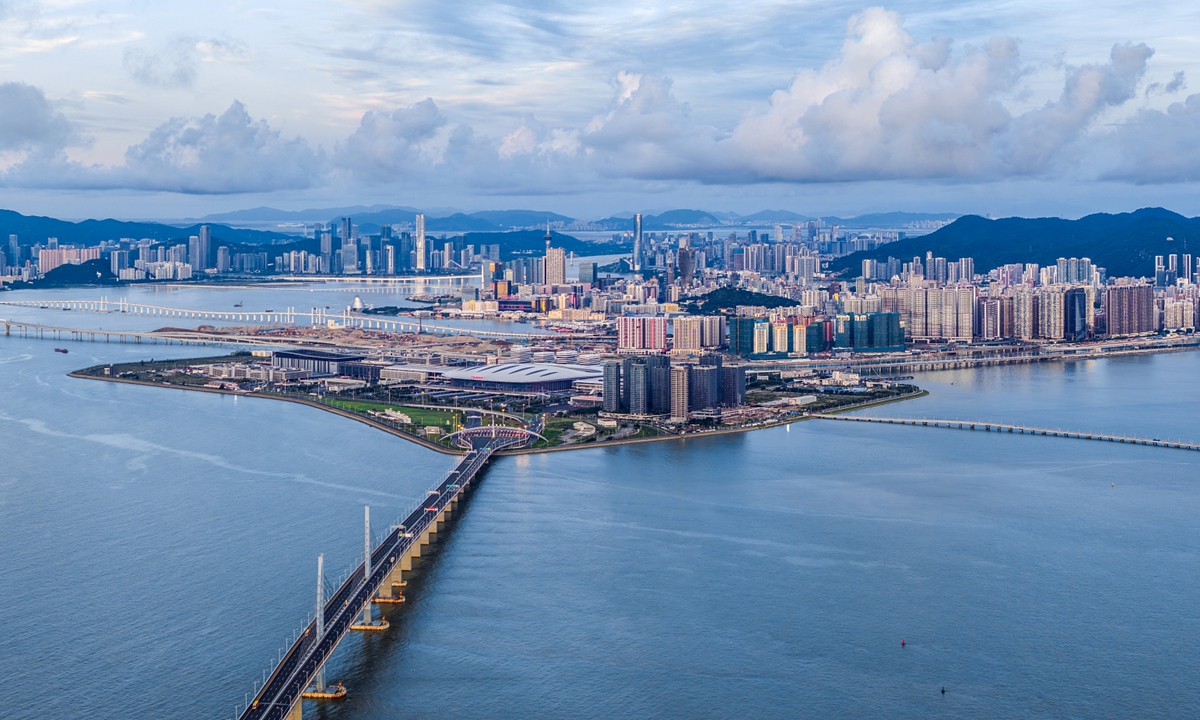
Zhuhai city in South China's Guangdong Province Photos: VCG
Speaking to the Global Times, Mexican poet Manuel Becerra said that he felt it was a form of poetic justice that a delivery rider had recently won one of China's highest literary awards.
Becerra is one of the seven writers from six APEC member economies currently taking part in the "2026 Global Writers in Guangdong Program" held in South China's Guangdong Province.
Organized by the Guangdong Provincial Writers' Association (GPWA), the program is one of the literary events held during the 2026 APEC "China Year," Xiang Xin, Party secretary of the GPWA, told the Global Times.
The program represents a two way engagement through which Chinese and foreign writers implement the Global Civilization Initiative with literature as the bridge. It is also an innovation-driven journey focused on literary creation, exploring open-ended narratives and internationally inflected expressions to write stories about Guangdong Province and China in general, Xiang said.
As the heartland of Lingnan culture, the birthplace of the Maritime Silk Road, and a pioneer of China's reform and opening-up, Guangdong is a rich literary treasure trove with vast potential for exploration, development, and creative transformation, Xiang said.
From Tangjiawan ancient town to the Hong Kong-Zhuhai-Macao Bridge, the international writers are on an immersive two-month tour that will take them to Guangdong's Shenzhen, Zhongshan, Jiangmen and Guangzhou to explore local Lingnan culture and draw inspiration for their literary creations. Lion dances, Guangzhou embroidery, Cantonese Opera, and Canton porcelain are some of the most representative Lingnan cultural symbols.
Drawing on their experiences from the tour, the seven writers will produce original literary works centered on the province, contributing to people-to-people exchanges during the APEC China Year and offering the world a richer, more multifaceted portrait of the province, according to GPWA.
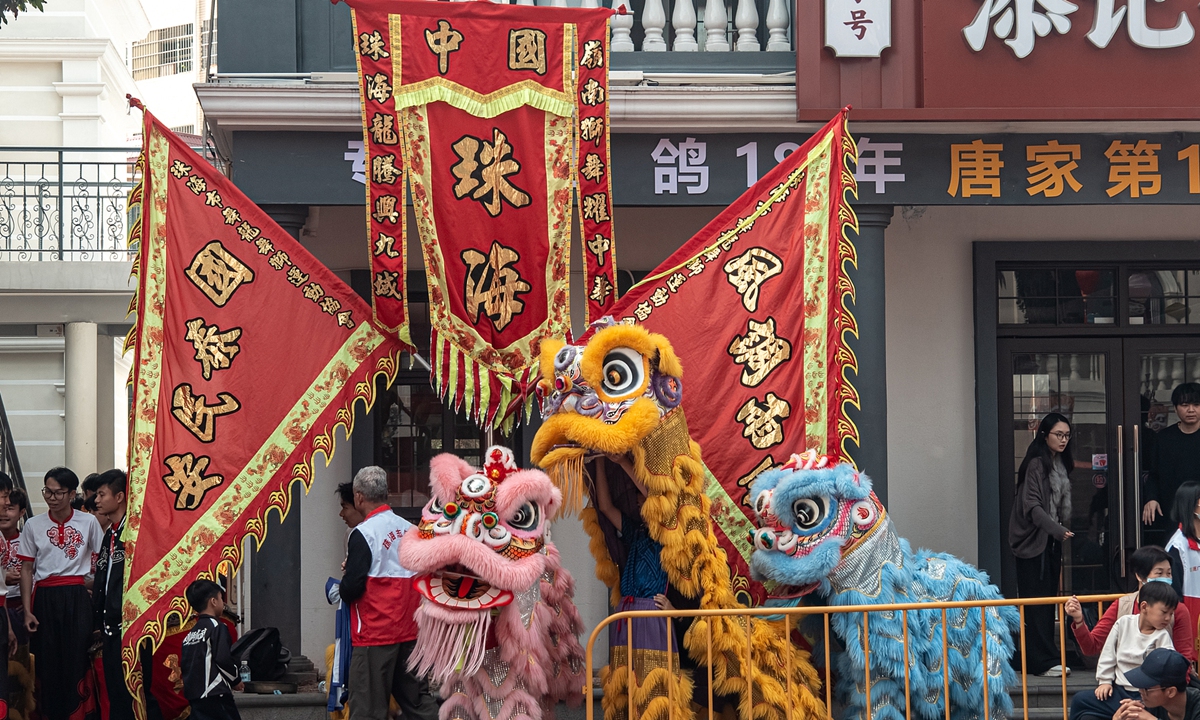
A lion dance is performed at Tangjiawan ancient town in Guangdong Province.
Like finding gold
Kicking off their tour in Shenzhen, the writers were amazed to learn about the city's transformation from a small fishing village into a modern international metropolis in just four decades. They were impressed by both the skyscrapers and the numerous delivery riders moving up and down the streets.
The delivery rider Becerra mentioned is 56-year-old Wang Jibing, who is known affectionately as the "delivery poet" from East China's Jiangsu Province. Wang won the 9th Lu Xun Literature Prize for his poetry collection Dichu Feixing (Low Flight) in July.
Becerra noted that immigrants from other provinces have been instrumental in shaping Shenzhen's unique identity.
"Shenzhen is a city shaped by immigrants, and I believe that migration enriches a country's culture. It creates an invaluable exchange of knowledge and personal experiences. We can look at border literature and countries where these phenomena take place. The most interesting books often come from immigrant communities," he said.
The Mexican poet said that walking through the streets of Shenzhen is like finding gold. "For writers, it is essential to remain attentive to 'certain signs' that emerge in ordinary life and to unexpected situations. As reality is filled with these 'certain signs,' it is necessary to cultivate an 'education of the gaze.'"
Peruvian poet Gian Pierre Codarlupo struck a similar tone.
"I hope to discover small stories, those of ordinary people, and to see the landscapes, to immerse myself in them. I'm interested in contemporary Chinese poetry, in addition to classical poetry. I would be delighted if this journey opened doors for future collaborations," Codarlupo told the Global Times.
The writers got an artistic view of Lingnan culture through artworks by local painters Su Hua and Lin Yong at the He Xiangning Art Museum in Shenzhen. The two are an iconic artist couple in contemporary Lingnan painting.
Becerra said what caught his attention, beyond their obvious artistic skill, was a sense of uniqueness, something new.
"I write about everything I can observe, experience and feel. Now I'm living in a country unlike any I have known before - one that, in fact, remains little explored first-hand by many people from other countries. I have stood before streets, buildings, museums, everyday scenes and events that have moved me almost to tears. As the painter Lin Yong once said, 'Here, I have cried and I have laughed,'" said Becerra.
Creative overflow
Peruvian poet Codarlupo said that his experience in Guangdong is already influencing his work and he wants to be a bridge between China and Latin America.
"I have been writing poems about what I have been able to observe. So far, I have completed four articles on Lin Yong, Su Hua and the Lingnan culture. All the landscapes I have seen will appear in my work. I am overflowing with creative inspiration," he noted.
Both writers expressed a desire to translate Chinese poetry, helping bring the voices of contemporary Chinese poets to Western readers.
"I hope that people from abroad can approach Lingnan culture through poetry and art, and that they will not see Shenzhen merely as a technological city, but go beyond that," said the Peruvian writer.
Taking Mexican author Octavio Paz, who won the 1990 Nobel Prize in Literature, as an example, Becerra said that cultural exchange can inspire profound literary creation.
Thanks to his stay in India, Octavio Paz wrote one of the most fascinating Spanish works: The Monkey Grammarian. That was made possible through cultural exchange, he said.
"What I have experienced has naturally had an impact on me as a poet. If something transforms an individual, there is also the possibility that it will, as a consequence, transform their society. I hope people can see Guangdong that I experienced, as if it were a film whose full appreciation requires the use of all five senses," Becerra said.
RELATED ARTICLES