US' 100% tariffs on imported drones largely targeting China lay bare its protectionism, disrupt global supply chain, backfire on own consumers: experts
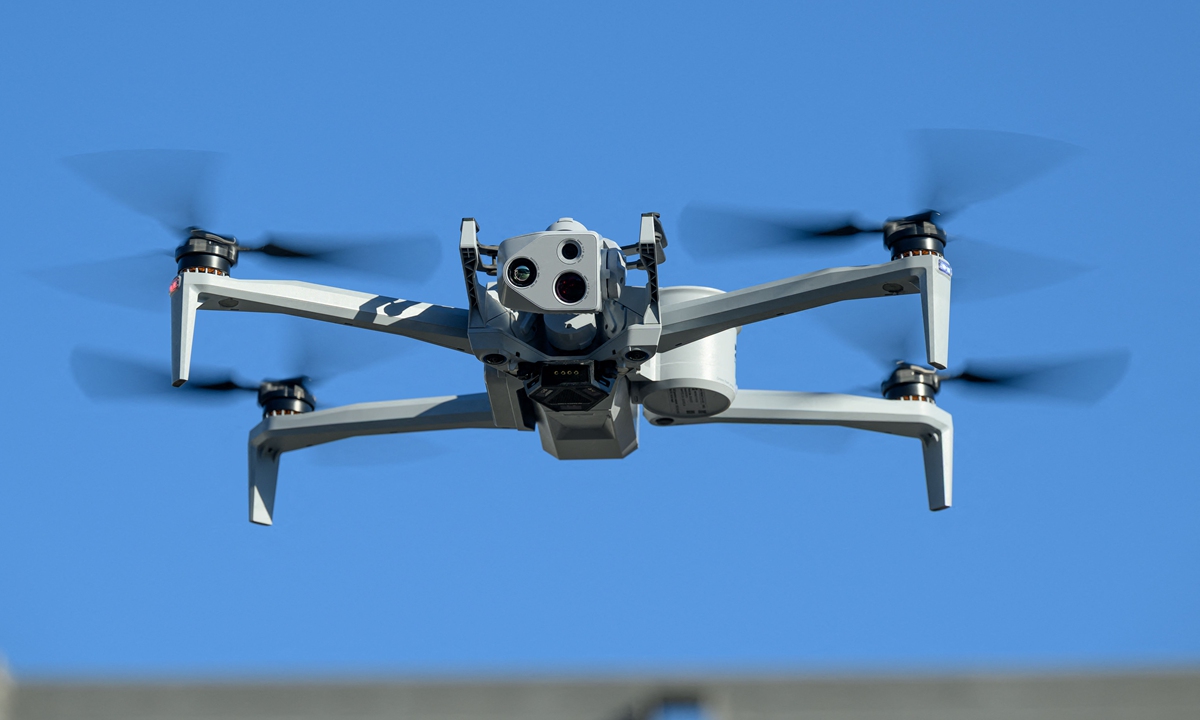
The Skydio X10 drone flies in Hayward, California, US on June 12, 2026. Photo: VCG
The US on Thursday imposed sweeping tariffs of up to 100 percent on imported drones and related components, a move Chinese experts said marks Washington's latest attempt to turn industrial competition into protectionism in the name of so-called national security, while using differentiated tariffs to disrupt global supply chains.
Although broadly applied, the tariffs are likely to fall most on Chinese suppliers given China's market dominance, experts said. Yet they cautioned that Washington may find it difficult to achieve rapid substitution, while higher tariffs could instead raise costs for US businesses and other drone users.
The steepest 100-percent tariff will hit larger drones weighing more than 25 kilograms, thermal-imaging models, docking stations and some critical components, while most smaller drones will face a 25-percent levy, according to a White House fact sheet. The tariffs, imposed under Section 232, will largely take effect on September 3.
Washington carved out lower rates for selected allies and partners: qualifying products from the EU, Japan, South Korea, Switzerland, Liechtenstein and China's Taiwan region will face tariffs capped at 15 percent, and those from the UK at 10 percent, provided key hardware, software and technology are sourced from those economies or the US.
It further framed the move as a way to reduce reliance on foreign drone supply chains, citing dependence on imported motors, electronic speed controllers, lithium-ion batteries and docking stations, while launching an "onshoring program" to encourage more drone and component production in the US.
Section 232 differs from Section 301 measures in that it generally targets products horizontally rather than being inherently country-specific, while allowing exemptions or differentiated treatment for particular trading partners, said Zhou Mi, a senior research fellow at the Chinese Academy of International Trade and Economic Cooperation.
"A measure formally applied across multiple trading partners does not necessarily have an evenly distributed impact," Zhou told the Global Times.
In practice, Chinese companies are likely to be among the hardest hit, given their large share of the global drone market, strong presence in the US market and overall competitiveness, Zhou added.
According to AUVSI, a US drone industry group, Chinese companies dominate key segments of the US market, including consumer, enterprise and first-responder drones. DJI alone supplies more than half of US commercial drones, Reuters reported, while earlier restrictions have also targeted DJI and Autel.
The Financial Times on Friday described the latest measures as tariffs "targeting Chinese drone technology" and saying they were intended to reduce US dependence on Chinese drone technology.
The combination of steep tariffs on key product categories and significantly lower rates for selected allies points to a broader US effort to not only curb imports, but also reshape supply chains, Huo Jianguo, former head of the Chinese Academy of International Trade and Economic Cooperation under the Ministry of Commerce, told the Global Times on Friday.
Larger drones and specialized models are widely used in agriculture, surveying and emergency response - sectors where the US is seeking to preserve space for domestic producers and retain key capabilities, Zhou said.
The tariff structure reflects Washington's increasingly protectionist trade approach, with differentiated treatment driven more by strategic interests than by multilateral trade rules, according to Huo.
The WTO has previously ruled against US use of Section 232 tariffs. In a 2022 dispute brought by China over steel and aluminum duties, a WTO panel found the US measures inconsistent with US obligations on bound tariff rates and most-favored-nation treatment, after concluding that they were not imposed "in time of war or other emergency in international relations."
The precedent shows that invoking national security does not give the US a free hand to impose tariffs, and such measures can still be challenged under WTO rules, Chinese experts said.
The latest move builds on earlier US restrictions that have increasingly tightened access for Chinese drone makers. In December, the Federal Communications Commission banned imports of Chinese drones by saying it would stop providing wireless communications approval for ones from adversary nations.
Global supply chains, built over years of specialization, cannot be rapidly reconstructed through tariff barriers. While the US retains strengths in some technologies and core components, drone manufacturing also depends on large-scale production capacity, batteries and an extensive network of supporting suppliers, Huo said.
Zhou said the tariffs risk disrupting established global supply chains rather than simply bringing production back to the US. "That could shift part of the tariff burden onto the US market. Chinese suppliers may raise prices or absorb some of the cost through lower margins, while US buyers could ultimately pay more where comparable alternatives are limited."
In its latest response involving US drone restrictions on August 5, China's Ministry of Commerce accused Washington of "generalizing the concept of national security" and repeatedly imposing restrictive measures targeting Chinese sectors including drones, saying China strongly opposed such moves.
China urges the US to immediately stop its wrongful practices, and return to the right track of resolving differences through friendly consultation and cooperation, according to the ministry.
RELATED ARTICLES