Heavy R&D investment, strong policy support, and global cooperation drive rapid growth of China's innovative drug industry
By Published: Aug 14, 2026 06:02 PM

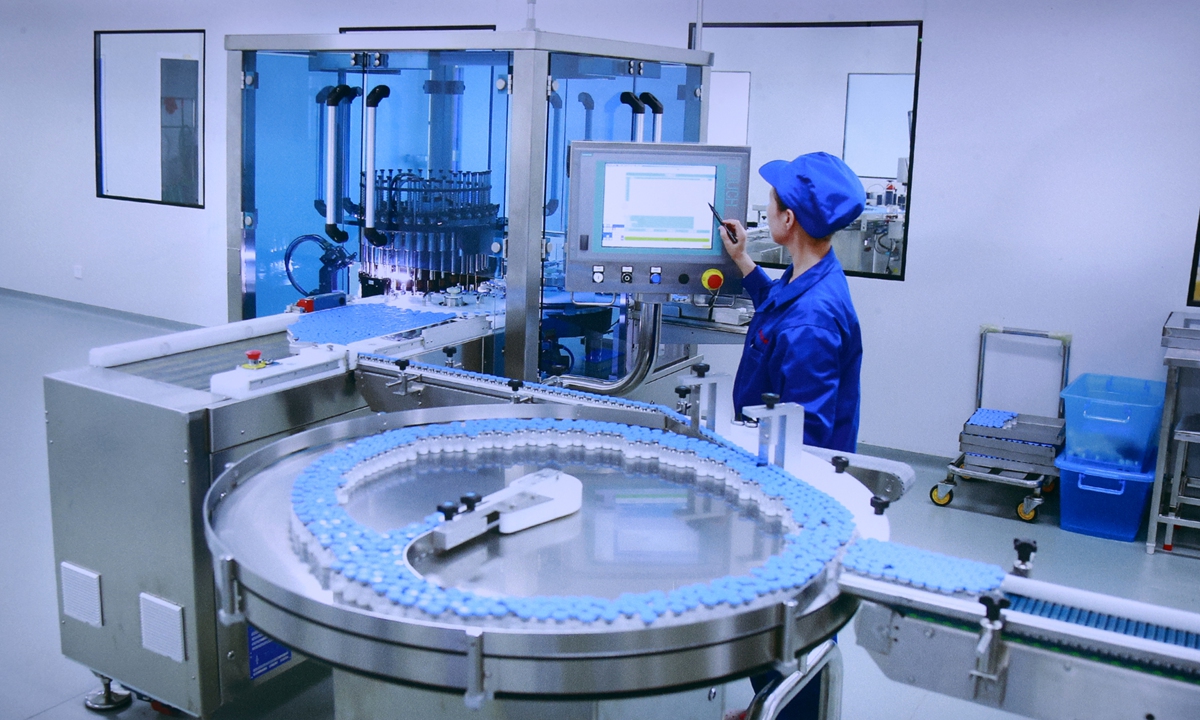
A worker operates a machine at a pharmaceutical company in Yanji, Northeast China's Jilin Province on August 11, 2026. Photo: VCG
"In the past, Chinese people used to believe that imported drugs were better than domestically made. Now, European and American markets are pinning hope on Chinese innovative drugs to cure their patients," said Liu Daogang, Party chief of the Tianjin International Joint Academy of Biotechnology & Medicine, commenting on a tectonic shift in how people around the world view Chinese-made drugs.
"This represents the emergence of Chinese innovative drugs after years of development, reflecting the advantages of China's national system and R&D strength, which marked the arrival of a 'DeepSeek moment' for China-made biopharmaceuticals," Liu told the Global Times on Friday. His institution has helped incubate listed companies such as CanSino Biotech and Danna Biotech.
In recent years, China's innovative pharmaceutical sector has gained global influence, with outbound technology licensing transactions reaching $110 billion in the first six months of 2026. In the first half, Chinese companies signed 81 outbound licensing agreements for innovative drugs with partners in 20 countries and regions, including the US, Britain, France and Italy. The total deal value reached 80 percent of the full-year figure for 2025.
China's innovative pharmaceutical sector has reached its "DeepSeek moment," the point at which years of sustained investment in infrastructure and regulatory framework are beginning to deliver tangible breakthroughs, industry insiders told the Global Times.
The global expansion of Chinese pharmaceutical companies has moved from the shallow waters of "product going global" to the deep waters of "value co-creation," while the rapid progress of Chinese innovative drugs is delivering new solutions to patients around the world, the insiders said.
Chinese innovation
Multinationals have in recent years stepped up cooperation with Chinese drug-makers, with some leading figures in the industry acknowledging that China has evolved from a "follower" into a "source" of original biopharmaceutical innovation.
Lan Gongtao, an official with the National Medical Products Administration (NMPA), said in January that China's outbound licensing transaction value in 2025 doubled from the previous year, while the number of approved innovative drugs also hit a record high, as a result of deepening drug review and approval reforms and the government's pro-innovation policies, the CCTV News reported.
While the number of innovative drugs has grown, China has maintained high standards aligned with international norms, and the surge in outbound licensing reflected international recognition of the value of Chinese innovative drugs, Lan said.
Jin Lei, founder and chief scientist of GeneScience Pharmaceutical Co Ltd, said that as more Chinese products and services are exported to other parts of the world, quality drugs from China are set to benefit more patients globally.
In 2025, GenSci signed its first overseas business development licensing deal worth up to $1.365 billion. The candidate is designed to directly disrupt the central mechanism of both Graves' disease (GD) and thyroid eye disease (TED), and GenSci's breakthrough offers hope to tens of millions of patients worldwide. "This is a direct response of Chinese wisdom," said Jin.
According to a post seen on the company's website, it recorded a three-year average growth rate of 164 percent in the global market, while its overseas revenue exceeded 100 million yuan, with its products reaching nearly 40 markets in Latin America, Southeast Asia, Middle East and North Africa. This significantly improves access to high-quality Chinese biologics, while providing advanced treatment options at affordable costs, improving local health conditions, Jin said.
According to Pharmcube, a pharmaceutical industry consultancy, China surpassed the US in the number of original drugs developed between 2015 and 2024, cementing its place among the world's leading innovators in pharmaceuticals, Xinhua News Agency reported. During that decade, the cumulative value of overseas licensing deals involving Chinese innovative drugs exceeded $1.2 trillion. Eighteen China-developed original medicines were approved abroad, with several outperforming foreign origin drugs in head-to-head clinical trials.
'Made in China' strength
These results highlight the transformation of China's pharmaceutical sector, which was once dominated by generic and imitative medicines.
China's domestic pharmaceutical industry is gradually moving away from imitative drug development, forming a new landscape in which artificial intelligence (AI) empowers front-end research and development (R&D), local enterprises drive independent innovation, and high-quality products reach global markets, demonstrating the vitality of new quality productive forces, analysts said.
In a sense, the success of Chinese innovative drugs is an extension of the success of China's overall manufacturing sector.
Policy support has played its role too. In the country's outline of the 15th Five-Year Plan (2026-2030), the government designated the biopharmaceutical industry as a strategic development sector.
Noting the progress achieved by China's innovative drugs in recent years, Liu said China has moved from following to running alongside the world's most advanced drugmakers, while taking the lead in some areas.
Regulators have continuously optimized policies and aligned with international standards to establish review and inspection systems with Chinese characteristics, greatly shortening approval timelines, Liu said.
Moreover, China's large population creates strong demand for treatments for complex and chronic diseases, laying a foundation for innovative drug R&D. Emerging technologies such as AI and supercomputing have strengthened the biopharma industry, enabling Chinese companies to catch up with and even surpass their European and American counterparts in the race to develop new drugs, Liu said.
Samuel Zhang, CBO of Suzhou-based biopharmaceutical company Innovent Biologics, told the Global Times on Thursday that the accelerated global expansion of Chinese innovative drugs is linked to new business models that emphasize co-development and benefit-sharing.
In 2025, Innovent Biologics inked several major deals with global pharmaceutical giants, involving deeper and more reciprocal cooperation, including co-development and co-commercialization in overseas markets.
"For instance, in May, in a partnership with a leading US pharmaceutical company, we agreed to engage in co-developing some of the key projects globally, and share the risks together. If the endeavor is proved successful, we will share the profits," Zhang said.
This new collaboration model has set a benchmark for the high-quality global expansion of Chinese innovative drugs and Chinese pharmaceutical companies, significantly enhancing their global influence, Zhang said.
Liu noted that another advantage comes from China's approach to drug pipeline development. At the national level, the government issues annual guidelines on major new drug development, which help chart the direction for drug research and development.
Strengthened regulatory oversight has also played an important role. China's drug regulatory system reform, launched in 2015, has introduced fast-track pathways for a set of breakthrough therapies, conditional approvals, and priority reviews, effectively shortening timelines across the drug development cycle.
"In recent years, the national guidance has focused on curing a series of complex chronic diseases, including infectious diseases, cardiovascular and cerebrovascular diseases. Such top-level design helps pharmaceutical companies avoid detours and stay on target," Liu said.
RELATED ARTICLES