South China's Guangdong launches first 'token loan' as Chinese localities bolster support for token economy
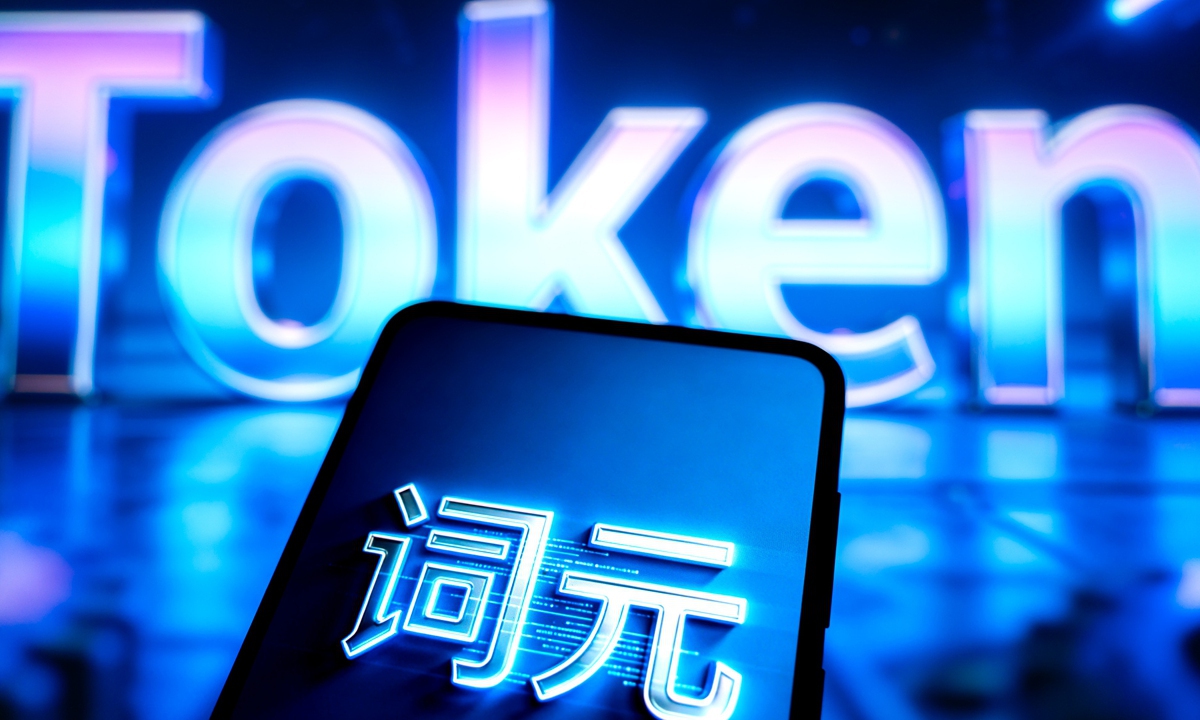
Token Photo: VCG
South China's Guangdong Province on Friday launched its first dedicated financial product for the token economy, the "Token Loan," in Guangzhou's Haizhu district, amid a wave of local initiatives to promote the token economy in recent months.
As a core factor of production in the era of large AI models, the generation, circulation and consumption of tokens are giving rise to a new economic model. As China accelerates AI development, a growing number of localities - from Beijing to Wuhan - are rolling out token-related support to meet industry needs.
Haizhu district also unveiled a package of measures to support the token economy, offering individual incentives of up to 5 million yuan ($741,500), according to local media outlet Nanfang Media Group.
Under the support measures, companies that have completed large-model or algorithm registration can receive subsidies covering up to 50 percent of their actual spending on model inference or training optimization, capped at 1.5 million yuan per company each year.
Haizhu is also supporting companies that package heterogeneous computing resources into token-based services, aggregate access to multimodal models, and provide one-stop settlement services. Eligible token-service aggregators can receive subsidies of up to 4 million yuan.
On the circulation side, the district supports the development of token distribution hubs that can connect multiple models, modalities, and heterogeneous computing platforms, while providing unified model aggregation and settlement services. Eligible platform operators can also receive up to 4 million yuan in support.
This is only the latest move by one of China's leading AI hubs. In recent months, local governments across the country have stepped up support for the token economy, pointing to a broader shift in how the AI industry is developing.
On August 5, Beijing issued its first systematic policy package covering the full token industry chain, offering eligible companies subsidies of up to 20 million yuan for computing-power rental costs and up to 5 million yuan for token use in real-world applications.
On July 22, Yangzhou in East China's Jiangsu Province announced that it would provide "token vouchers" covering a portion of eligible expenses, with each applicant able to receive up to 500,000 yuan annually and total fiscal support capped at 10 million yuan a year, according to local media.
Wuhan's Jiang'an district, in Central China's Hubei Province, has also rolled out 10 million yuan in annual token vouchers to directly subsidize companies' token usage costs and ease their operating burden, the Changjiang Daily reported in April.
These measures not only provide tangible support for AI companies, but also translate China's broader policy push for new quality productive forces into targeted local action.
In early 2024, China's average daily token usage stood at 100 billion. By the end of 2025, it had surged to 100 trillion, and by March this year, it had exceeded 140 trillion — an increase of more than 1,000-fold in just over two years, according to a People's Daily report.
The significance of developing the token economy goes beyond building more computing centers; it is about creating a closed loop linking computing power, models, data and application scenarios, turning infrastructure investment into intelligent services and industrial value, and ultimately translating AI into real productive capacity, said Wang Peng, head of the Chinese delegation and deputy chief economist of the China Institute of Nuclear Industry Strategy.
Differentiated policy experiments across regions can generate replicable models and help build a nationally coordinated AI industrial system with clearer regional specialization, while avoiding low-level redundant investment, Wang told the Global Times.
RELATED ARTICLES