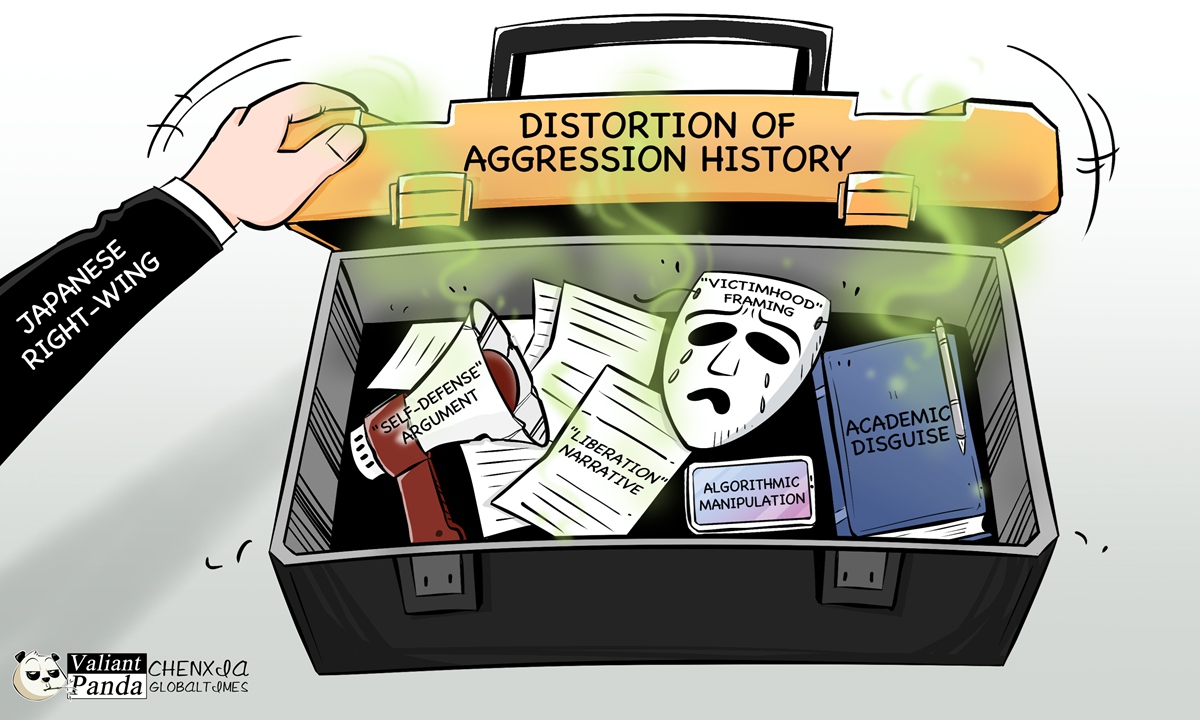
Illustration: Chen Xia/GT
Public discourse in Japan has already shifted from "whether Japan should take responsibility for its war of aggression" to "whether it should worship ghosts on such a sensitive day." Muddying the waters has long been a tactic favored by Japan's right wing. But there's no getting away with this one. As the international community watches closely, Japan must return to the fundamental question: What exactly should it do, to whom must it be accountable, and how should it answer for its actions?
August 15 marks the 81st anniversary of Japan's announcement of its unconditional surrender in World War II. Multiple Japanese media outlets have reported that Prime Minister Sanae Takaichi does not plan to visit the Yasukuni Shrine on the day. Some have interpreted this as "a goodwill gesture," suggesting that Takaichi is taking into account the feelings of China, South Korea, the US and others. This interpretation is completely wrong. The Yasukuni Shrine enshrines 14 Class-A war criminals and stands as a spiritual symbol of militarism; no Japanese political leader should take even one step through its gates. That is the bare minimum, not "a goodwill gesture" by any means. Treating a decision "not to visit" as an act of goodwill is itself a desecration of historical justice.
Eighty-one years ago, under the heavy blows of China and the world's anti-fascist forces, Japan declared unconditional surrender. This was not the so-called "end of the war," but a defeat - the complete bankruptcy of militarist aggression. From the Cairo Declaration to the Potsdam Proclamation, a series of international legal documents forms an irrefutable chain of legal authority, clearly stipulating the postwar obligations Japan must undertake. This is not an option Japan can simply choose to do or not do; as a defeated nation, Japan has no way around it, nor does it have any room to bargain.
What warrants vigilance is that, according to Japanese media reports, Liberal Democratic Party (LDP) Secretary-General Shunichi Suzuki and other members of the party's "four-man leadership" were coordinating a collective visit to the Yasukuni Shrine on August 15. Whether they ultimately go or not, the entire axis of Japan's public discourse has already been dangerously skewed by such actors. The baseline of discussion has shifted from "whether Japan should take responsibility for its war of aggression" to "whether it should worship ghosts on such a sensitive day." Muddying the waters has long been a tactic favored by Japan's right wing. But there's no getting away with this one. As the international community watches closely, Japan must return to the fundamental question: What exactly should it do, to whom must it be accountable, and how should it answer for its actions?
First, Japan must admit its guilt. In recent years, as Japanese politics has shifted increasingly to the right, historical revisionism has gained ground, with a steady stream of words and deeds that downplay, glorify, or even deny Japan's history of aggression. Such attempts to distort right and wrong trample on the conscience of humanity. What Japan must acknowledge is its launching of wars of aggression against other countries - in the name of the state, through legislation, and in clear and unequivocal terms, and acknowledge as incontrovertible historical facts all of its crimes, including the Nanjing Massacre, the forcible recruitment of "comfort women" and labor, and the biological warfare and human experimentation conducted by Unit 731. Without admitting its guilt, there can be no genuine reflection or apology.
Second, Japan must reflect on its actions and apologize. The 1995 "Murayama statement" explicitly used the phrases "deep remorse" and "heartfelt apology," representing a solemn commitment Japan made to the international community. However, in his "August 15" address in 2013, Shinzo Abe omitted these expressions and his successors, Yoshihide Suga and Fumio Kishida, followed suit.
Takaichi publicly declared as early as 1995 that "I do not think there is any reason for me to be asked to reflect on it." There is now considerable doubt over whether she will utter the word "remorse" on August 15. For Japan to genuinely complete the process of reflection and apology, the prime minister must, on behalf of the state, explicitly use the words "aggression" and "apology." The government must also restore "deep reflection" and "a pledge to never wage war" to its official address and institutionalize these commitments. Reflection is not a superficial gesture for other countries to see; it is an obligation Japan must fulfill to itself, to all victims of aggression, and to history.
Third, Japan must change course and immediately stop its military buildup and preparations for war. Japan's Chief Cabinet Secretary has described August 15 as a "day to pray for peace." But Japan cannot sing paeans to peace on this one day while sharpening its swords on the other 364. In reality, even on August 15, the fangs of militarism remain visible beneath Japan's so-called "peaceful" facade. In recent years, Japan has used so-called "external threats" as a pretext to dramatically increase its defense budget, vigorously develop offensive capabilities, and massively expand its military-industrial sector. Japan's "neo-militarism" is increasingly revealing its true nature. Peace is shaped by concrete actions. If Japan is serious about committing to peace, it must immediately return to the framework of the postwar international order, freeze all plans to expand its military capabilities, and stop provoking confrontation and stoking bloc divisions in the Asia-Pacific region.
On these three fundamental issues - admitting guilt, reflecting and apologizing, and changing course - Japan today is no longer merely "handing in a blank paper"; it is actively moving in the opposite direction. While the Japanese government turns a deaf ear to its historical responsibilities, its actions are accelerating down the dangerous path of remilitarization. We urge Japan to engage in profound reflection, acknowledge and atone for its crimes, strictly uphold the postwar international order, make a clear break from its militarist past, and stop its dangerous pursuit of "remilitarization." If Japan persists in going its own way and once again takes the wrong path, it will only face an even more painful defeat and a more thorough reckoning.
RELATED ARTICLES