US appeals court's order to reconsider DJI’s Pentagon listing highlights necessity of legal push against US unilateral measures: expert
By Published: Aug 16, 2026 02:18 PM

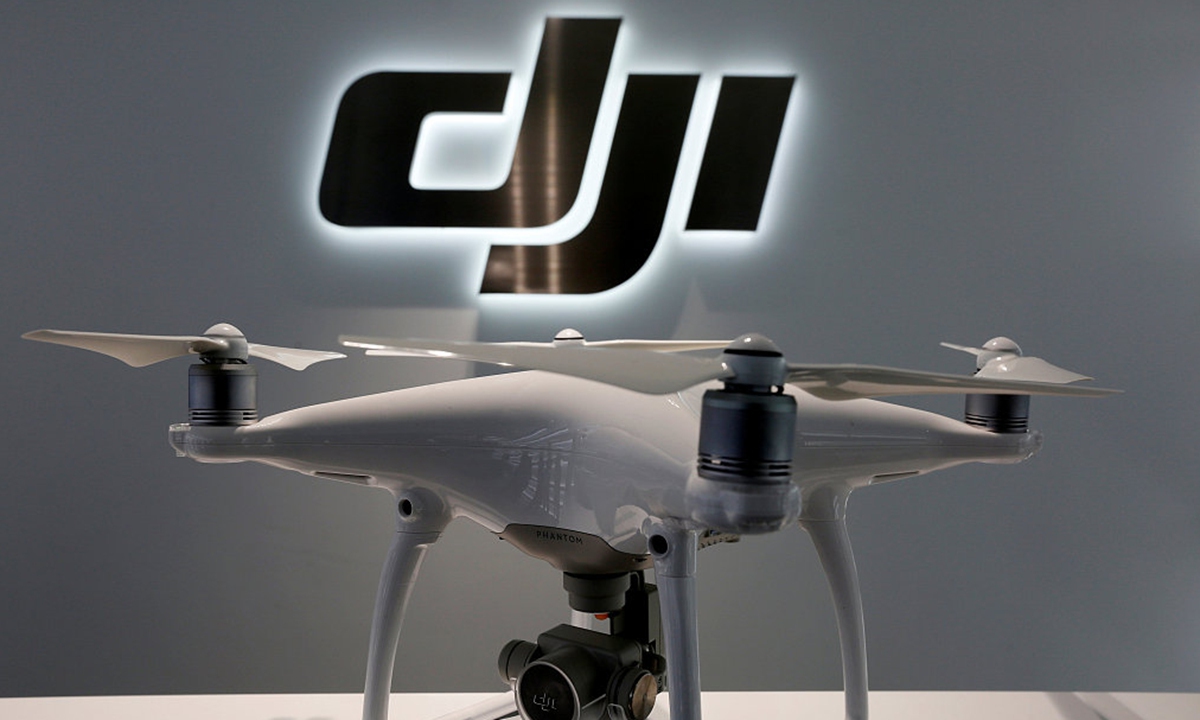
DJI Photo:VCG
A US appeals court's order for a lower court to reconsider whether China-based DJI should be removed from a Pentagon list of companies allegedly supporting the Chinese military is a fresh indication that Chinese companies should make resolute use of legal means to defend their legitimate rights so that unilateral, arbitrary administrative measures by the US government do not disrupt international supply chains, a Chinese expert said on Sunday.
The US Court of Appeals for the District of Columbia Circuit ruled on Friday that the lower court "erred by relying only on the unclassified record" in concluding that DJI, the world's largest dronemaker, contributes to the Chinese defense industrial base, according to Reuters.
DJI is one of a growing number of Chinese companies challenging their inclusion on the Pentagon's list of Chinese military companies. The list bars the Defense Department from contracting with designated companies, and a broader ban on buying their products via third parties takes effect in 2027.
A spokesperson for DJI called the ruling "a significant step toward correcting an unjustified designation." DJI has consistently maintained it is not a military company, the spokesperson said, according to Reuters.
A US district judge last year rejected a bid by DJI to be taken off the Pentagon's list.
"The latest ruling by the US appeals court offers more time and space for parties involved in the litigation to provide evidence and arguments as the legal process moves forward, and it is a major development in the case of DJI being placed on the Pentagon list," Zhou Mi, a senior research fellow at the Chinese Academy of International Trade and Economic Cooperation, told the Global Times on Sunday.
The Pentagon list is essentially a unilateral move that lacks sufficient information disclosure and transparency. The Pentagon will need to provide more evidence in the interests of justice, Zhou said, noting the ruling by the US appeals court aims to address procedural flaws and lack of information disclosure in the ongoing litigation.
The development in the DJI case came after a US federal judge earlier in the month temporarily "barred the Pentagon from including Chinese biotechnology group WuXi AppTec on a list of companies believed to support Beijing's military." Chinese experts hailed the ruling as a positive signal, showing that Washington's arbitrary, fact-deficient national security blacklists are not beyond challenge.
For companies facing unfair treatment in the US, the developments in the DJI case and other relevant cases have shown that Chinese companies' use of legal means in the US is both necessary and impactful, Zhou said, noting that the trend itself is a warning to the US government, which has frequently adopted arbitrary measures in recent years.
In January 2021, Xiaomi was placed on a similar Pentagon list. The Chinese company later announced in May 2021 that a US court had removed the company's designation as a military-related company and lifted all restrictions on US persons buying or holding its stock, Reuters reported.
Chinese experts noted that the Pentagon's controversial "list-first, evidence-later" approach has bred massive operational uncertainty for Chinese enterprises. By arbitrarily imposing restrictive labels before presenting credible proof, Washington creates an opaque and unpredictable regulatory environment that disrupts normal commercial expectations.
When asked about the US placing several Chinese technology companies including, Alibaba, Tencent and BYD, on a list of firms that allegedly aid China's military, Chinese Foreign Ministry spokesperson Lin Jian said on June 9 that China firmly opposes the US overstretching the concept of national security and formulating various types of discriminatory lists to go after Chinese businesses. "We urge the US to correct its wrongdoings, and stop the unwarranted suppression of Chinese businesses. China will do what is necessary to firmly protect their legitimate and lawful rights and interests," said Lin.
Alibaba, the e-commerce and technology giant, is also suing the US government over the Pentagon list, according to media reports.
RELATED ARTICLES