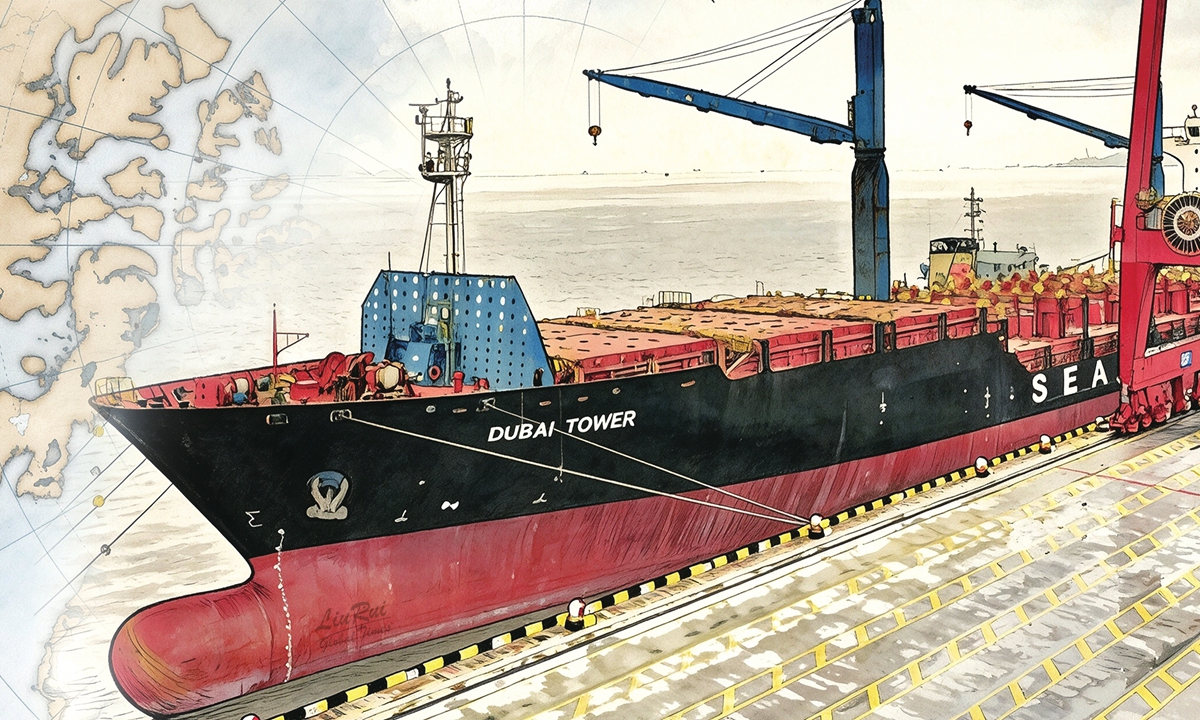
The China-Europe Arctic container express route enters regular weekly operations during the summer season in 2026. Illustration: Liu Rui/GT
The China-Europe Arctic container express route has entered regular weekly operations during this year's summer season, the Xinhua News Agency reported on Saturday.
What matters is the word "regular." For years, the Arctic route was discussed largely in terms of whether it could become a commercially viable link between China and Europe. Its transition into regular operations marks the beginning of a new stage: a route once seen as a possibility is taking shape as a practical option for international trade.
On September 22 last year, the China-Europe Arctic Express between Ningbo-Zhoushan Port and Felixstowe, UK, completed its maiden voyage. In less than a year, operational standards, fleet capacity and port services have continued to improve, allowing the seasonal weekly service to enter normal operations. The pace of this transition is worth noting: in less than a year, the Arctic Express service has evolved from its maiden voyage into scheduled operations, underscoring its commercial potential and the possibility of a larger role for the Arctic passage in China-Europe trade.
What counts the most is not only how often the Arctic Express can sail, but how confidently businesses can plan around it.
According to Xinhua, the service is expected to maintain a stable 4-month annual operating window in the medium and long term, although continued advances in polar navigation and supporting infrastructure could gradually extend the operating period. As the route becomes more predictable, the Arctic passage could become a more practical option within China-Europe trade networks, allowing businesses to incorporate it into their supply chain planning.
The Arctic passage is not a replacement for existing logistics routes; it is a complement to them. Its value lies in expanding the range of reliable options available to China-Europe trade. As the shipping lane becomes more regular and commercially viable, a more diversified logistics network could help strengthen the resilience of China-Europe supply chains.
Although the Arctic Express has only recently entered normal weekly operations for the summer season, its commercial value is already becoming evident. Time is the most immediate advantage: the voyage between China and Europe can be reduced to about 20 days, roughly half the duration of traditional maritime routes. For businesses, the value of such savings goes beyond speed itself - shorter transit time means greater flexibility in managing inventories, responding to demand changes and adjusting supply chains.
On lower-latitude maritime routes, cargo containers can in some cases reach 50 C to 60 C, creating additional challenges for temperature-sensitive goods. The Arctic passage, by contrast, provides a naturally cooler transport environment that can help reduce cargo losses and lower the costs of temperature control. As trade in products such as batteries and energy storage equipment expands, this could add to the route's commercial potential.
These advantages may only represent the beginning. The Arctic passage is still evolving, and its long-term potential will be determined not only by today's capabilities, but by how technology, infrastructure and commercial demand continue to evolve and advance.
At least over the past year, the progress has been notable. The Arctic Express moved from its maiden voyage to regular operations, reflecting not only advances in technology and infrastructure, but also the growing demand for new logistics connections as China-Europe trade continues to grow. Also, the emergence of such routes reflects the depth and continued potential of China-Europe trade.
The development of the Arctic Express comes at a time when China-Europe trade continues to expand. In the first seven months of this year, trade between China and the EU increased by 13.6 percent year-on-year, with both imports and exports keeping expanding. Behind these figures is the deep industrial complementarity between the two markets, suggesting that China-Europe trade still has room to develop further.
The rise of the Arctic Express reflects this broader trend. As China-Europe trade evolves, logistics networks evolve alongside it, creating new connections which will provide strong logistical support for growing commercial exchanges.
The author is a reporter with the Global Times. bizopinion@globaltimes.com.cn
RELATED ARTICLES