How large is China’s companion robot market?
Some have been put into service in nursing homes, highlighting the segment’s significant potential
By , Chen Zishuai and Yu Jiayin in Shenzhen Published: Aug 16, 2026 10:47 PM

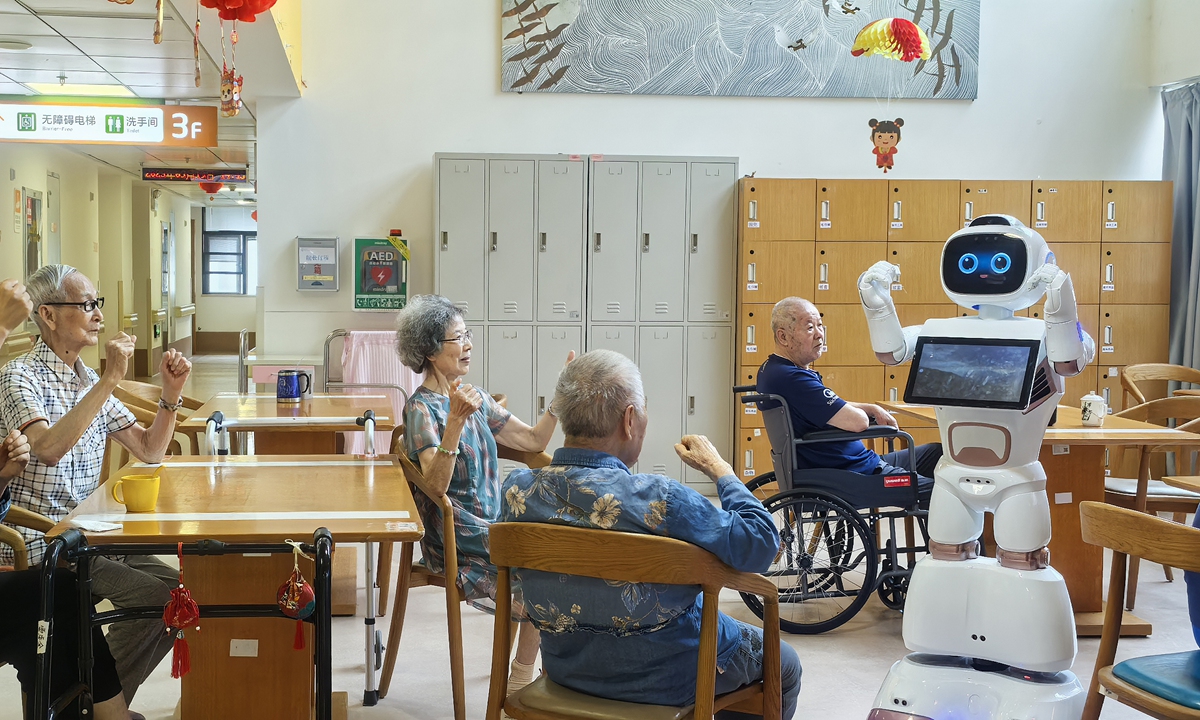
Elderly residents interact with a robot at the Shenzhen Nursing Home, South China's Guangdong Province. Photo: Courtesy of Shenzhen Nursing Home
In a sunlit activity room at Shenzhen Nursing Home in Shenzhen, South China's Guangdong Province, the day unfolds with quiet companionship from robots that have become part of the elders' daily lives.
"What are you still sleeping for? Time to get up and high!" a resident in her 70s surnamed Chen playfully calls out. Immediately, a robot with its arms and legs folded inside a nearby black box - just delivered to the nursing home in the morning from Digit Robotics - rises to its feet and walks steadily toward her, ready to join the fun.
Across the room, a soft-spoken robot begins to recite Saying Goodbye to Cambridge Again, a classic modern Chinese poem by Xu Zhimo (1897-1931). Its gentle voice rises and falls with the familiar lines as a few elderly residents close their eyes and quietly follow along.
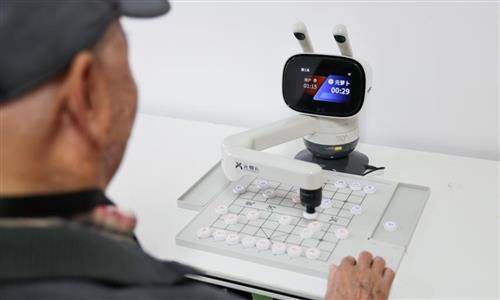
In one corner, a humanoid robot moves in slow, graceful arcs, leading a small group of elderly residents through the flowing motions of tai chi. Nearby, another robot sits opposite an elderly resident at a low table, studying the board before making a deliberate move in a game of Chinese chess. The elder chuckles and responds, the two locked in a silent, patient contest.
Further down the corridor, a compact walker robot "Wukong" made by UBTECH, stands by a desk, listening attentively to an elderly woman without interrupting. When she finishes recounting a story from her younger days, Wukong offers a brief, gentle summary of her feelings and a few words of comfort. She nods, a small smile spreading on her face.
Meanwhile, in the elders' rooms, a wheeled humanoid robot X Square 0755 is busily completing its daily tasks - delivering necessities to designated spots, folding clothes and tidying tabletops - while chatting with residents whenever needed.
"We began introducing robots in 2019, in collaboration with nearby Shenzhen companies. Now, they are playing an increasingly important role in our eldercare, especially in psychological counseling and daily companionship for the seniors," Wang Yuanyuan, vice president of the Shenzhen Nursing Home, told the Global Times.
The scenes at the nursing home are more than a local experiment. They offer a vivid glimpse into a rapidly expanding market for the robots that serve as "companions capable of emotional resonance."
Industry observers believe this emerging segment could become a significant growth driver in the coming years, while also functioning as a real-world testing ground before humanoid robots are deployed in ordinary households on a large scale.
Improving companionship
Amid an aging Chinese population, one of the most promising early applications for companion robots is in the eldercare market. Across the country, nursing homes in Beijing, Shanghai, and Hangzhou, East China's Zhejiang Province - in addition to Shenzhen - have already begun introducing and purchasing various types of robots into their daily eldercare.
By the end of 2025, more than 320 million people in China were aged 60 or above, accounting for 23 percent of the total population. This number is expected to exceed 400 million within a decade, according to a report by the Xinhua News Agency. As a result, eldercare has become an increasingly pressing national issue.
The rising demand is also partly driven by the fact that many elderly people lack companions to talk to, and particularly to enjoy the stories and life experiences from the past.
"A robot that can listen to, record these stories and engage in such interactions can significantly ease the elderly people's loneliness, provide emotional support and make their lives more interesting," Wang said.
According to Wang's observations, the abilities of these robots on duty have improved markedly in recent years, as they have been trained in real-world scenarios, accumulating rich frontline experience and insights, and therefore enabling their continuous optimization of their capabilities based on task feedback.
"With the support of multimodal large models and embodied intelligence technologies, robots are gradually acquiring capabilities in emotion recognition, proactive communication and emotional feedback," Li Junlan, research manager for robotics and the Internet of Things at International Data Corporation (IDC) China, told the Global Times on Thursday. "As a result, emotional value is becoming an important differentiated competitive advantage for companion robot products.".
Analysts believe that in addition to eldercare, high-interaction scenarios such as child companionship, educational tutoring for adolescents and children, psychological intervention in medical institutions, and rehabilitation assistance for special groups also hold significant potential. Li nevertheless stressed that the overall market awareness and large-scale practical applications remain in a cultivation and development stage.
Potential market
In May, Chinese company UBTECH Robotics unveiled the UWORLD U1 Series - a line of full-size ultra-bionic humanoid robots designed for mass production, as part of its broader strategy to promote human-robot symbiosis.
Pang Jianxin, vice president of UBTECH, told the Global Times that to date, the U1 series' pre-orders have surpassed 10,000 units.
The company projected that China's ultra-bionic robotics market will surge from the tens of billions to the trillion-yuan level between 2026 and 2036.
"Human-robot companionship is a novel solution proposed for the field of mental health, as well as an innovative form of care," Pang said. He also stressed that the early commercialization of companion robots is a result of full-chain research and development, hardware, operating system, emotional large models and complete-machine production.
For example, the company's emotional large model developed specifically for long-term companionship can recognize more than 20 fine-grained emotions with an accuracy rate exceeding 90 percent. Meanwhile, the self-developed drive system controls the synchronization delay between speech and lip movements to within 20 milliseconds.
While the industry is in a period of rapid development, some industry insiders remain cautious in regard to issues such as user data privacy and leakage, ethical norms for human-robot interaction as well as the risk of addiction. Some also called for further technological upgrades and stronger industry self-regulation to address those emerging challenges.
In July, the China Humanoid Robot 100-Member Association, together with the China Machinery Industry Federation, issued a development initiative calling on the industry to advance in an orderly manner under the principle of technology for good, with human well-being as the core goal, and safety, ethics and privacy protection integrated throughout the entire product lifecycle.
"At the product design stage, the distinction between human and robot identities should be clearly defined, with the product positioned as a companion rather than a substitute for real-world interpersonal relationships. Corresponding privacy protection measures should also be built into the design, including restricted data collection and related safeguards," Zhao Siquan, research manager at IDC China, told the Global Times on Friday.
RELATED ARTICLES