Frigate deal on agenda during Koizumi’s upcoming Australia defense talks bears ‘geostrategic implications,’ risks pushing Japan’s remilitarization
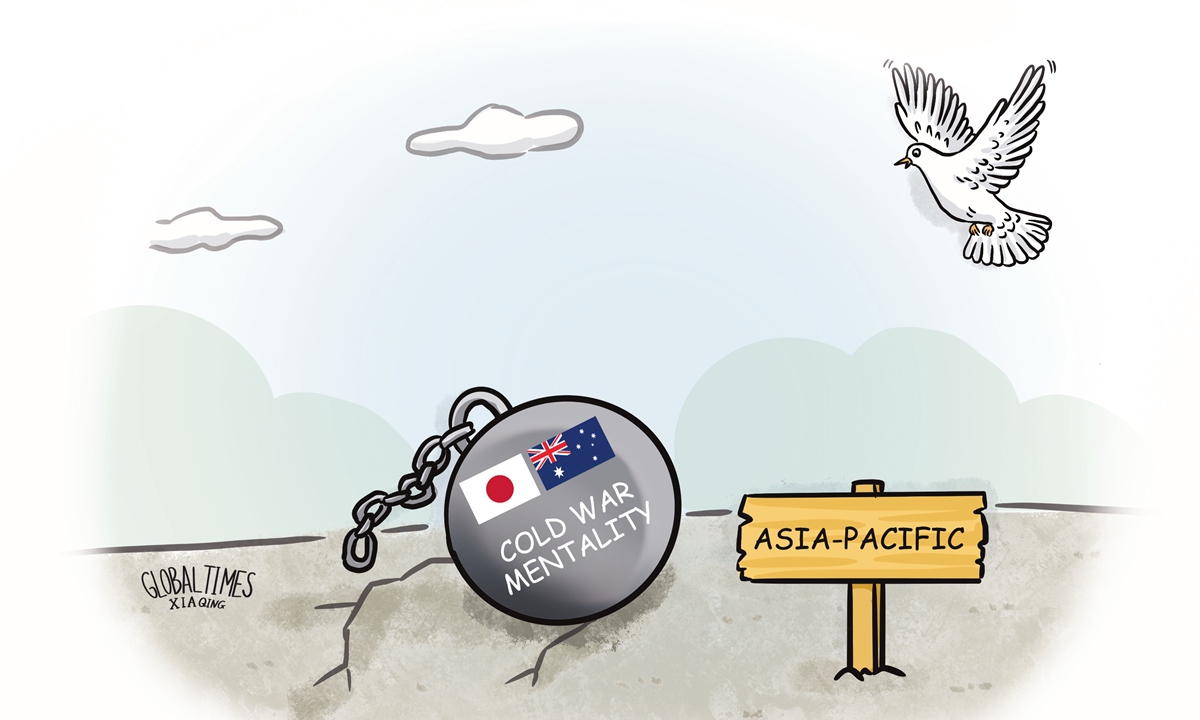
Illustration: Xia Qing/GT
Australia's acquisition of Japan's Mogami-class frigates, a key topic reportedly expected to feature in Japanese Defense Minister Shinjiro Koizumi's upcoming talks with his Australian counterpart and deputy prime minister on Tuesday, could go beyond a warship transaction, potentially extending to the transfer of related technologies and industrial supply chains and carrying broader geostrategic implications, a Chinese analyst said, adding that such moves risk stoking tensions and furthering Japan's remilitarization.
Koizumi is set to visit Australia and India for five days from Monday, the Japanese Defense Ministry said Friday, according to Japanese media outlet Jiji Press.
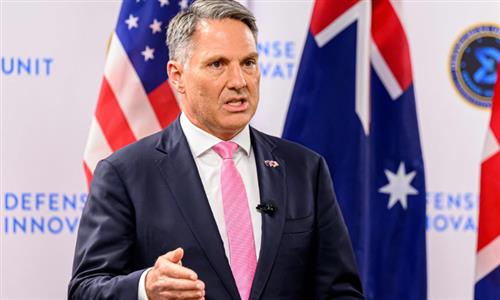
The discussion with Australian Defense Minister Richard Marles on Tuesday during the Japanese official's visit to Canberra is expected to center on the joint development of a new vessel based on Japan's advanced Mogami-class frigate, according to both Australian and Japanese media outlets.
In April this year, Tokyo reached an agreement with Canberra to supply the first three of a planned fleet of 11 upgraded Mogami-class frigates to the Australian Navy. This is the largest defense export contract in Japan's postwar history, which The Japan Times called "a major breakthrough for Japan's defense industry."
The Japanese government expects this deal to serve as the "first large-scale defense equipment transfer case" and to become a catalyst for promoting future arms exports, Japanese media Asahi Shimbun reported in April.
For the upcoming meeting on Tuesday, the two defense ministers are likely to "reaffirm steady progress" on the Royal Australian Navy's project to replace its aging frigates with an upgraded version of the Mogami-class frigate, Jiji Press reported on Saturday.
The report by Jiji Press also noted that Koizumi is expected to discuss ways to deepen bilateral security cooperation, adding that the meeting was "apparently with China in mind."
Da Zhigang, a research fellow at the Institute of Northeast Asian Studies of the Heilongjiang Academy of Social Sciences, told the Global Times on Monday that the defense exports have been positioned by Japan as a benchmark for deepening bilateral diplomatic and defense ties and as a model for its broader "Indo-Pacific" engagement in Oceania, especially against the backdrop of the Japan-Australia 2+2 Foreign and Defence Ministerial Consultations and the Reciprocal Access Agreement.
Following the attempt by Japan on revisions to the Three Principles on Transfer of Defense Equipment and Technology, Japan has also portrayed such exports as a means of sustaining domestic production capacity and as a model for future defense equipment transfers, Da said.
Notably, the expert said the export could extend beyond weapons to related technologies and industrial capabilities, particularly as associated facilities are to be established in Australia. Koizumi's visit to Australia may also have broader regional considerations, including potentially encouraging New Zealand to procure the same equipment.
Koizumi's meeting followed his visit to the notorious Yasukuni Shrine on Saturday - a move that drew strong opposition from China, with a foreign ministry spokesperson saying no pretext whatsoever can hide the Japanese politicians' true intention which is to change the verdict on the war criminals, cover up Japan's war crimes, distort the historical facts, and pave the way for accelerating remilitarization.
Da said that Australia's limited scrutiny of Japan's remilitarization risks could provide Japan with greater room to deepen defense cooperation and use Australia as a foothold for broader engagement with the Pacific Islands countries. This could further accelerate Japan's remilitarization and create greater uncertainty for regional stability.
Japan could also use Australia as a platform to expand military cooperation to other countries, potentially contributing to a new round of arms competition in the region. This could directly undermine regional mutual trust and cooperation, worsen the overall security environment, and erode mutual understanding and trust among the peoples of the region, the expert warned.
RELATED ARTICLES