China’s semiconductors output rises 23.1% in first 7 months, as new drivers contribute half of the country’s industrial growth
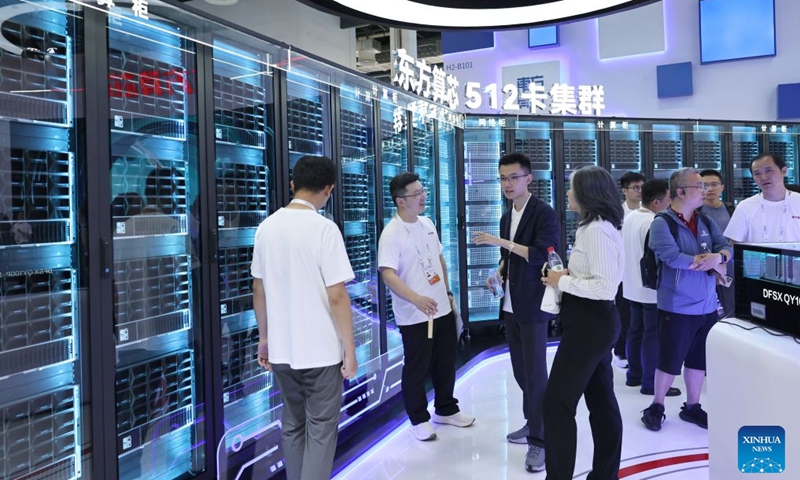
People view a high-performance AI chip cluster displayed during the 2026 World AI Conference and High-Level Meeting on Global AI Governance in Shanghai, east China, July 17, 2026. (Xinhua/Fang Zhe)
China's semiconductor and robotics sectors maintained strong momentum in the first seven months of 2026, with integrated circuit output rising more than 20 percent year-on-year and industrial robot production up nearly 30 percent. Rapid AI development also continued to drive investment in computing-related sectors, official data showed on Monday.
Analysts said the figures point to a broader spill-over from China's AI boom, as demand generated by the technology increasingly reaches beyond computing infrastructure into chips, intelligent equipment and advanced manufacturing.
China produced 334.2 billion semiconductors in the first seven months, up 23.1 percent from a year earlier. The momentum remained strong in July, when chip output rose 20.7 percent year-on-year to 53 billion units, according to data released by the National Bureau of Statistics (NBS) on Monday.
The latest figures extend particularly strong growth recorded earlier in the year. In the first half, value-added output in integrated circuit manufacturing surged 67.3 percent year-on-year, an earlier NBS breakdown showed, underscoring the rapid expansion of one of the key industries underpinning computing and AI development.
NBS data showed particularly rapid expansion in technology-intensive manufacturing closely linked to digitalization and intelligent upgrading. Value-added output of the computer, communications and other electronic equipment manufacturing industry rose 15.4 percent in the first seven months, while its July growth accelerated to 19.1 percent.
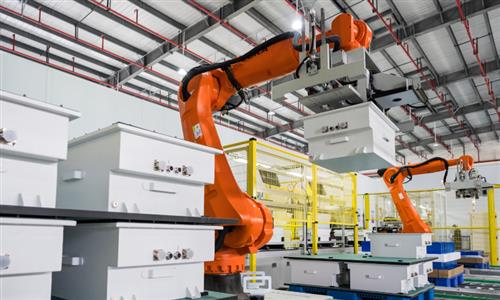
Robotics provided an even more visible gauge of the expansion. China produced 635,056 industrial robots in the first seven months, up 28.5 percent year-on-year. In July alone, output jumped 30.2 percent to 98,677 units. Service robot production also rose 12.2 percent in the January-July period to more than 12.1 million units.
The three areas stand out within an already fast-growing high-tech manufacturing sector. Value-added output of high-tech manufacturing rose 13.8 percent year-on-year in the first seven months, more than twice the 5.3-percent expansion of overall industrial output. In July alone, high-tech manufacturing output grew 16.9 percent.
NBS spokesperson Fu Linghui told a press briefing on Monday that new growth drivers remained a key contributor to growth, accounting for about half of the growth in value-added output of major industrial enterprises in the first seven months, while accelerating digitalization and intelligent transformation provided a strong boost to related industries.
The momentum on the production side is being reinforced by investment.
Investment in integrated circuit manufacturing rose 11.5 percent year-on-year in the first seven months, accelerating by 2.7 percentage points from the first half, according to Zhang Gang, an official with the NBS investment department. Investment in electronic circuit manufacturing surged 57.7 percent, with its growth rate accelerating by 2.1 percentage points. Investment in electronic special materials manufacturing rose 9.4 percent.
AI-related investment was another standout. Investment in information services increased 19.2 percent in the first seven months, 3.7 percentage points faster than in the first half. Accelerated deployment of AI computing capacity also helped support equipment investment.
In semiconductors, Chinese memory chip maker ChangXin Memory Technologies (CXMT) raised about $8.6 billion in its IPO in July, after first-quarter revenue surged more than sevenfold year-on-year. In robotics, Unitree Robotics has drawn intensive investor interest, with its IPO more than 8,000 times oversubscribed by investors.
The strength in these new industries stands out against the broader industrial picture. Value-added output of China's major industrial enterprises rose 5.3 percent year-on-year in the first seven months, with new growth drivers gaining weight and the industrial structure continuing to upgrade, according to NBS.
Manufacturing output rose 5.6 percent, while equipment and high-tech manufacturing grew 9.7 percent and 13.8 percent, respectively. Among advanced products, output of 3D printing equipment surged 52.3 percent and lithium-ion batteries rose 40.2 percent, official data showed.
The figures come as China places chips, AI and robotics at the center of its push to develop new growth drivers during the 15th Five-Year Plan period.
The 2026 Government Work Report called for developing semiconductors and other emerging industries, fostering future industries including embodied intelligence, and further advancing the "AI Plus" initiative to combine digital technologies with China's manufacturing and market strengths.
Global Times
RELATED ARTICLES