Multiple Q1 indicators signal solid start for economy
Growth in infrastructure, high-tech sectors leads way: data
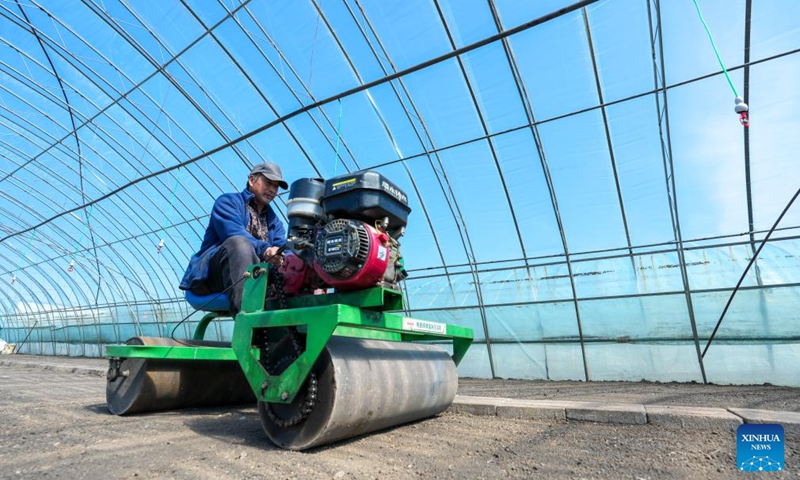
A farmer levels seedbed soil in a rice cultivating greenhouse of Youyi Farm Co., Ltd. under Beidahuang Group in Shuangyashan, northeast China's Heilongjiang Province, April 9, 2026. Heilongjiang, a major grain-producing area in China, has entered the spring ploughing season for rice. Photo: Xinhua
Leading indicators on China's investment, consumption and foreign trade released recently by the State Information Center under the National Development and Reform Commission (NDRC) point to a solid start for the economy in the first quarter, CCTV News reported.
Investment picked up in the first quarter, with project construction accelerating. The excavator index showed the average nationwide operating rate of construction machinery rose by about 16 percentage points month-on-month in March and by about 4 percentage points from January, pointing to a broad rebound in infrastructure equipment activity.
"Supported by the rollout of policy measures, a concentration of major projects and improved weather conditions, the pace of economic activity accelerated in March," Bian Yongzu, an executive deputy editor-in-chief of Modernization of Management magazine, told the Global Times on Sunday.
Bian noted that infrastructure development has been advancing faster in central and western China, noting that the regions' vast size and relatively less-developed infrastructure, particularly in transport, leave significant room for growth, while increased government investment - especially in transport - further support the trend. He added that this is not only helping stabilize growth, but also promoting more balanced development between eastern and western regions.
Accelerated infrastructure development has been underpinned by stronger funding. The NDRC's estimates show that new special-purpose bond issuance nationwide rose 20.8 percent year-on-year in the first quarter, while the value of winning bids for projects related to computing infrastructure and software and hardware development increased by 4.7 percent.
Investment in frontier fields such as artificial intelligence (AI) and humanoid robots surged 45.5 percent year-on-year, according to the NDRC data. Innovation momentum is strengthening as resources continue to concentrate in the AI sector.
Alongside faster project construction, activity indices for start-ups and technology-driven firms both improved in the first quarter. The operating vitality index for start-ups rose 8.8 percent year-on-year, while that for tech-oriented enterprises increased 8.1 percent, underscoring AI's growing role as a key driver of new quality productive forces, the NDRC data showed.
Patent data also indicate robust innovation activity in the AI sector. In the first quarter, patent grants related to China's strategic emerging industries rose 8.7 percent year-on-year, with those in March alone rising 18.4 percent. AI-related patent grants surged 31.2 percent, pointing to steadily strengthening innovation momentum.
The faster issuance of special-purpose bonds and the marked acceleration in high-tech investment are closely tied to China's current stage of development, Wang Peng, an associate research fellow at the Beijing Academy of Social Sciences told the Global Times.
China has entered a stage where stronger self-reliance in science and technology is essential, with some fields already leading globally and others in close competition with developed economies, making faster indigenous innovation imperative amid a tightening external environment, Wang noted.
Bian said that China has multiple advantages in developing science and technology, with notable progress in infrastructure, basic research and applications boosting returns on tech investment and strengthening firms' willingness to increase high-tech spending, making it a key driver of rising investment.
China's six emerging pillar industries are expected to surpass 10 trillion yuan ($1.45 trillion) in total value in 2030, Zheng Shanjie, head of the NDRC, said in March. The combined output of sectors including integrated circuits, aviation and aerospace, biomedicine, the low-altitude economy, new types of energy storage, and intelligent robots approached 6 trillion yuan in 2025, Zheng said.
Meanwhile, the port "barometer" is also rebounding, underscoring sustained resilience in foreign trade. In the first quarter, the operating rate of port equipment nationwide rose markedly, registering both year-on-year and quarter-on-quarter growth, reflecting the steady strength of exports.
Average daily port cargo and container throughput rose 2.4 percent and 8.5 percent year-on-year, respectively, while the tonnage of departing and arriving vessels at major ports increased 9.6 percent and 5.4 percent.
Bian said that despite a complex and challenging external environment, exports maintained relatively stable growth, reflecting deepening global reliance on Chinese manufacturing.
Wei Ying, an official at the State Information Center under the NDRC, said that China has made notable progress this year in expanding into emerging export markets, with a strong export performance to Belt and Road partner countries, adding that foreign trade is expected to continue providing solid support to economic growth, according to CCTV News.
The consumer market also saw a steady start with strengthening momentum. Since the beginning of the year, targeted policies including a new round of trade-in programs and coordinated fiscal and financial support have boosted demand. Online, the composite consumption index for lifestyle services rose 2.6 percent year-on-year in the first quarter, with notable gains in catering, hotel accommodation and leisure consumption.
In physical stores, consumption payments rose 3.4 percent year-on-year in the first quarter, up 2.2 percentage points from the fourth quarter. Goods consumption increased 5.2 percent, with faster growth in electronics and home appliances.
RELATED ARTICLES