China's market regulator rolls out measures to address 'involution-style' competition in platform economy, key sectors
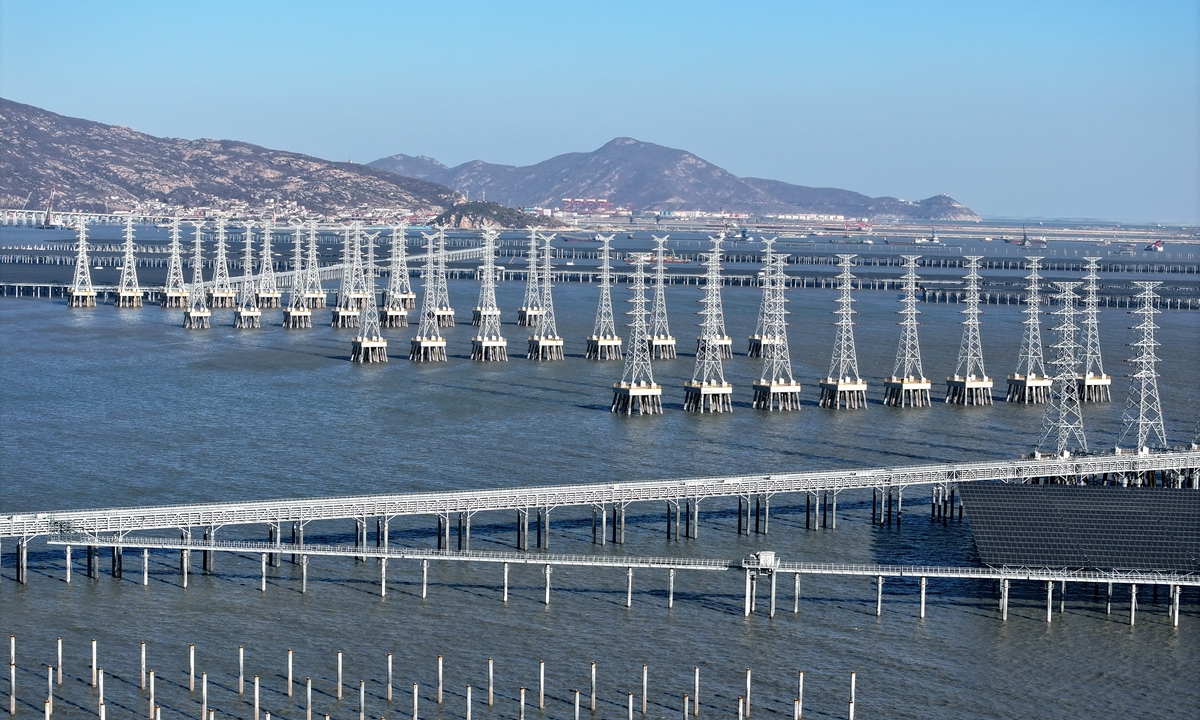
China's largest offshore photovoltaic (PV) project, the CNNC Tianwan 2 million kilowatt tidal flat PV demonstration project, is under construction in the warm discharge waters near the Tianwan Nuclear Power Plant in Lianyungang, East China's Jiangsu Province, on January 11, 2026. Developed by CNNP Rich Energy Co under the CNNC, the project involves an investment of 9 billion yuan ($1.29 billion) and covers 1,875.77 hectares. Photo: VCG
China's market regulator on Monday unveiled measures to tackle "involution-style" competition across the platform economy and key new‑energy sectors, as part of greater efforts to advance a fair, high‑quality unified national market. A Chinese expert said that the move aims to create a market order where good quality commands good prices and healthy competition prevails.
In a notice issued by the State Administration for Market Regulation (SAMR) on further implementing the Anti‑Unfair Competition Law, authorities said that they will "comprehensively rectify 'involution-style' competition" by deploying a range of anti‑unfair competition tools. The move targets platform operators and firms engaged in the photovoltaic, lithium‑ion battery and new-energy vehicle sectors, among others.
"Involution-style" competition is a concept that has gained traction in recent years to describe cutthroat competition, where companies vying for market share aggressively cut prices but get trapped in a cycle of diminishing returns, according to Li Chang'an, a professor at the Academy of China Open Economy Studies under the University of International Business and Economics.
According to the notice, the administration has singled out specific practices by online platforms that it said will be precisely identified and investigated, including using search rankings, seller ratings, algorithmic controls, flow restrictions, product delistings, fee increases, delayed payments, transaction suspensions or internal penalties — as well as forcing or coercing merchants during subsidy or promotional activities (such as discounts, coupons, "red packet" incentives, "full reduction" promotions, and buy‑one‑get‑one offers) to sell goods at below cost, disrupting market order.
The regulator urged platform operators to establish clear, internal fair‑competition rules, set up dedicated working mechanisms, accept complaints and reports, and improve dispute resolution procedures.
Li said that these new measures echo policy guidance for the 15th Five‑Year Plan period (2026-30), with the aims to build a unified, open, competitive and orderly national market and to foster a rule‑of‑law, credit‑based, internationalized business environment that ensures the strengths of China's enormous market continue to shine.
The ongoing efforts send a clear message that China is committed to building a high-level socialist market economy system where the market plays a decisive role in resource allocation while the government ensures fair competition, as the country adapts to evolving market dynamics and increasing international uncertainty, according to Li.
To eliminate bottlenecks and obstacles hindering the development of a unified national market, the SAMR said that it will work to prevent large firms from delaying payments to small and medium‑sized enterprises by building coordinated mechanisms to address arrears.
The notice said online unfair competition supervision will be strengthened, with greater protection for emerging industries such as artificial intelligence (AI), better safeguarding of legitimate rights of data element participants, and maintenance of data market competition order. Regulators will also promptly address new forms of online unfair competition and curb practices that misuse data, algorithms, technologies, and platform rules.
With the growing use of algorithms, large-language AI models and big data in product promotion, regulators face new challenges in identifying and preventing behavior that can be used to create "involution-style" competition, said Li. Such measures respond to the needs of high-quality development and the growth of new quality productive forces, Li added.
The notice also states that any unfair competition practices carried out overseas, such as false advertising, unfair online competition, commercial defamation, and infringement of trade secrets, that disrupt the domestic market competition order and harm the legitimate rights and interests of domestic businesses or consumers, will face resolute crackdowns to safeguard the security of the country's industrial and supply chains, and protect national and corporate interests.
The notice also outlined measures to strengthen trade-secret protection, as an important effort to continuously optimize the business environment and promote high-quality development; ensure effective implementation of the Anti-Unfair Competition Law, and improve institutional frameworks that align with high-level international economic and trade rules.
Against the backdrop of a nationwide campaign to curb "involution-style" competition — a practice that has caused domestic market disorder and harmed producers and consumers — rectifying such behavior has become crucial to improving the business environment and restoring market order, Li told the Global Times on Monday.
Meanwhile, as new emerging sectors and business models emerge, "involution-style" competition has spawned new tactics. The notice highlights key sectors such as the platform economy and new energy, where such competition can impede the healthy development of domestic industries, making these sectors a focus of the current rectification.
RELATED ARTICLES