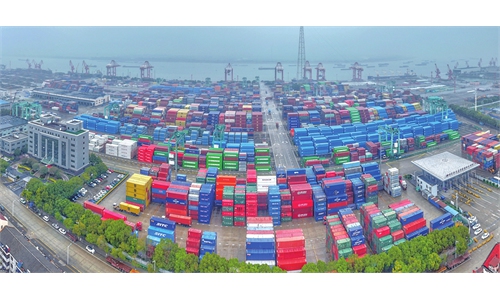
An aerial view of the Xinhaigang Port in Haikou, South China's Hainan Province File photo: VCG
China's economy has started the year on a strongly recovering trajectory in the first quarter of 2026, with a series of high-frequency indicators highlighting its resilience and potential to achieve the annual growth target of 4.5-5 percent.
From robust offline consumption and thriving port logistics to vibrant entrepreneurial activity, the latest data shows the giant economy adapting to global uncertainties.
Between January and March, China's offline consumption payment volume rose 3.4 percent year-on-year, with the rate 2.2 percentage points higher than in the fourth quarter of last year. Over the period, the deadweight of cargo ships on departure and arrival at major Chinese ports rose by 9.6 percent and 5.4 percent year-on-year, respectively. Meanwhile, the country's startup activity rose by 8.8 percent year-on-year in the first quarter, according to a report by the Economic Information Daily on Wednesday.

Li Renliang Photo: Courtesy of Li Renliang
Overall, the economy has started the year positively, with stronger resilience and steady progress. This momentum is rooted in China's structural strengths - including a complete industrial supply chain, a massive consumer market, and a steadfast commitment to opening-up - which underpin its economic stability.
Following years of high-speed growth, China has firmly established itself as the world's second-largest economy. According to the Government Work Report, China targets economic growth of 4.5 percent to 5 percent this year, with room to outperform. This target reflects China's economic fundamentals.
Aiming for a reasonable growth rate will balance growth in economic scale with improvements in quality. This is important for promoting steady social development, elevating public well-being, and supporting the global growth. Bolstered by its strong resilience, the economic growth target is both realistic and pragmatic, which is achievable.
China's technological innovation has emerged as a key driver of innovation. Through large-scale innovation coupled with a "cost revolution," China has transformed clean energy from a niche product into a mainstream solution. The rapid development of photovoltaics, lithium-ion batteries, and new-energy vehicles has significantly lowered the global costs of green power and electric transportation, accelerating global decarbonization.
China's tech innovation is generating significant spillover effects. By significantly reducing global costs, expanding supply, and fostering new market frontiers, China is effectively reshaping global supply chains and accelerating the dual transition toward green and digital development. Furthermore, China's innovative strides are instrumental in bridging the development gap between the North and the South.
In recent years, China's opening-up has evolved from a model focused on the flow of goods and capital to a comprehensive institutional model focused on rules, regulations, management, and standards. The core of this transition lies in streamlining access, expanding opening-up, aligning with international benchmarks, and protecting legitimate rights and interests.
This institutional opening-up is evidenced in multiple aspects. In terms of foreign investment access, China has fully liberalized its manufacturing sector while ramping up opening-up of the service industry. The negative list for foreign investment has been consistently shortened, while increasing the share of products covered by the zero-tariff policy for the least developed countries that maintain diplomatic relations with China from 98 percent to 100 percent.
Notably, the high-quality construction of the Belt and Road Initiative (BRI) has created new opportunities globally.
In the first two months of this year, the China-Europe freight trains operated 3,501 trips and transported 352,000 standard containers of goods, marking year-on-year growths of 32 percent and 25 percent respectively, official data showed. Trade with the BRI partner countries has become an increasingly important driver of China's stable trade growth, which has helped reduce reliance on any single market, foster a more diversified trade structure, and significantly enhance the resilience of the country's foreign trade.
Extending from the BRI, China and Asian countries have significant scope for cooperation in a wide range of sectors, as they share similar development experience and goals.
For example, by staying the course on cooperation and development, China and ASEAN have worked together to advance the building of a closer China-ASEAN community with a shared future. China and ASEAN have remained each other's largest trading partners for consecutive years, making it one of the most dynamic economic regions.
Looking ahead to the 15th Five-Year Plan period (2026-30), China and ASEAN countries are poised to deepen cooperation across five core pillars including institutional opening-up, connectivity, industrial chains, digital-green transition, and financial security. By implementing the China-ASEAN Free Trade Agreement 3.0 and leveraging the benefits of the Regional Comprehensive Economic Partnership (RCEP), the China-ASEAN partnership is creating even more powerful engines for growth.
The article is compiled based on an interview with Li Renliang, deputy dean for Academic Affairs, Graduate School of Social Development and Management Strategy, National Institute of Development Administration, Bangkok, Thailand. bizopinion@globaltimes.com.cn
RELATED ARTICLES