Consistently and unwaveringly pursue economic development as the central task
Be alert to these misinterpretations about China’s economy
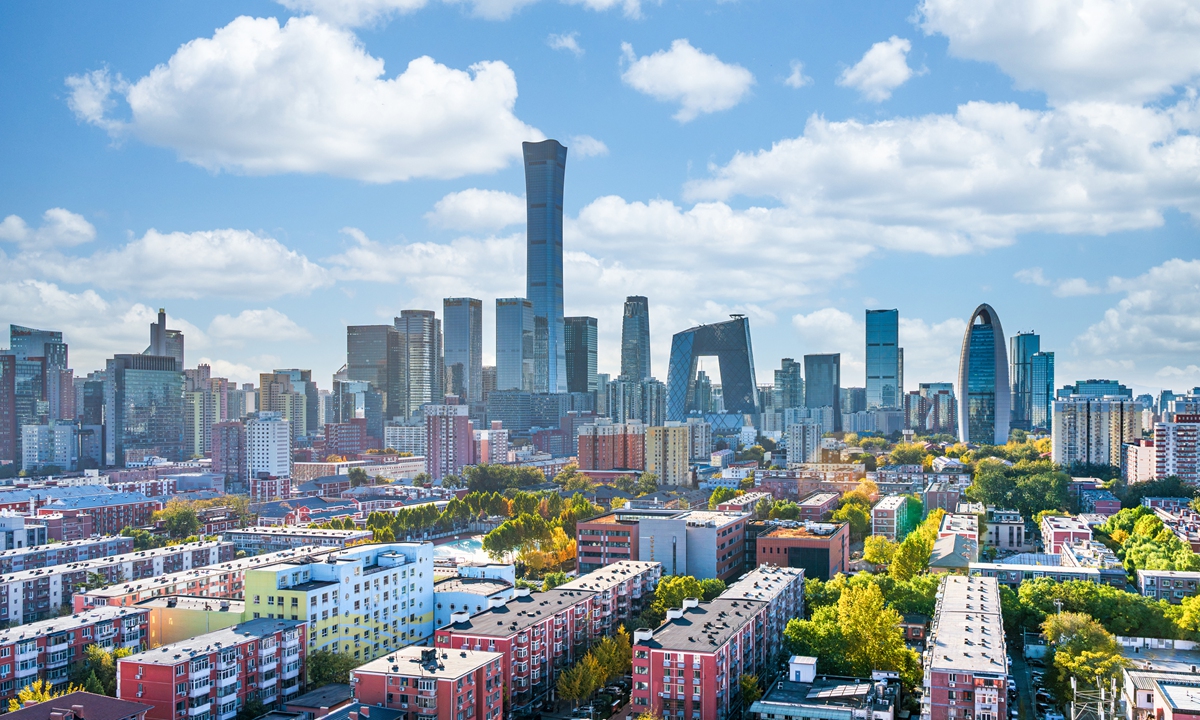
The CBD area of Beijing, China Photo: VCG
Recently, some foreign media outlets have made absurd interpretations of a series of economic and social development targets, tasks, and policies proposed by the Chinese government. Some claimed that China has continuously lowered its economic growth targets, indicating that it is no longer pursuing growth, while others claimed that China's economic policies lack sufficient strength, suggesting that it is no longer centered on economic development. These interpretations completely distort the facts, aiming to mislead expectations and undermine market confidence. Let us examine and clarify these fallacies one by one.
The first misinterpretation is that "China has set its GDP growth target at 4.5 percent to 5 percent, the lowest in decades, indicating a conservative approach that no longer prioritizes economic growth but instead focuses more on withstanding external shocks."
Some foreign media outlets generalized the conclusion from partial observations in interpreting China's economic growth targets and development intentions, which amounts to subjective speculation that disregards facts.
The full formulation of this year's economic growth target in the Government Work Report is "GDP growth of 4.5-5 percent, while striving for better in practice." This represents a scientifically grounded target that comprehensively considers domestic economic performance and the complex changes in the external environment, balancing development needs with practical feasibility.
A growth rate of 4.5-5 percent is well above that of major global economies, and cannot be considered conservative; it aligns with China's actual economic conditions. In 2025, China's GDP surpassed 140 trillion yuan ($19.4 trillion). With growth of "4.5-5 percent" this year, the incremental increase will reach 6.3 trillion to 7 trillion yuan, close to the total GDP of the country ranked 20th globally in 2025, equivalent to the economic size of a medium-sized country. This increment is substantial.
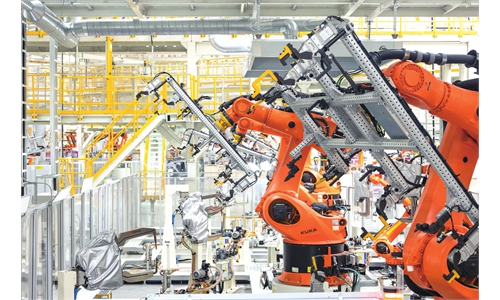
In particular, China's economy has shifted toward high-quality development, no longer focusing solely on GDP growth, but on developing new quality productive forces and strengthening hard capabilities. In 2025, China remained at the forefront globally in the research and application of artificial intelligence, biomedicine, robotics, and quantum technology; achieved new breakthroughs in independent chip development; launched the Tianwen-2 mission; expanded the large-scale application of the BeiDou Navigation Satellite System; and saw domestically developed large models lead the global open-source ecosystem… Meanwhile, the industrial structure continued to improve, with value added in high-tech manufacturing increasing by 9.4 percent and that in equipment manufacturing by 9.2 percent, while output of industrial robots rose by 28 percent and that of integrated circuits by 10.9 percent.
At present, China's economic development faces a complex external environment: increasing global turbulence, instability in the Middle East, rising trade barriers, and the risk of prolonged slowdown in global growth. Nevertheless, China has maintained strategic resolve, focusing on medium- and long-term development goals and advancing step by step. "Strong and resilient the tree stands, no matter which way the wind blows." China formulates its economic policies to manage its own affairs well, and has never been, is not, and will not be swayed by external shocks.
The second misinterpretation is that "China's macroeconomic policies have limited effect and lack sufficient strength, indicating that it is no longer centered on economic development."
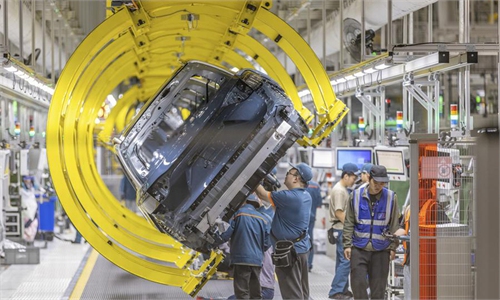
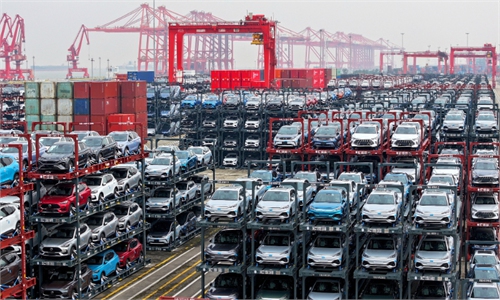
The data speak for themselves: During the 14th Five-Year Plan period (2021-25), China's total economic output achieved "four consecutive leaps," successively surpassing milestones of 110 trillion, 120 trillion, 130 trillion, and 140 trillion yuan, with an average annual growth rate of 5.4 percent, significantly higher than the global average. The scale of value added in manufacturing has ranked first globally for 16 consecutive years, and China's position as the world's largest trader in goods has been further consolidated. More than 60 million new urban jobs have been created cumulatively.
These achievements did not come out of thin air, but are the result of strong and effective economic policies. China has actively responded to US-imposed tariffs, fully leveraged existing policies, and introduced a series of new measures to stabilize employment and the economy, effectively offsetting downward pressure; implemented a more proactive fiscal policy and a moderately accommodative monetary policy, lowered policy interest rates and the reserve requirement ratio, and continuously reduced overall financing costs for society; and expanded the consumer goods trade-in program.
This year, China's macroeconomic policy stance is even stronger. The deficit-to-GDP ratio for this year is set at around 4 percent. The government deficit is set at 5.89 trillion yuan, 230 billion yuan more than last year; Expenditure in the general public budget is projected to reach 30 trillion yuan for the first time, an increase of about 1.27 trillion yuan over last year. China will continue to apply an appropriately accommodative monetary policy, flexibly and effectively employing a range of policy instruments, including cuts to required reserve ratios and interest rates, and maintain adequate liquidity. China will boost coordination between fiscal, financial, employment, industrial, and other policies, explore policy alignment opportunities, and develop new implementation tools, so as to deliver the best outcomes possible… This year's Government Work Report has made arrangements for macroeconomic policies, placing greater emphasis on integrating existing and incremental policies, strengthening counter-cyclical and cross-cyclical adjustments, and effectively enhancing macroeconomic governance capacity.
Since the beginning of the new era, amid complex and severe domestic and international conditions, China has adhered to pursue economic development as the central task and achieved remarkable accomplishments, with growth rates ranking among the top of major economies, becoming the most stable and reliable engine of global economic development.
Pursuing economic development as the central task, with high-quality development as the main focus, reform and innovation as the fundamental driving force, meeting the people's ever-growing needs for a better life as the fundamental goal, and full and rigorous Party self-governance as the fundamental underpinning for all efforts, these five focuses encapsulate the worldview and methodology of Xi Jinping Thought on Socialism with Chinese Characteristics for a New Era and provide strategic guidance for economic and social development during the 15th Five-Year Plan period (2026-30). Pursuing economic development as the central task, fully and faithfully applying the new development philosophy, achieving greater self-reliance and strength in science and technology, and promoting the development of new quality productive forces in light of local conditions are essential requirements for adhering to the basic line of the Party and addressing all of China's contemporary challenges.
"Potential," "stability," "opportunity," and "reliability" were key words used by executives of multinational companies at the China Development Forum 2026 Annual Meeting held recently, reflecting their strong confidence in China's market prospects. Since the beginning of 2026, foreign-invested enterprises have stepped up their presence in China, with many announcing increased investment or new facility plans. Data show that in the first two months of this year, 8,631 new foreign-invested enterprises were established nationwide, a year-on-year increase of 14 percent.
One of the institutional strengths of socialism with Chinese characteristics lies in maintaining the continuity and stability of its lines, principles, and policies. Over the 48 years since reform and opening-up, regardless of the difficulties and challenges encountered, China has never wavered in adhering to the line of pursuing economic development as the central task. Looking ahead, in building a modern socialist country, this fundamental principle will be consistently upheld without any deviation.
This was compiled based on an article published in the "Chisu Jinsheng" economic commentary column of the People's Daily on March 27, 2026.
RELATED ARTICLES