So-called ‘China economic slowdown’ claim completely unfounded
Be alert to these misinterpretations of China’s economy - II
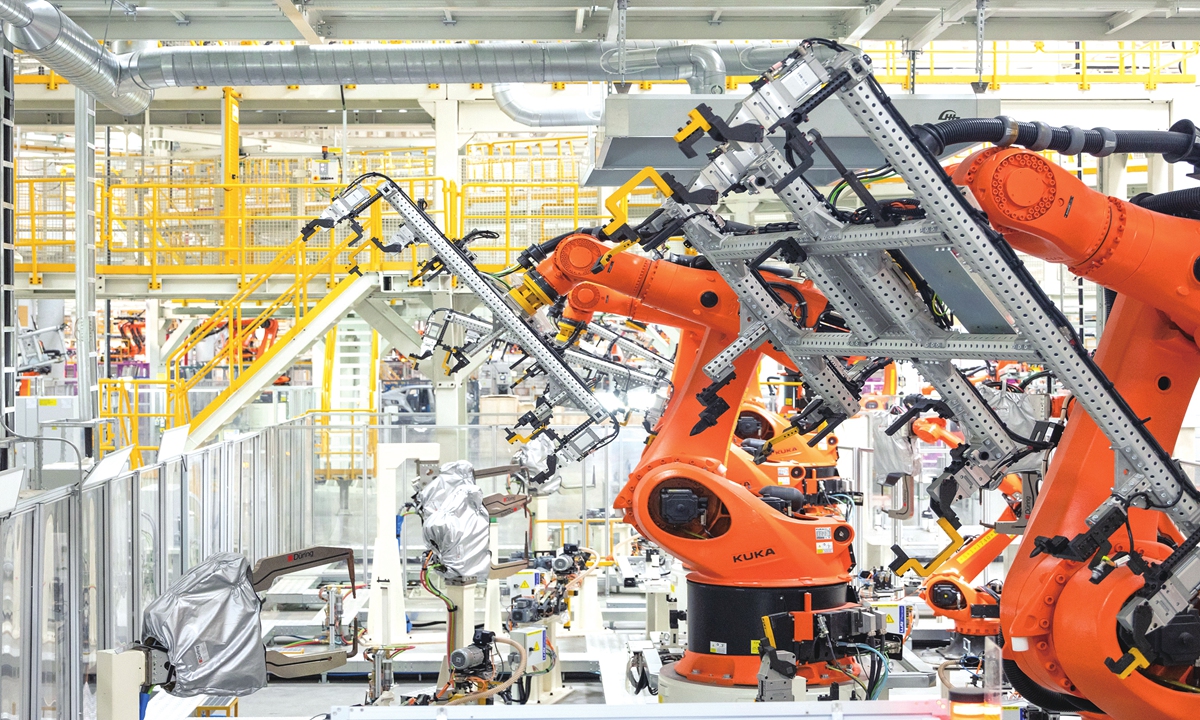
Industrial robot arms operate at the vehicle body workshop of Volkswagen's smart manufacturing base in Hefei, East China's Anhui Province. Photo: Courtesy of Volkswagen
Recently, as China unveiled its economic growth target for 2026, some voices in the US and Western media have once again revived the hype about a so-called "slowdown" of the Chinese economy. The Wall Street Journal claimed that "China Signals New Era of Slower Economic Growth," while Bloomberg ran a piece titled "Six Charts That Explain China's Weakening Economy." Such claims are completely unfounded.
Let us first look at the latest economic data released for the first two months of 2026: from January to February, the value added of industrial enterprises above designated size nationwide grew by 6.3 percent year-on-year; fixed-asset investment rose by 1.8 percent, reversing a previous decline; investment in high-tech industries increased by 5.1 percent; total retail sales of consumer goods grew by 2.8 percent; and total imports and exports of goods surged by 18.3 percent. With such performance at the start of the year, where is the so-called "slowdown" or "weakening"?
Another set of figures tells a similar story: in the first two months, 8,631 new foreign-invested enterprises were established in China, up 14 percent year-on-year; actual use of foreign investment reached 161.45 billion yuan ($23.36 billion). Foreign investment in high-tech industries totaled 63.21 billion yuan, up 20.4 percent year-on-year, accounting for 39.2 percent of the total and 8.5 percentage points higher than the same period last year.
The latest China Economic Update released by the World Bank noted that more proactive fiscal policy and moderately accommodative monetary policy have supported domestic consumption and investment. Meanwhile, China's export markets have become more diversified, helping sustain export resilience. Against the backdrop of sluggish global cross-border investment, foreign investors are "voting with their feet," demonstrating that China remains a highly attractive destination—a "pillar of certainty" and a "safe harbor of stability" for the world.
To put it bluntly, some US and Western media follow the same pattern when assessing China's economy—it is not that they fail to understand, but that they choose not to look objectively. When China's growth is fast, they call it a "threat"; when it moderates slightly, they cry "collapse." They attempt to shape narratives with selective numbers, yet fail to account for the most basic fact: by 2025, China's economic aggregate had surpassed the benchmark of 140 trillion yuan, with annual incremental output equivalent to the total GDP of a medium-sized economy.
A horizontal comparison further underscores this point. In 2025, real GDP growth in the US was 2.1 percent, Japan was 1.1 percent, and France was 0.9 percent. Against the backdrop of an economy already exceeding 140 trillion yuan, China's growth target of "4.5 percent to 5 percent" for this year is by no means low. Rather, it represents a proactive yet pragmatic goal - one that aims high while maintaining steady progress.
At present, global economic growth lacks momentum, while international trade and investment remain subdued. External conditions are becoming more complex, severe, and uncertain. Against this backdrop, China has proactively calibrated its pace by setting a target range of "4.5 percent to 5 percent," balancing the present and the long term, domestic and international factors, development needs and realistic possibilities, as well as favorable conditions and potential risks. It is a target aligned with China's development realities and promotes higher-quality economic growth while achieving an appropriate increase in economic output.
Some foreign media fixate solely on growth rates while deliberately ignoring that China's economy is undergoing transformation and upgrading toward higher-quality, more sustainable growth.
The advantages of a super-large market continue to be unleashed, with cultural tourism, leisure services, and new forms of consumption flourishing. New quality productive forces are steadily developing, with the "new three" products selling strongly worldwide, and future industries such as biomanufacturing, quantum technology, and embodied intelligence gaining strong momentum.
Employment and prices remain generally stable, social welfare is precisely targeted and effective, and market confidence among business entities is strengthening. These visible changes and tangible results outline a clear trajectory of China's economy advancing under pressure while moving toward innovation and higher quality.
Far from "slowdown," China's economy is running more steadily, healthily, and robustly on an innovation-driven track. "4.5 percent to 5 percent" target is not a sign of deceleration, but rather a reflection of confidence and composure following profound changes in development philosophy, mode, and drivers.
Working backward from China's long-range objectives through the year 2035 and considering the projected population at that time, China's GDP will need to grow at an average annual rate of 4.17 percent over the next decade.
Viewed within the broader context of Chinese modernization, the "4.5 percent to 5 percent" target is organically aligned with medium- and long-term development goals. It leaves ample room for structural adjustment, risk prevention, and reform, while ensuring stable livelihoods and market expectations through reasonable growth. It demonstrates China's strategic resolve—not to pursue high growth blindly, but to focus on high-quality development.
China is not incapable of achieving higher growth rates; rather, it is committed promote higher-quality economic growth while achieving an appropriate increase in economic output. China does not engage in a "numbers game," but strives to "deliver results that can stand the test of practice, the people, and history."
In the face of both internal and external challenges, China vows to adhere to the general principle of pursuing progress while ensuring stability, implement more proactive and effective macro policies, make policies more forward-looking, targeted, and coordinated.
From building a robust domestic market, to fostering new growth drivers at a faster pace; from moving faster to achieve greater self-reliance and strength in science and technology, to expanding high-standard opening up, a series of measures aim to stabilize growth in the short term while strengthening momentum for the long term.
The facts are clear: China's economy has strong resilience, vast potential, and broad space for development. With precise and effective macro regulation, it is fully capable of achieving its set growth targets "while striving for better in practice."
Ultimately, the malicious hype about a so-called "China economic slowdown" by some US and Western media is never about objective analysis, but political calculation. History and reality have repeatedly shown that China's economic achievements are the result of the hard work of the Chinese people, not something that can be defined by a few words of praise or criticism from outside. Those repeatedly recycled narratives of "China collapse" cannot change the overall trajectory of China's economy toward higher quality and innovation, nor can they halt the country's steady and determined pace of development.
This was compiled based on an article published in the "Chisu Jinsheng" economic commentary column of People's Daily on March 27, 2026.
RELATED ARTICLES