China has advantages to achieve its 2026 GDP growth target, remaining the most stable engine driving global economy: Justin Lin Yifu
Regional cooperation becomes a crucial path to compensate for global collaboration amid rising geopolitical tensions: Justin Lin

Professor Justin Lin Yifu Photo: Ma Jingjing/GT
China's GDP growth target of 4.5-5 percent is realistic and achievable, as the economy has significant advantages in multiple aspects, Justin Lin Yifu, a member of the 14th National Committee of the Chinese People's Political Consultative Conference (CPPCC) and dean of the Institute of New Structural Economics at Peking University, told the Global Times in a recent interview.
"China's contribution to world economic growth, I believe, will be greater than in the past," Lin said. He noted that China remains the most stable driving force when the world economy is mired in long-term stagnation.
He stated that amid rising geopolitical conflicts and technological revolutions, the current global governance system is under strain, and external demand is slowing down, which are headwinds faced by all countries.
"However, while a small boat will rock violently in stormy waves, a large ship like the Chinese economy can ride the wind and break the waves by managing its own affairs well," Lin said.
Four advantages
The large-ship advantages Lin mentioned are characteristics of China as an ultra-large economy: abundant talent, vast market, complete industrial system, and superior institutions.
First is the advantage in innovation. In China, some traditional industrial sectors are still striving to catch up, possessing the latecomer's advantage. This enables not only original innovation but also the introduction, digestion, absorption, and re-innovation. Some industries have already reached the global frontier through innovation. At the same time, the Fourth Industrial Revolution has created many new opportunities in emerging industries. All sectors are continuously advancing indigenous technological innovation and industrial upgrading to drive the development of new quality productive forces, Lin said.
Second is the advantage of human capital. Innovation cannot be achieved without talent. Compared with other countries and regions, China boasts a large pool of talent, with over 5 million graduates annually in fields such as science, technology, engineering, and mathematics (STEM), ranking among the top in the world. The improvement in human capital will offset the adverse effects brought about by population aging, he said.
Third is the advantage of the domestic market's size. "China has the world's largest domestic market and the most application scenarios, along with a complete industrial system and a full industrial chain, which serve as an important foundation for creating new technologies, developing new industries, and providing hardware support. This is the greatest source of resilience in our economic development," Lin noted.
Fourth is China's institutional advantage, the economist said, noting that China is adept at leveraging an effective market and, through a proactive government, addressing the issue of "market failure" faced by enterprises in technological innovation and industrial upgrading.
Based on these advantages, as well as theoretical analysis and historical experience, Lin said that he believes China's economic growth has significant potential.
According to this year's Government Work Report, China targets economic growth of 4.5 percent to 5 percent in 2026 and will strive to perform better in practice.
"Such a growth rate takes into account both our growth potential and the needs to address risks and challenges while advancing reforms. Despite the world economy being in long-term stagnation, we have the potential, advantages, and conditions to achieve the 4.5-5 percent target. We also have confidence in continuing to contribute around 30 percent to world economic growth," Lin said.
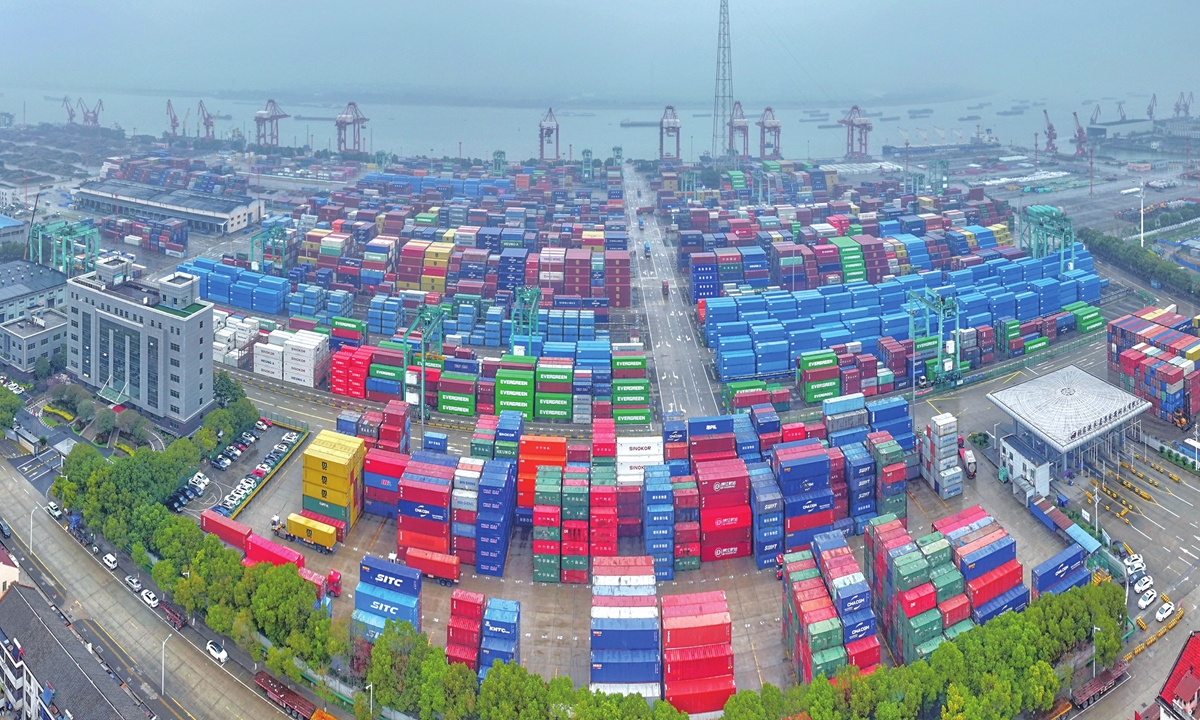
Transport vehicles shuttle between stacks of containers at the container terminal of Zhangjiagang Port, as cargo operations proceed in a busy and orderly manner in Zhangjiagang, East China's Jiangsu Province, on March 16, 2026. Photo: VCG
Boosting regional cooperationCurrently, the world is facing unprecedented changes unseen in a century: Geopolitical tensions are intensifying, the global economic outlook remains sluggish, and multilateralism and free trade are facing severe challenges. Against this backdrop, this year's Government Work Report stated that "We should continue to pursue mutually beneficial cooperation, steadily expand opening-up at the institutional level, and promote broader international economic flows, so as to advance reform and development through opening-up."
China's development provides an important foundation for addressing global issues and a key driving force for world economic growth, Lin said.
Lin pointed out that in recent years, the global governance system and international trade order have been impacted, and the role of multilateral mechanisms like the WTO has been weakened. "However, globalization remains an irreversible trend, and regional cooperation has become an important path to compensate for the shortcomings of global cooperation," he said.
"Previously, the US was China's largest trading partner, but now ASEAN has become China's largest trading partner," Lin said. "This change highlights the vitality of regional cooperation."
As a responsible major country, China has always promoted globalization. At the same time, through the China-proposed Belt and Road Initiative, China helps partner countries address infrastructure gaps and drives their development through trade and investment to achieve mutual benefit and win-win results, the economist noted.
In terms of China's contribution to the global economy, Lin said China has contributed around 30 percent on average to global economic growth each year since 2008.
"The proportion may have been higher in 2025, which will be confirmed after the World Bank releases the relevant data in June or July," he said.
Lin emphasized that China is committed to open development, guided by the new development philosophy featuring innovative, coordinated, green, open, and shared development. This not only enables Chinese people to share the dividends of development but also creates jobs and boosts economic growth for other countries through trade, he said.
Regarding how the international community can share China's development achievements, Lin said that as long as they adhere to international trade rules and maintain friendly trade relations with China, they can seize the opportunities from China's development and achieve common development.
RELATED ARTICLES