Editor's Note:
With services now forming the bedrock of the Chinese economy, the country has elevated the sector's strategic importance to new heights. The 15th Five-Year Plan (2026-30) has called for improving the services sector's quality, efficiency and competitiveness, underscoring its role in supporting industrial upgrading, meeting people's livelihood needs and driving job growth. To document the sector's rapid development, the Global Times has launched this special column - China Services Momentum. This piece focuses on how China is bolstering its commitment to providing better services for its senior citizens.
Tucked inside a community commercial complex in Shanghai, a wall plastered with handwritten sticky notes bears seniors' genuine requests, offering a tangible snapshot of the transformation underway in China's elderly‑care services industry.
Notes read: "I need stair lifts," "I want easy‑to‑use nail clippers," "My bathroom floor is slippery and needs age‑friendly renovation." Every small wish is collected, matched with professional brands and services, and eventually turned into real-life improvements. This heartwarming scene is a vivid example of China's booming silver economy.
Launched in December 2025, Shanghai's silver‑age store is a front‑line offline outlet dedicated to individual senior consumers. It not only sells products tailored for seniors but also compiles a wish list of goods and services requested by senior visitors.
"We set up the wish wall to gather all kinds of product and services demands from seniors," Song Xiaobao, assistant general manager of Shanghai Aging Industry Development Co, which operates the store, told the Global Times. "We call this 'demand cross‑matching.' We connect seniors' real‑world needs with brands looking to develop home‑based elderly‑care businesses, turning handwritten wishes into complete, accessible service packages."
Wishes made, steps taken
Many items requested on the wish wall have been rolled out since the store opened, ranging from small goods such as magnifying nail clippers to larger mobility equipment like stair lifts.
Spanning 1,200 square meters, the store brings together dozens of Chinese and foreign brands, offering the elderly more than 100 categories of age‑friendly products and services.
The outlet follows an "experience‑first, purchase‑later" approach. In dedicated experience zones, smart wheelchairs, exoskeleton robots, fall‑proof vests, anti‑slip flooring, safety grab bars and accessible shower chairs are on show. On‑site staff provide one‑on‑one hands‑on guidance and real‑life scenario demonstrations to ease senior citizens' apprehension and confusion over unfamiliar high‑tech elderly‑care devices.
"Many seniors just drop by for a casual look on their first visit. They come back with measuring tapes to take dimensions and draft custom renovation plans for their old apartments," Song said.
Operational data shows strong momentum for community‑led, experience‑based elderly‑care services. The store receives 300‑500 daily visitors in peak season, with monthly sales averaging 500,000 yuan ($74,197). Monthly preliminary orders for home age‑adaptation renovations hover around 1 million yuan, signaling solid demand for premium in‑home senior solutions.
Zhou Lida, who runs a hearing rehabilitation booth at the store, told the Global Times the space was originally just for brand promotion. Yet actual sales have exceeded expectations. This shared showroom model lowers costs and helps B2B businesses connect with elderly household customers.
This pioneering outlet in Shanghai is not an isolated local trial. It represents local implementation of national‑level silver‑economy and services‑consumption expansion policies rolled out in 2026.
Similar silver‑care stores have been launched in cities including Beijing, Jinan in East China's Shandong Province and Suzhou in East China's Jiangsu Province.
Trillion-dollar market
Industry experts point out that silver‑care stores across the nation offer a vivid example of how demand‑driven community platforms can unlock new potential in elderly‑related services consumption, in line with national strategies.
On July 13, the State Council issued the plan for expanding consumption under the 15th Five‑Year Plan (2026‑30) period, which calls for expanding elderly‑care consumption. In services consumption, it advocates expanding and supporting elderly‑care-related spending.
The plan encourages social entities to deliver more affordable senior‑care services and advance sustainable growth for the silver economy. It includes measures to upgrade county‑level elderly‑care services and leverage digital tools and new technologies to modernize the senior‑care sector.
In January, eight ministries including the Ministry of Civil Affairs jointly released measures to cultivate elderly‑care service operators and boost silver‑economy development, putting forward 14 targeted policies to meet seniors' diverse demands.
Policy priorities include optimizing supplies of senior‑care and age‑friendly products, expanding 15‑minute convenient‑life service circles, building platforms that connect suppliers, service providers and elderly consumers, and advancing research and development for elderly‑care technologies such as robotics, rehabilitation aids and smart‑home systems.
"The silver economy spans thousands of industries," Song said. "Any consumption or service that improves the quality of life for people aged 50 and above falls within its scope. Over the next five to 10 years, the post‑1960s and post‑1970s generations will enter old age, bringing rising demand for premium elderly‑care services and moving the whole industry toward sustainable profitability."
China's silver‑economy still holds huge untapped potential. Official data shows China's population aged 60 and above exceeded 310 million in 2024 and is projected to surpass 400 million by 2035.
The silver economy is not just simple elderly care services. It covers all products and services for seniors, as well as retirement preparation needs for middle-aged and young people. It includes daily supplies, life services, healthcare, entertainment and retirement planning. This full-chain industry has the potential to boost domestic consumption, improve people's livelihoods and drive economic upgrading, with steady market demand and huge growth potential, Zhang Yi, CEO of iiMedia Research, told the Global Times on Monday.
According to data from the State Information Center, the market size of China's silver economy reached 8.3 trillion yuan in 2024 and is expected to exceed 20 trillion yuan by 2030.
With services now forming the bedrock of the Chinese economy, the country has elevated the sector's strategic importance to new heights. The 15th Five-Year Plan (2026-30) has called for improving the services sector's quality, efficiency and competitiveness, underscoring its role in supporting industrial upgrading, meeting people's livelihood needs and driving job growth. To document the sector's rapid development, the Global Times has launched this special column - China Services Momentum. This piece focuses on how China is bolstering its commitment to providing better services for its senior citizens.
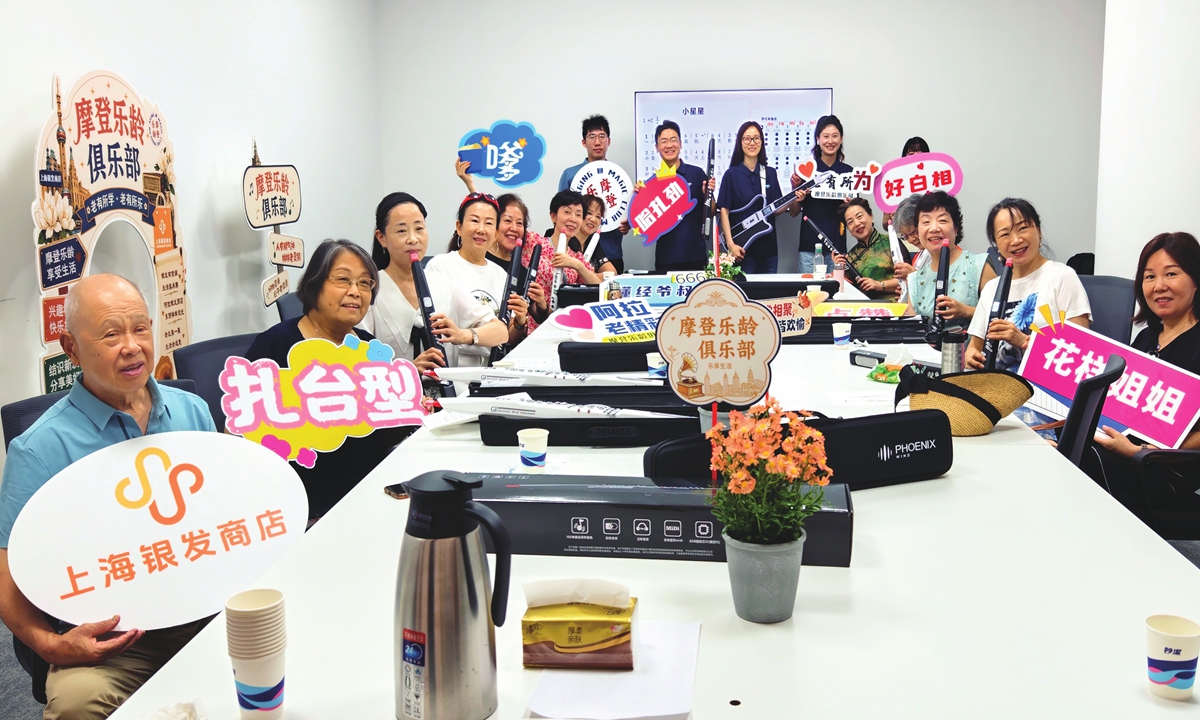
Seniors try out electronic saxophones at Shanghai silver?age store on July 27, 2026. Photo: Courtesy of the store
Tucked inside a community commercial complex in Shanghai, a wall plastered with handwritten sticky notes bears seniors' genuine requests, offering a tangible snapshot of the transformation underway in China's elderly‑care services industry.
Notes read: "I need stair lifts," "I want easy‑to‑use nail clippers," "My bathroom floor is slippery and needs age‑friendly renovation." Every small wish is collected, matched with professional brands and services, and eventually turned into real-life improvements. This heartwarming scene is a vivid example of China's booming silver economy.
Launched in December 2025, Shanghai's silver‑age store is a front‑line offline outlet dedicated to individual senior consumers. It not only sells products tailored for seniors but also compiles a wish list of goods and services requested by senior visitors.
"We set up the wish wall to gather all kinds of product and services demands from seniors," Song Xiaobao, assistant general manager of Shanghai Aging Industry Development Co, which operates the store, told the Global Times. "We call this 'demand cross‑matching.' We connect seniors' real‑world needs with brands looking to develop home‑based elderly‑care businesses, turning handwritten wishes into complete, accessible service packages."
Wishes made, steps taken
Many items requested on the wish wall have been rolled out since the store opened, ranging from small goods such as magnifying nail clippers to larger mobility equipment like stair lifts.
Spanning 1,200 square meters, the store brings together dozens of Chinese and foreign brands, offering the elderly more than 100 categories of age‑friendly products and services.
The outlet follows an "experience‑first, purchase‑later" approach. In dedicated experience zones, smart wheelchairs, exoskeleton robots, fall‑proof vests, anti‑slip flooring, safety grab bars and accessible shower chairs are on show. On‑site staff provide one‑on‑one hands‑on guidance and real‑life scenario demonstrations to ease senior citizens' apprehension and confusion over unfamiliar high‑tech elderly‑care devices.
"Many seniors just drop by for a casual look on their first visit. They come back with measuring tapes to take dimensions and draft custom renovation plans for their old apartments," Song said.
Operational data shows strong momentum for community‑led, experience‑based elderly‑care services. The store receives 300‑500 daily visitors in peak season, with monthly sales averaging 500,000 yuan ($74,197). Monthly preliminary orders for home age‑adaptation renovations hover around 1 million yuan, signaling solid demand for premium in‑home senior solutions.
Zhou Lida, who runs a hearing rehabilitation booth at the store, told the Global Times the space was originally just for brand promotion. Yet actual sales have exceeded expectations. This shared showroom model lowers costs and helps B2B businesses connect with elderly household customers.
This pioneering outlet in Shanghai is not an isolated local trial. It represents local implementation of national‑level silver‑economy and services‑consumption expansion policies rolled out in 2026.
Similar silver‑care stores have been launched in cities including Beijing, Jinan in East China's Shandong Province and Suzhou in East China's Jiangsu Province.
Trillion-dollar market
Industry experts point out that silver‑care stores across the nation offer a vivid example of how demand‑driven community platforms can unlock new potential in elderly‑related services consumption, in line with national strategies.
On July 13, the State Council issued the plan for expanding consumption under the 15th Five‑Year Plan (2026‑30) period, which calls for expanding elderly‑care consumption. In services consumption, it advocates expanding and supporting elderly‑care-related spending.
The plan encourages social entities to deliver more affordable senior‑care services and advance sustainable growth for the silver economy. It includes measures to upgrade county‑level elderly‑care services and leverage digital tools and new technologies to modernize the senior‑care sector.
In January, eight ministries including the Ministry of Civil Affairs jointly released measures to cultivate elderly‑care service operators and boost silver‑economy development, putting forward 14 targeted policies to meet seniors' diverse demands.
Policy priorities include optimizing supplies of senior‑care and age‑friendly products, expanding 15‑minute convenient‑life service circles, building platforms that connect suppliers, service providers and elderly consumers, and advancing research and development for elderly‑care technologies such as robotics, rehabilitation aids and smart‑home systems.
"The silver economy spans thousands of industries," Song said. "Any consumption or service that improves the quality of life for people aged 50 and above falls within its scope. Over the next five to 10 years, the post‑1960s and post‑1970s generations will enter old age, bringing rising demand for premium elderly‑care services and moving the whole industry toward sustainable profitability."
China's silver‑economy still holds huge untapped potential. Official data shows China's population aged 60 and above exceeded 310 million in 2024 and is projected to surpass 400 million by 2035.
The silver economy is not just simple elderly care services. It covers all products and services for seniors, as well as retirement preparation needs for middle-aged and young people. It includes daily supplies, life services, healthcare, entertainment and retirement planning. This full-chain industry has the potential to boost domestic consumption, improve people's livelihoods and drive economic upgrading, with steady market demand and huge growth potential, Zhang Yi, CEO of iiMedia Research, told the Global Times on Monday.
According to data from the State Information Center, the market size of China's silver economy reached 8.3 trillion yuan in 2024 and is expected to exceed 20 trillion yuan by 2030.
RELATED ARTICLES