World's longest undersea high-speed rail tunnel completes high-pressure shield cutter replacement in E.China
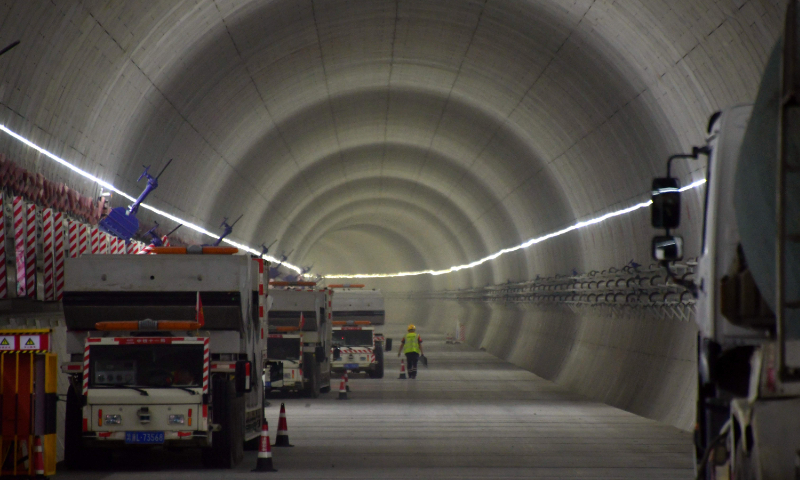
Material transport vehicles park at the construction site of the Jintang undersea tunnel of the Ningbo-Zhoushan high-speed railway in Ningbo, East China's Zhejiang Province. It is the world's longest undersea high-speed rail tunnel. File photo: VCG
Construction workers have completed the inspection and replacement of 104 shield cutting tools over a period of 21 days under high water pressure at the Jintang undersea tunnel on the Ningbo-Zhoushan railway in East China's Zhejiang Province. This marks a major milestone for the world's longest undersea high-speed rail tunnel and confirms that China's independently developed technology has passed a prolonged, ultra-high-pressure real-world test.
The 16.18-kilometer Jintang tunnel, with an 11.21-kilometer shield section, is the critical section of the Ningbo-Zhoushan high-speed railway. It will link the major port city of Ningbo with the Zhoushan islands, on the east side of Ningbo. Currently, the journey takes 1.5 to 2 hours by road or ferry. Once the railway opens, travel time will drop to as little as 26 minutes between the two cities.
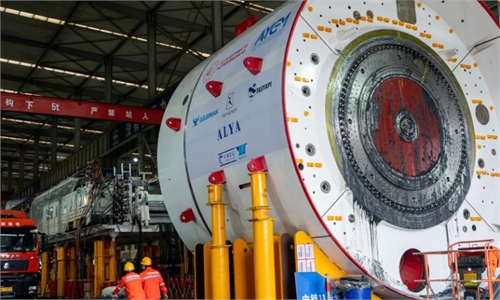
Two super-large-diameter shield machines are boring toward each other from opposite shores of Ningbo and Zhoushan. The shield machine "Yongzhou" on the continental shelf side must drive 4,940 meters through 24 alternating soft-and-hard rock layers - nearly 70 percent of the route, said China Railway 14th Bureau Group Co, the builder of the tunnel.
Rock strength reaches 191 megapascals (MPa), which falls into the "high strength" to "very high strength" category in geomechanical rock classification, causing severe cutter wear. At its deepest point, 92 meters below sea level, water and soil pressure hits 8.5 bar, with a 2,000-meter stretch exceeding 6 bar. Replacing cutters under such extreme pressure is widely regarded as one of the toughest challenges in shield tunneling, the company said.
Traditional compressed-air methods allow only about 40 minutes of effective work per person per day and are limited to depths of around 60 meters. To overcome this, the construction team spent three years adapting deep-sea saturation diving technology.
They developed China's first domestically built saturation hyperbaric system for shield tunneling - nicknamed the "Deep-Sea Space Station," Dong Bing, chief mechanical engineer of Jintang tunnel project at the company, was quoted as saying.
"The system includes living, transfer and control modules, all designed and manufactured in China. It can house nine workers for extended periods. Crew members travel to the work face in a transfer chamber and can operate for up to eight hours at a stretch, enabling 24-hour multi-shift work for as long as 28 days. After the job is finished, workers undergo a single controlled decompression, greatly reducing health risks from repeated pressure changes," said Dong.
At present, the "Yongzhou" machine has already advanced 3,936 meters - nearly 80 percent of its task.
Global Times
RELATED ARTICLES