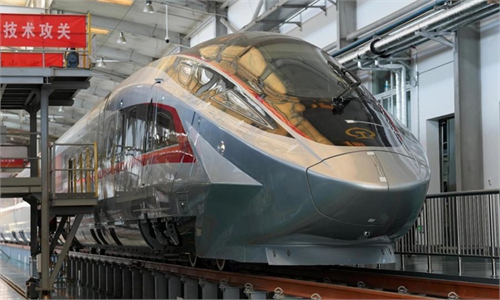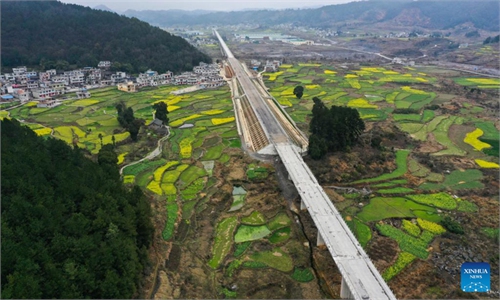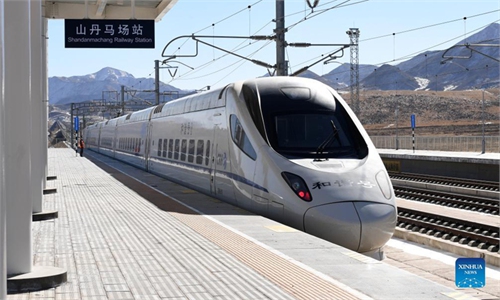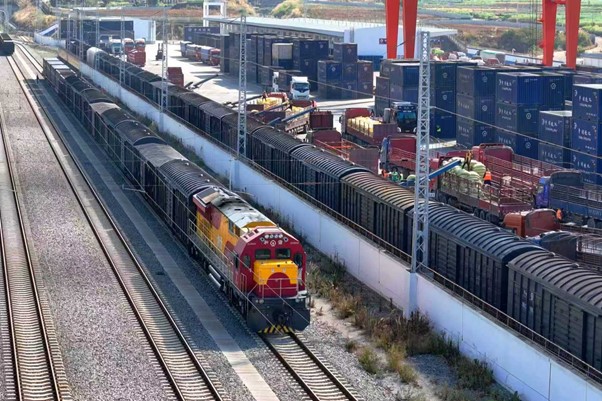
China's high-speed rail network achieves a milestone on December 10, 2025, as the Yiliang Tunnel — the country's longest tunnel built for a 350 km/h line — is bored through after more than 1,560 days of construction, paving the way for the Chongqing-Kunming high-speed railway. Photo: Courtesy of China Railway Kunming Group
China's high-speed rail program reached a milestone as the Yiliang Tunnel, the longest tunnel built for any 350 kilometers per hour rail line in the country, was bored through on Wednesday after more than 1,560 days of construction, laying a solid foundation for the opening of the Chongqing-Kunming high-speed railway, according to a statement China Railway Kunming Group Co sent to the Global Times.
The Yiliang Tunnel, located in Zhaotong, Southwest China's Yunnan Province, stretches 24.8 kilometers and is designed for trains running at 350 kilometers per hour. With a maximum overburden of 920 meters and a twin-bore, single-track layout, it is China's longest and fastest high-speed rail tunnel to be completed, according to the statement.
The tunnel cuts through the heart of the Wumeng Mountains, an area of steep terrain and highly complex geology. Builders faced a range of extreme conditions including rock bursts, high temperatures, inrushes of water, mud surges, severe soft-rock deformation, and high stress, placing the project in the highest risk category and making construction exceptionally challenging.
Rao Shengbin, project director for the Yukun high-speed railway at China Railway Construction Bridge Engineering Bureau Group Co, said that the project team used an integrated smart temperature-control system that combined ice cooling, intelligent ventilation and mist spraying to keep the tunnel at about 30 C, ensuring safe working conditions for crews and equipment, according to the statement.
The team also developed a three-dimensional drainage system featuring coordinated pump stations, smart monitoring, emergency backup and wastewater separation. With high-power pumps working in tandem, the tunnel can drain up to 345,000 cubic meters of water per day, providing a new solution for uphill drainage in the construction of China's high-speed rail system.
With the breakthrough of the Yiliang Tunnel, 96 percent of all tunnels on the Yukun high-speed railway's Yunnan section have been completed, with all 53 tunnels set to be fully connected soon, the statement said.
The Yukun line runs roughly 700 kilometers, including 388.6 kilometers in Yunnan. It is the province's first 350 kilometers per hour high-speed railway. It will cut the travel time between Chongqing and Kunming to about two and one-half hours, strengthening links between the Chengdu-Chongqing economic circle and the central Yunnan city cluster and supporting high-quality development along the corridor.
Bian Yongzu, a senior researcher at the China Institutes of Contemporary International Relations, told the Global Times on Wednesday that the breakthrough of the Yiliang Tunnel once again underscores China's ability to build high-speed rail through some of the country's most challenging geology.
As one of the longest and fastest high-speed rail tunnels in China, it reflects world-leading progress in tunneling equipment, engineering methods and project management. He noted that China's infrastructure sector has repeatedly set new records in complex, high-risk environments, showing that its technical system has reached a high level of maturity.
Bian noted that China's infrastructure strength lies not only in engineering prowess but also in its organizational and system-level capabilities. Behind major projects, ranging from high-speed rail and bridges to supertall buildings, China has developed a comprehensive management and standards system that keeps its infrastructure sector globally ahead. Such capacity has become one of the most competitive national assets in today's global economy, according to Bian.
Bian noted that the Chongqing-Kunming high-speed rail line carries significance far beyond transport. It will deepen the flows of people, goods and industry between the two regions. It will boost cross-province travel and property demand, given Chongqing's hot summers and Yunnan's mild climate, strengthening broader economic ties.
Strategically, Yunnan is China's gateway to South and Southeast Asia, while Chongqing is a major hub for China-Europe freight trains. The new line will tighten the corridor linking Southeast Asia, Western China and Central Asia, offering faster channels for logistics and mobility and further unlocking the region's development potential, he said.
Global Times
RELATED ARTICLES