Global clients make business trips to China to seek tech solutions
Trend driven by nation’s industrial upgrade, enhanced innovation capacity
By Liu Yang and Published: Aug 18, 2026 07:16 PM

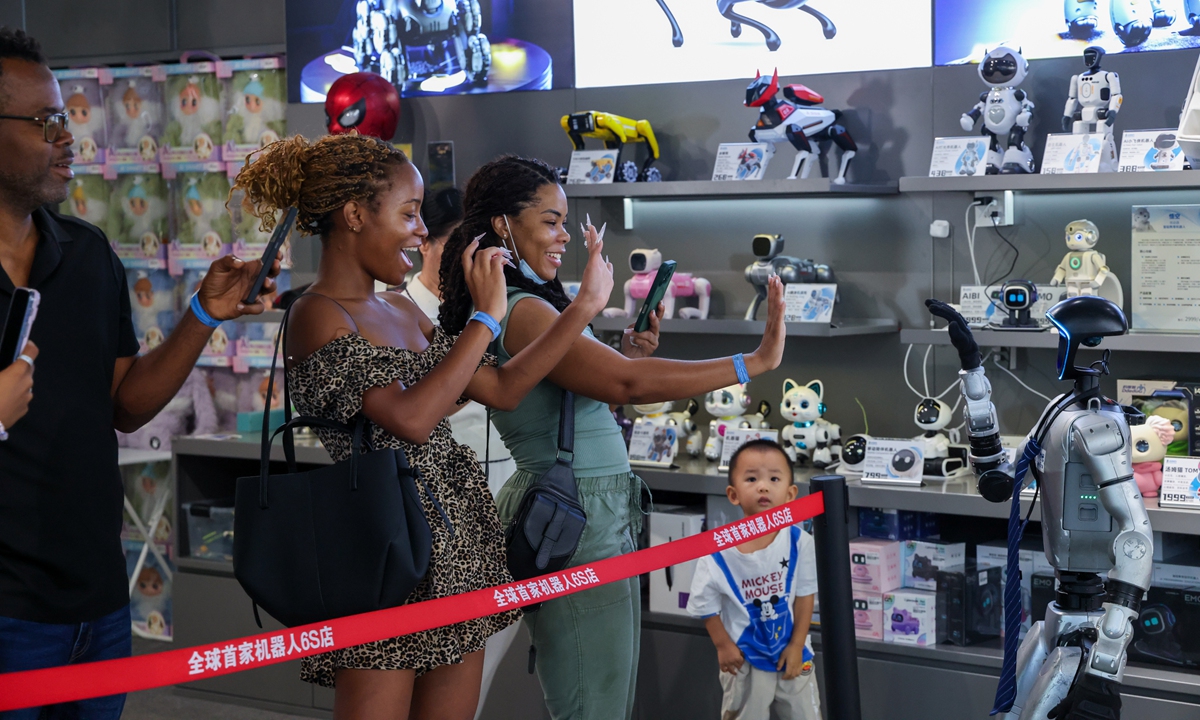
Photo released on August 9, 2026 shows tourists from Jamaica interacting with a humanoid robot at the world's first robot 6S store in Longgang District, Shenzhen, South China's Guangdong Province, on August 4. Photo: Xinhua
Following the trend of "reverse overseas shopping" — where foreign tourists arrive in China with empty suitcases for shopping sprees — an increasing number of overseas clients are now coming to China on business trips in search of the latest technology solutions and next-generation products.
Chinese experts said that it reflects China's comprehensive upgrade from making products to building up innovation capability, thanks to the country's efficient supply chains and rich application scenarios, which will continue to provide good opportunities for global companies.
"We've recently hosted a number of foreign companies, including ones from Europe such as Germany and the UK, Southeast Asia, and South Korea. Almost everyone who comes asks similar questions: Why has China's development — especially in artificial intelligence and robotics — been so fast? And what can they learn from it and actually put into practice?" Liu Shaoshan, director of the Embodied AI at the Shenzhen Institute of Artificial Intelligence and Robotics for Society based in South China's Guangdong Province, told the Global Times on Tuesday.
These foreign clients usually visited robot 6S stores in Shenzhen, toured robot exhibition halls, listened to our introductions of specific companies, and then received recommendations on which ones to approach for concrete discussions on collaboration, Liu said.
Chen Yilun, CEO of Shanghai TARS Robotics Co, shared a similar story in a recent interview with CCTV News, during which he said that the research and development director of a Nordic automotive supply chain company visited his company three times within nine months.
Coming every three months, the director found that the ideas he had heard about on the previous visit had already become reality, and progress even exceeded expectations in some cases. On the third visit, the Nordic client simply moved its annual global innovation summit to the laboratory of TARS.
In addition to the robotics sector, Chinese photovoltaic producer LONGi also welcomed several visits from two foreign solar-powered racing teams, one from Belgium and another from the Netherlands.
"These two teams came here to work with our R&D engineers and production lines to repeatedly refine solutions, as they aimed to stand out in the 2026 Elektrek American Solar Challenge held in the US," a company representative told the Global Times on Tuesday.
After several rounds of discussions, the company provided distinct technical routes and vehicle designs with custom flexible modules and high-efficiency cell solutions for these two teams, and they swept the top two places of the race, according to the company.
In the past, China, as the "world's factory," handled production and manufacturing in the global industrial division of labor. Today, this path is being rewritten. In emerging fields such as robotics and photovoltaics, some Chinese companies have already acquired the capability for "technology definition," Hu Qimu, a deputy secretary-general of the Digital-Real Economies Integration Forum 50, told the Global Times on Tuesday.
"Overseas clients coming to China are no longer looking for contract manufacturing, but rather seeking the latest technology solutions and next-generation products. This reflects China's comprehensive upgrade from product manufacturing to full-spectrum innovation capability," Hu noted.
China possesses a complete industrial system and resilient, efficient production and supply chains, which have forged the world-astounding "China Speed." This is also a key reason that continuously attracts foreign clients to make business trips to China, Hu said.
Liu told the Global Times that in Shenzhen, innovation is a highly efficient process. He estimates that for the same robot hardware, China's development cycle is only one-tenth to one-fifth of that in the US.
More examples support Liu's remarks. In robotmaker Agibot's supply chain, 90 percent of components can be sourced locally within the Yangtze River Delta, with core parts achieving hour-level response times. A new-energy vehicle can be fully manufactured without even leaving Anhui Province. In Shanghai's "Brain Intelligence Hub," numerous brain-computer interface companies cluster together, where "upstairs and downstairs are upstream and downstream," the People's Daily reported.
According to a report released by the World Intellectual Property Organization, China entered the global top 10 for the first time and ranked fifth worldwide in the innovation output dimension in 2025. Among the world's top 100 innovation clusters, China accounted for 24, ranking first for the third consecutive year.
The significance of these clusters goes beyond the sheer number of patents and academic papers. It lies in the high-frequency interaction among talent, supply chains, capital, and application scenarios within a relatively compact space, analysts said.
China's ultra-large market and extremely rich application scenarios also support the continuous expansion of "China solutions" overseas, Li Chang'an, a professor at the Academy of China Open Economy Studies at the University of International Business and Economics, told the Global Times on Tuesday.
"The Chinese market's huge demand and diverse scenarios enable technologies to be rapidly tested and iterated. Overseas clients can find solutions to their real-world problems in China, form proven models, and then apply and promote them to the global market," Li Chang'an said.
RELATED ARTICLES