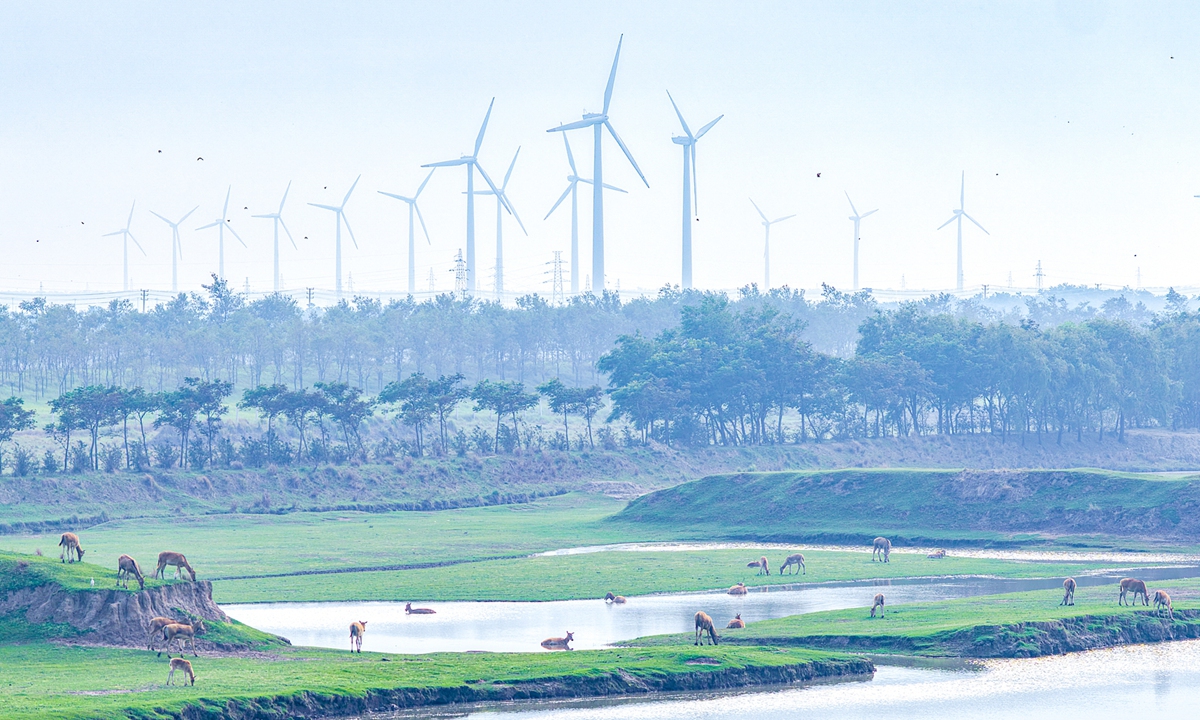
Herds of elk graze in the foreground of a lush wetland in Yancheng, East China's Jiangsu Province, while rows of wind turbines turn gracefully against the distant sky on July 16, 2026. Photo: VCG
Western media outlets have long viewed China's renewable energy progress with a bias rooted in competitive anxiety, warning of "overcapacity" when installations surge, and crying "waste" the moment curtailment shows up.
The latest case was a Reuters report on Monday headlined "China leads wave of clean power wastage as grids globally hit limits." The report claimed that "China turned away enough clean energy to power Mexico for a year in the six months through June as its grids hit their limits."
While the article acknowledged that power curtailment - the pre-emptive rejection of wind or solar power because a grid reaches capacity - is not exclusive to China, it nonetheless put the country squarely in the spotlight. This was hardly the first time that some in the West targeted China's new-energy sector. Build too little, and China is accused of dragging its feet on the energy transition; build too much, and it is slapped with labels of "overcapacity" or "waste."
The core of the issue is never that any single country is building "too much" new-energy capacity. It is simply that upgrades to power grids, energy storage systems and market mechanisms have failed to keep pace with the growth of renewable energy installations. This is a systemic challenge faced by all economies integrating high shares of intermittent renewables, rather than a China-specific problem.
Even the Reuters report acknowledged that curtailment issues are spreading globally. Australia's curtailments surged 37 percent to 2.93 terawatt-hours in the first half of 2026, while Japan's grid rejected 2.35 terawatt-hours, a jump of 34 percent. India curtailed 8.13 terawatt-hours of solar power in the second quarter. In Europe, as renewable energy capacity grows and energy storage capacity lags, negative prices for electricity are getting more common.
Given this global backdrop, why is China singled out? The answer is simple: China has the largest market and the fastest growth, and it draws the most global attention.
According to China's National Energy Administration, the country's wind power utilization rate reached 90.9 percent and the photovoltaic utilization rate reached 91.4 percent in the first half of 2026, meaning that more than 90 percent of China's generated clean electricity was actually put to use. Such utilization holds up well against global benchmarks. Fixating purely on absolute curtailment volumes without referencing utilization rates creates a misleading comparison.
What's worse is that some highlight the curtailment issue while selectively overlooking China's sustained efforts to tackle the problem. China spans a vast territory, with rich wind and solar resources located far away from the densely populated load centers, creating inherent natural challenges for long-distance power transmission. To address this, China has been steadily advancing the construction of its ultra-high voltage (UHV) transmission network.
Today, it takes only an instant - about 5 milliseconds, to be exact - for electricity generated in Northwest China's Qinghai Province to travel more than 1,500 kilometers and reach the power-intensive Central China via UHV lines. To date, 46 UHV transmission lines have been completed, with the transmission capacity of the country's west-to-east power transmission program reaching more than 340 million kilowatts.
When it comes to energy storage, China's progress has also been impressive. The country's installed new-type energy storage capacity increased 61 percent year-on-year to 153 million kilowatts as of the end of June 2026.
A report released by the National Energy Administration showed that during the 14th Five-Year Plan (2021-25) period, China's installed new-type energy storage capacity increased from 3 million kilowatts to 136 million kilowatts, roughly doubling each year.
From expanding long-distance transmission corridors to scaling up the deployment of energy storage, these are not empty promises but concrete, systematic actions. They represent China's direct response to the integration challenges and its ongoing exploration of how to complete a new-type power system.
The energy transition is a marathon that demands persistence and patience. Any major economy pursuing large-scale replacement of fossil fuels with renewables must navigate growing pains, including grid adaptation, storage rollout and the adjustment of market mechanisms, and this can never be accomplished overnight.
China's massive investment in renewable energy serves not only its own dual carbon commitments but also explores a viable global path for the steady operation of an energy system with a high proportion of renewables.
Rather than having nitpicked the short-term challenges in China's development process, some in the West would be better advised to tackle their own homegrown troubles surrounding the energy transition and grid upgrading. After all, global climate targets will never be achieved by blaming others.
RELATED ARTICLES