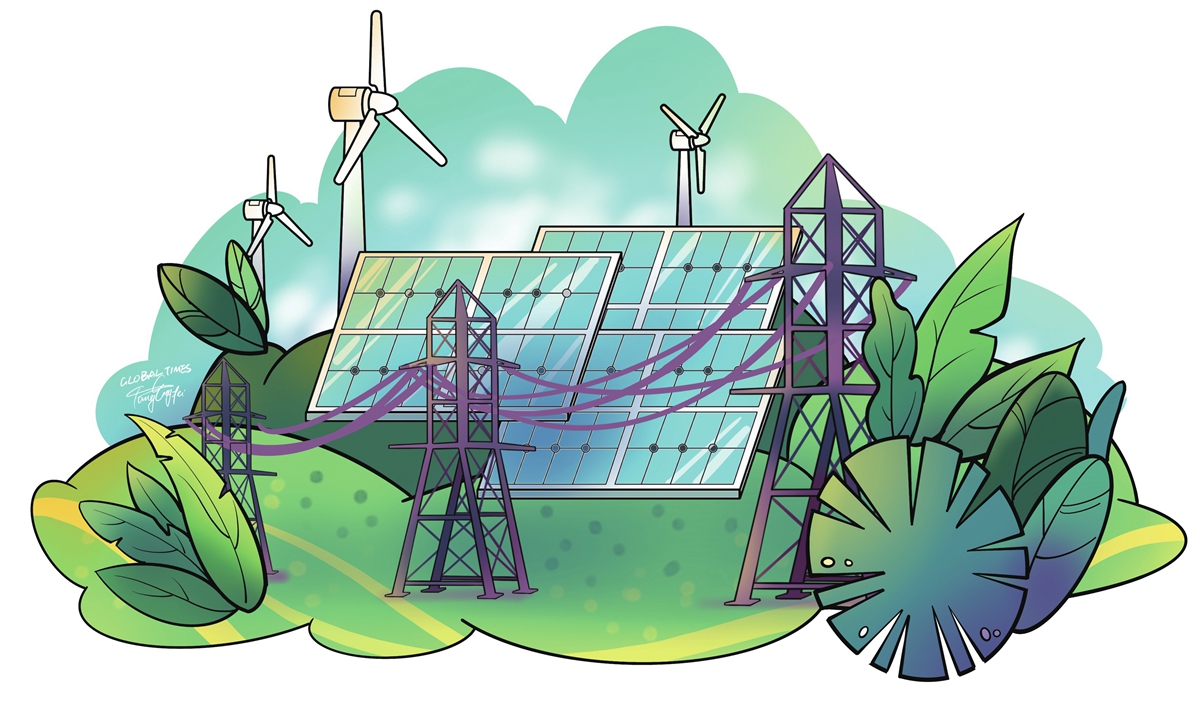
Illustration: Tang Tengfei/GT
On Tuesday, Bloomberg published an article headlined "China's Still Building Wind and Solar Despite Risk of Waste." The headline directs attention to a question: does China's renewable energy expansion really create the risk of "waste"?Around China's renewable energy sector, an unsupported narrative of "overcapacity" is being promoted in some international discussions. The argument is that if China continues to add renewable capacity while some of the electricity risks going unused, this could initially appear to reinforce the claim that the industry has expanded beyond demand. But is that really the case? The answer can be found by looking at three aspects.
First, unused renewable generation does not necessarily mean that too much renewable capacity has been built. It's a challenge confronting clean energy markets around the world. In many cases, the issue is not that renewable generation exceeds demand, but that the power system lacks sufficient capacity to store, transmit or integrate the electricity produced.
A simple example can illustrate the point. Many solar projects are built in remote areas with abundant sunlight, such as deserts. The electricity generated often needs to be transmitted over long distances to regions with higher demand. If transmission capacity falls short, some generation cannot be delivered to consumers, leaving renewable resources unused.
This is a global challenge. For instance, some regions in Europe face mounting pressure. Bloomberg reported in May that longer daylight hours during the solar season this year could result in about 40 terawatt-hours of electricity going to waste. That's up by one-quarter from 2025.
Second, in China, unused renewable generation remains within a limited and manageable range. Official data shows that renewable power utilization rates remain high. In the first three quarters of 2025, the average utilization rate for wind power reached 94.0 percent, while that for solar power stood at 94.7 percent.
These high utilization rates reflect China's broader efforts to build a more resilient renewable energy system. While expanding renewable capacity, China has also invested in supporting infrastructure, including power grids and energy storage, allowing different parts of the system to work together more efficiently.
To improve cross-regional transmission of renewable power, China has continued to upgrade its power grid. During the 15th Five-Year Plan (2026-30) period, China plans to add 15 ultra-high-voltage direct current green power transmission corridors, bringing the scale of west-to-east power transmission to more than 420 million kilowatts.
Energy storage has become another important part of this effort. As of the end of 2024, China had built and put into operation 73.76 million kilowatts of new energy storage capacity. Its installed capacity accounted for more than 40 percent of the global total, making China the world's largest market for new energy storage.
These efforts have helped raise renewable power utilization rates. But maximizing the rate is not always the most economically efficient goal. Beyond a certain point, each additional percentage point of improvement can require disproportionately higher costs in grid upgrades, storage and other measures, ultimately increasing the cost of energy use. The objective is therefore not to eliminate every instance of unused renewable generation at any cost, but to find a level that balances renewable integration with overall system efficiency. This is fundamentally different from the idea of renewable energy waste or overcapacity.
Third, the ongoing process of integrating renewable power should not be mistaken for signs that China's renewable energy expansion has run out of room for growth. China's renewable energy sector continues to expand. In 2025, newly added renewable power capacity increased 21 percent year-on-year.
At the same time, China's evolving economy continues to create sustained demand for clean electricity. The growth of high-tech industries, including computing infrastructure, is adding new sources of electricity demand, with some of these sectors being particularly energy-intensive.
China's continued expansion of renewable power capacity is not a waste, nor does it point to overcapacity. On the contrary, there is still considerable room for further development. As high-tech industries such as computing infrastructure continue to expand, China will need a renewable energy sector that can keep pace with the evolution of its economy. The same is true for the global economy: growth will also require a strong and resilient renewable energy sector. What lies ahead is not overcapacity, but opportunity. Those opportunities should not be wasted through misunderstanding, geopolitical competition or narratives unsupported by facts.
The author is a reporter with the Global Times. bizopinion@globaltimes.com.cn
RELATED ARTICLES