China accounts for 71% of Brazilian soybean exports in first seven months of 2026: Brazilian grain exporters association
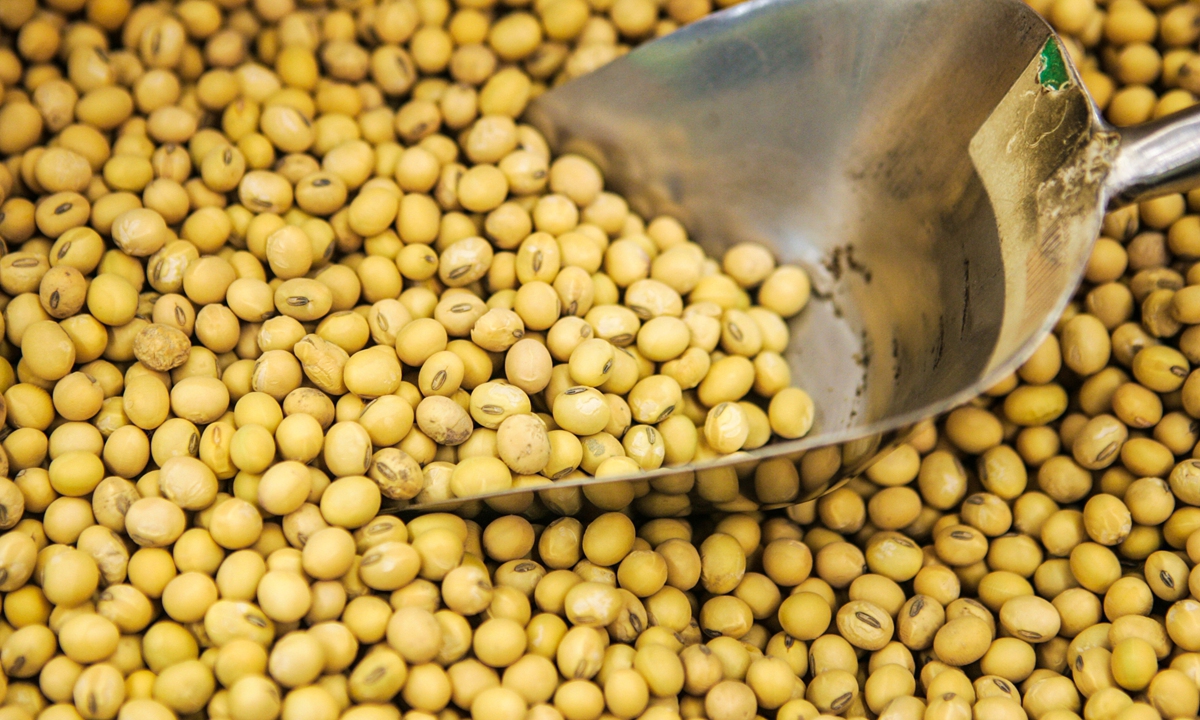
Soybean File photo: VCG
China remained by far the largest destination for Brazilian soybean exports in the first seven months of 2026, according to the Week 31/2026 statistics released by Brazil's National Association of Grain Exporters (ANEC).
From January to July, China accounted for 71 percent of Brazil's soybean exports, far ahead of Spain, the second largest destination, which accounted for 4 percent, while Thailand, Turkey and Iran each accounted for 3 percent, according to the latest data from the ANEC.
This followed a year-on-year decline in total US soybean exports during the 2025/26 marketing year, driven by US-China trade tensions.
Data from China's General Administration of Customs shows a sharp decline in soybean imports from the US. China's soybean imports from the US fell 20.6 percent year-on-year to 1.27 million tons in June, while imports from Brazil rose 13.7 percent to 12.08 million tons, according to GAC data.
Despite the contrasting trends in imports from different suppliers, China's overall soybean import demand remains strong. China's soybean imports reached 13.55 million tons in June, the highest level ever recorded for the month, data from the China Soybean Industry Association showed.
In 2025, China imported 111.83 million tons of soybeans, up 6.5 percent year-on-year, official data showed. China imported an average of 61 percent of the world's traded soybean supplies, more than the rest of the world combined, the American Soybean Association said, noting that "China is the world's largest soybean buyer, and the competition is nowhere close."
"The significant share of Brazil's soybeans exported to China demonstrates the importance of Chinese market for South American countries including Brazil... It also reflects the strong complementarity between the two economies, with bilateral agricultural trade remaining resilient despite uncertainties in global trade," Tang Jie, an expert at the Institute of American and Oceanian Studies at the Chinese Academy of International Trade and Economic Cooperation, told the Global Times on Wednesday.
As the world's biggest buyer and consumer of soybeans, China meets its substantial demand through imports from multiple countries and regions. Brazil, the US and Argentina are its three major soybean suppliers, while China also imports soybeans from countries including Canada and Uruguay.
The latest figures also reflect China's continued efforts to diversify its soybean import sources and strengthen the resilience of its agricultural supply chain, reducing potential disruptions arising from excessive reliance on any single supplier, said Tang, noting that with strong domestic demand and a growing number of suppliers, China has greater flexibility to adjust its purchases in response to changes in global market.
Imported soybeans are currently mainly used to produce soybean meal for animal feed and edible oil for food consumption.
Commenting on the significance of the Chinese market, Lucas Beber, President of the Brazilian Association of Soybean Growers (Aprosoja Brasil), told the Global Times in a previous interview that "China is absolutely strategic to Brazil's soybean industry," citing data showing that in 2025, China purchased 85.4 million metric tons, representing approximately 79 percent of all Brazilian soybean exports.
The two countries also have a highly complementary trade relationship. For Brazilian farmers, Chinese demand provides scale, market liquidity and greater capacity for long-term planning, said Beber.
China continues to be the leading destination for Brazilian soybeans, and the Brazilian soybean industry wants to further deepen this relationship, expecting historically high volumes in the coming months, said the head of the Brazilian industry association.
Global Times
RELATED ARTICLES