Taiwan island’s DPP rattled as Malaysian PM reaffirms Taiwan is part of China
By Published: Aug 19, 2026 01:34 PM

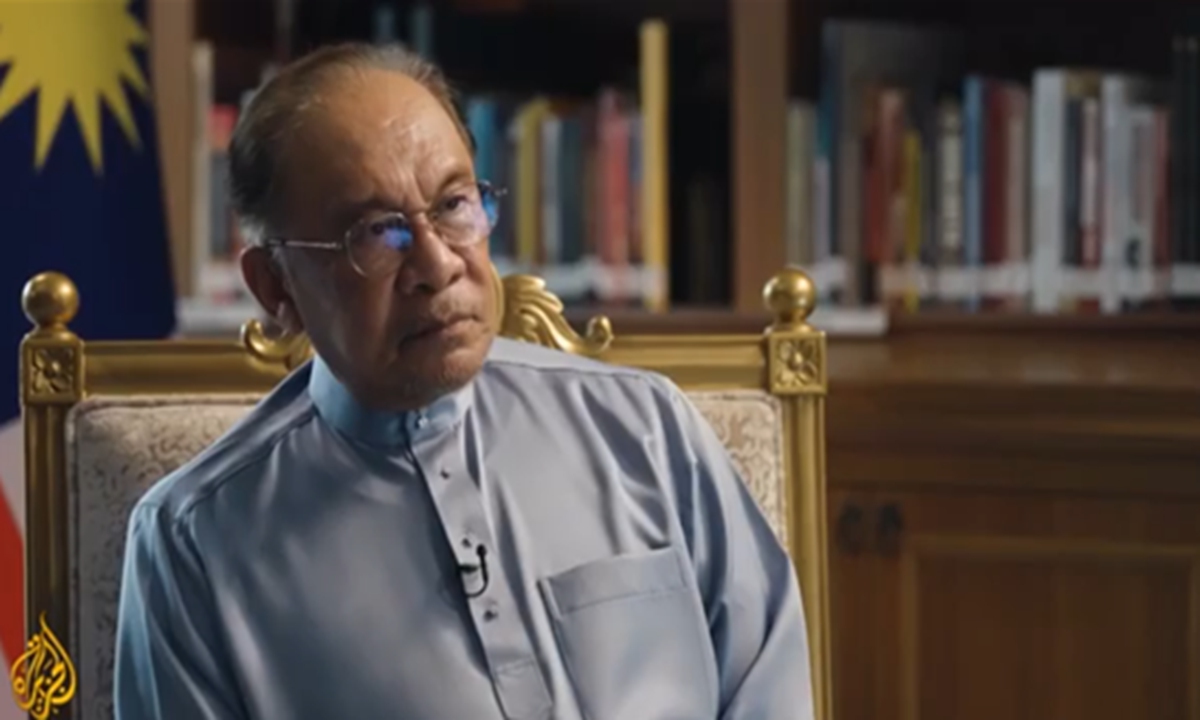
Screenshot from the video of Al Jazeera's interview with Malaysian Prime Minister Anwar Ibrahim
Upholding the one-China principle is where public opinion trends and the right thing to do. The international community's commitment to the one-China principle is not to be shaken. China commends Prime Minister Anwar Ibrahim's remarks, said Chinese Foreign Ministry spokesperson Lin Jian when asked to comment that Malaysian Prime Minister Anwar Ibrahim's recent remarks in an interview that Taiwan is part of China."Let me stress once again that there is but one China in the world, and Taiwan is an inalienable part of China's territory. China must and will achieve reunification. This will not be stopped," said Lin.
Speaking in a video interview released by Al Jazeera on Sunday, Anwar said, "I see Taiwan as part of China, period. We may disagree, there are some excesses. Yes, express your view, but it must be in the context. It is one China. It is accepted by all."
In response to the question on that "China has said that if peaceful reunification doesn't work, they reserve the right to use force. If it comes to that, would you condemn that?" Anwar responded by drawing an analogy with Malaysia. He said that if one province of Malaysia decides to break away, it would be his responsibility to protect the identity and unity of the nation.
When the host asked, "So, you would use force?" Anwar answered, "Yes," adding that otherwise the country would risk becoming fragmented.
Anwar's remarks on the Taiwan question highlight the firm international consensus on the one-China principle and reaffirm the basic principles enshrined in the UN Charter and international law, Zheng Jian, a professor at the Graduate Institute for Taiwan Studies at Xiamen University, told the Global Times.
Zheng noted that the Taiwan question is China's internal affair. A sovereign state has the right to safeguard its territorial integrity.
The Taiwan island's Democratic Progressive Party (DPP) was clearly rattled by Anwar's remarks on the Taiwan question.
Experts said this only underscores the one-China principle has long been an established international consensus, and that the more the "pro-independence" DPP peddles narratives of "international support for Taiwan" and stirs up trouble, the more developments will emerge that run counter to its "Taiwan independence" agenda.
In a statement issued on Tuesday, Taiwan's regional external affairs department called Anwar's recent remarks on Taiwan "false," claiming that Anwar openly justifies the mainland's position regarding use of force to unify Taiwan.
The Taiwan regional authorities claimed that Anwar's support for the Chinese mainland could negatively affect the confidence of Taiwan businesses investing in Malaysia.
The Taiwan regional authorities' claim of possible economic and trade losses for Malaysia carries limited weight and amounts largely to bluffing. Zheng noted that Taiwan island does not control any critical lifelines of Malaysia's economy, while Malaysia has alternative channels and partners. Such narratives therefore amount to little more than verbal posturing.
The Taiwan regional authorities' fierce but useless overreaction stems from the heavy reliance of "Taiwan independence" forces on external support. Once international statements contradicting their narrative gain traction within Taiwan region, their domestic propaganda - such as claims of "widespread international support" for Taiwan - risks unraveling, prompting their sharp backlash.
Also, aside from the Malaysian prime minister's recent remarks, the joint exercises recently held by China and Indonesia have also dealt a blow to the DPP authorities. As key countries along the "first island chain", their moves have opened a rift in the denial-and-deterrence defense system built by the US, Japan and Taiwan island, delivering a major strategic blow to "Taiwan independence" forces, said Zheng.
"The more the DPP provokes and hypes up issues, the more international developments unfavorable to 'Taiwan independence' will emerge. If the DPP continues down the doomed and erroneous path of 'independence,' there will be more occasions in the future when it finds itself rattled," Zheng said.
RELATED ARTICLES