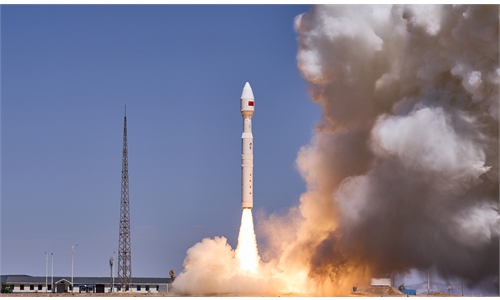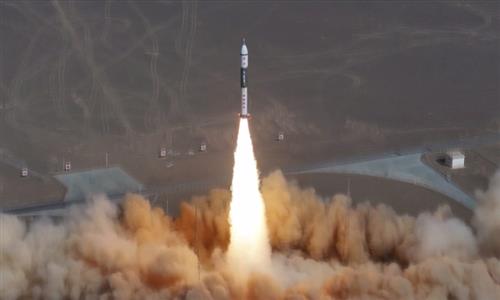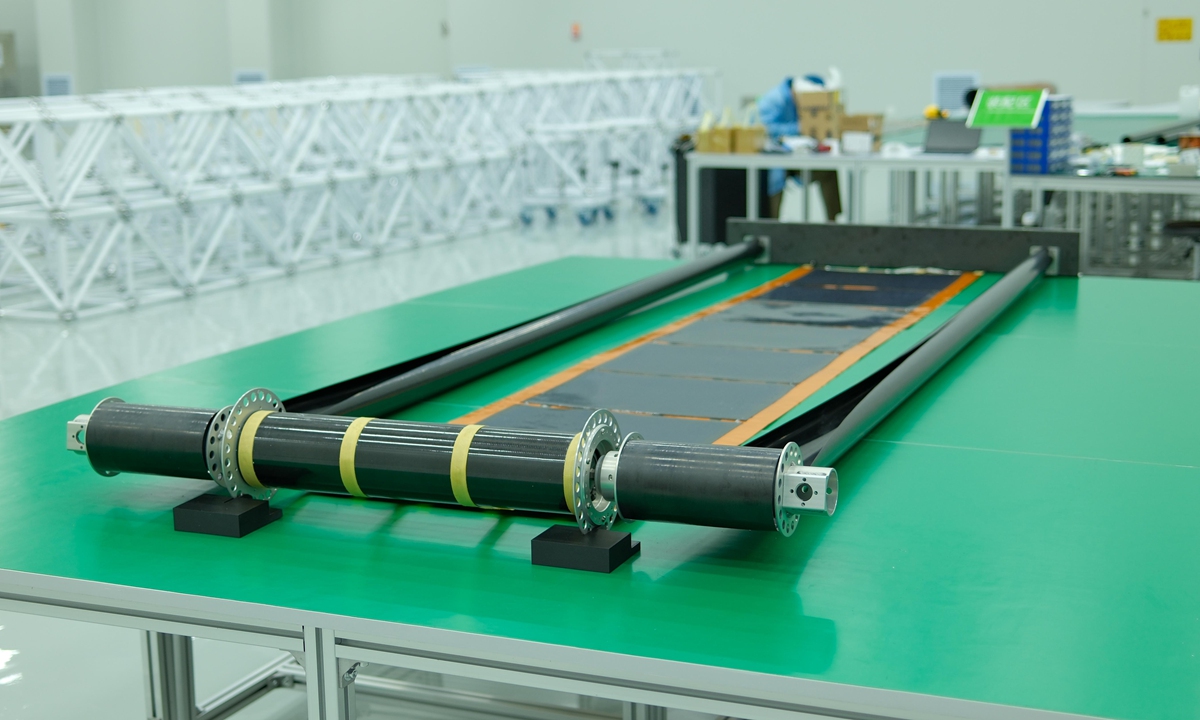
China's homegrown perovskite rollable solar wing prototype has completed and is about to enter in-orbit testing phase. Photo: Courtesy of Yanhe Tech
Recently completed, China's homegrown perovskite rollable solar wing prototype is about to enter the in-orbit testing phase. It can provide satellites with "ultra-light soft batteries" and marks the transition of perovskite space photovoltaic (PV) technology from laboratory validation to the engineering application stage, Chinese PV tech company Yanhe Tech told the Global Times on Wednesday in a statement.The prototype "Xingyun," developed by the enterprise, reconfigures the form and application model of space solar wings. During the launch phase, it can be rolled up into a compact reel form roughly the diameter of a thermos flask and flexibly mounted on the side walls of a satellite, maximizing the reduction of launch volume.
Once in orbit, it deploys in a controlled and smooth manner via a passive drive mechanism, offering precise retraction and deployment control with stable and reliable operation, said the statement.
With the accelerated development of China's commercial space industry, the mass deployment of micro-nano satellites, CubeSats, and low-Earth-orbit small constellations has become the mainstream trend. Traditional foldable solar wings, with their complex structures, relatively high weight and limited storage efficiency, are increasingly revealing their shortcomings and struggle to meet the high-frequency of multi-satellite mission launches. The industry urgently needs independently controllable, lightweight new-generation solar wings.
The "Xingyun" is 25 percent to 30 percent lighter than traditional foldable solar wings, enhancing effective payload capacity. When stowed, the solar wings - made of super-elastic memory composite material - are rolled up, which is much more space efficient than folding. Deployment is easier too, as the wings only need to be stretched outward in a single direction instead of undergoing the more complicated movements of being unfolded, according to the statement.
With a storage ratio of 35:1, it maximizes satellite payload space and better accommodates multi-satellite launches and stacking configurations, the Global Times learned from the company.
In terms of applications, a single-wing prototype can meet the power supply needs of micro-nano satellites and CubeSats. When multiple wings are arrayed to expand power output, it can support diverse space missions such as low-Earth-orbit communication and remote-sensing constellations, space computing nodes, and deep-space exploration payloads, making it a preferred technical solution for the next generation of lightweight spacecraft energy systems.
Founder and CEO Feng Fan said that perovskite solar wings still have a long way to go before large-scale application. Service life and tolerance to the extreme environment in space remain severe challenges that urgently need to be overcome. "The perovskite cells intended for application in space have an expected lifespan of only six months and are still at the initial stage of technology verification. The company is also using high-throughput AI to solve material formulation issues, continuously driving technological iteration and performance breakthroughs," Feng noted.
According to the company, "Xingyun" will next enter the in-orbit test phase. Building on its full-chain technological experience in new space PV technologies and space energy systems, the company has officially launched a space power station plan for 2030, which aims to construct, in phases, a three-tier space-based energy internet covering low Earth orbit, medium-to-high Earth orbits, and lunar space.
"China possesses the world's most complete and competitive PV industrial chain, which is the foundation of our confidence in developing space energy," Feng said, noting that private innovation forces will work in sync with major national missions, jointly exploring the space energy track.
RELATED ARTICLES