China’s 200,000 satellite filings at ITU underscore global responsibility
Aerospace exploration deepens
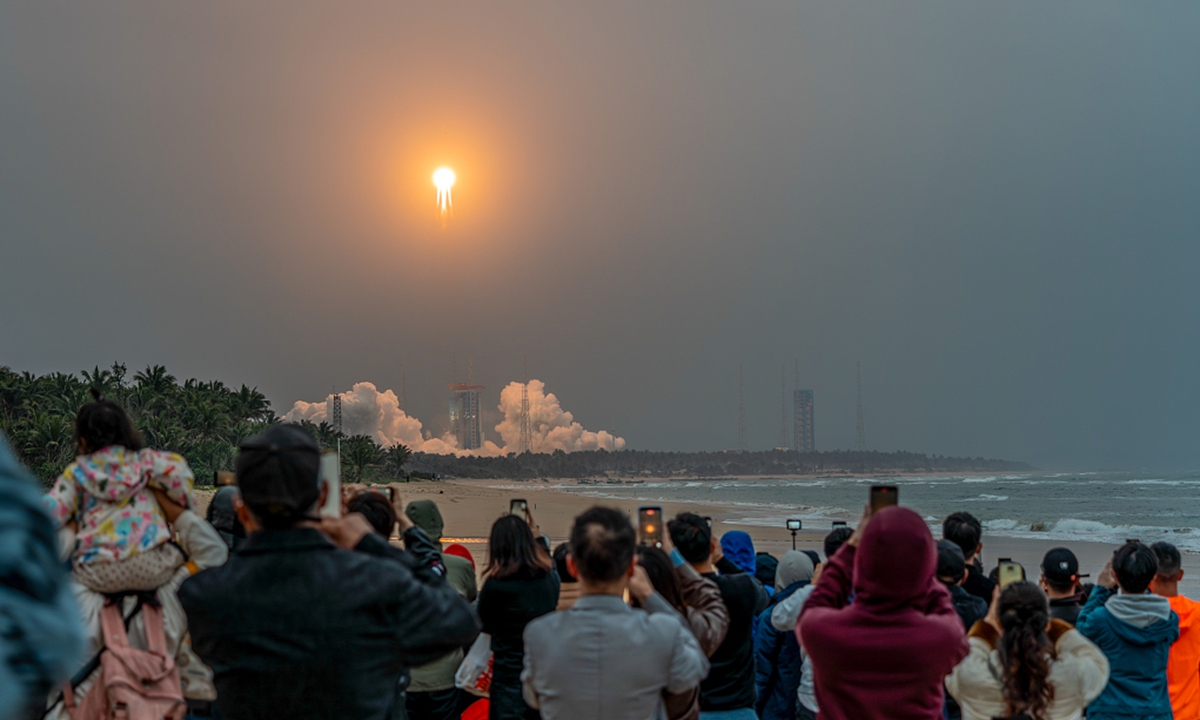
People watch the launch of a Long March-8A carrier rocket at South China's Hainan commercial space launch site in Wenchang on December 26, 2025. Photo: VCG
At 11:25 pm on Tuesday, a Long March-8A carrier rocket lifted off from China's Hainan commercial space launch site, sent the payload — the 18th group of low-orbit internet satellites — into preset orbits, Xinhua News Agency reported.The rocket's developer, China Academy of Launch Vehicle Technology, said the mission marked a complete success, delivering a "strong start" of the space launch program in 2026. The mission formally opened a year expected to see a dense cadence of space launches in China.
In the final week of 2025, multiple Chinese satellite operators were on the move. Information seen on the official website of the International Telecommunication Union (ITU) shows that China formally submitted applications for frequency spectrum and orbital resources covering more than 200,000 additional satellites with the ITU.
According to China's Science and Technology Daily, this represents the largest single batch of international frequency-and-orbit filings that China has ever made.
The move immediately drew attention from the domestic capital market investors and the international media. On Monday, shares linked to China's space sector surged sharply, prompting several listed companies to issue announcements explaining "abnormal" price movements. Some overseas media outlets even framed the development as Chinese space enterprises involving in a "space race" with SpaceX, whose satellite network is increasingly seen as carrying strategic weight on a global scale.
Experts say that with orbital resources becoming increasingly limited, China's active participation in space governance is not about competing with others. Instead, it reflects a distinctive commercial space development path, emphasizing major-power responsibility, rule-based coordination, and long-term planning to reduce the risk of future satellite collisions.
Systemic development path
Between December 25 -31, 2025, multiple Chinese satellite companies submitted applications covering approximately 203,000 satellites for frequency and orbital resources, spanning 14 satellite constellations across the medium- and low-Earth orbits (LEO), the ITU's website showed.
Notably, the two largest constellation s— CTC-1 and CTC-2 — each involve more than 96,700 satellites. Both were filed by the newly established Institute of Radio Spectrum Utilization and Technological Innovation, accounting for a majority of global applications.
A report by Securities Times shows that the institute was registered on December 30, 2025, in Xiong'an New Area, North China's Hebei Province. It was jointly founded by seven entities, including the National Radio Monitoring Center, local governments, commercial enterprises, and Chinese universities. The applications for the two mega-constellations were submitted one day before the institute's registration.
Liu Yuzhang, director of Taibo Research Institute, pointed out that the institute is not a traditional commercial operator, but rather an industry-academia-research consortium. "This suggests that China's satellite internet strategy has moved beyond the level of individual operations and is instead engaging at a higher level in international satellite communications governance, including the shaping of rules and standards."
He said that, by advancing coordinated mechanisms, China can form synergies in technical standards, communication protocols, and terminal compatibility, reducing redundant construction and resource waste, which reflects a more systemic and long-term strategic approach, distinct from development paths in the US and Europe that are often led primarily by capital or commercial alliances.
While satellite networks cannot fully replace terrestrial communications in the short term, they can establish new systems in remote areas or regions where ground base stations are difficult to deploy, Xiang Ligang, director-general of the Beijing-based Information Consumption Alliance, told the Global Times.
Chinese companies' massive satellite constellations fillings at the ICU reflect strategic planning and early-stage preparation in satellite communications, with the emphasis on building up its own connectivity capability and industrial layout rather than intensifying global competition, Xiang noted.
'A responsible move'
Compared with geostationary orbit and medium-Earth orbit, LEO satellites — offering lower latency and lower costs — have become a focal point of contest among countries building satellite communication systems. However, LEO space is not unlimited. According to Xinhua, multiple countries have submitted filings involving satellite networks exceeding 100,000 satellites.
At present, SpaceX's Starlink satellites account for a dominant share of all LEO satellites, with another 7,500 such satellites already approved by the US Federal Communications Commission on January 9, 2025.
Liu stressed that China's move demonstrates its active participation in global space governance. As a responsible major country, China has consistently called for stronger international cooperation on the peaceful uses of outer space.
The Xinhua report said that recent filings of satellite network information by Chinese satellite operators with the ITU are routine procedures, citing a representative from China's national radio regulation center, noting that China has always strictly complied with ITU radio regulations.
In terms of "space traffic management," China has laid the groundwork by deploying a space situational awareness system capable of monitoring satellite trajectories, velocities, and other parameters.
"Without clear rules and coordination, collision risks could escalate and evolve into complex international liability disputes. From this perspective, China's participation is both necessary and responsible," Liu said.
Capability and confidence
As Chinese enterprises expand overseas, the Belt and Road Initiative, South-South cooperation, and the growing presence of Chinese companies abroad are driving rapid growth in demand for satellite communications — both broadband and narrowband.
China currently has three planned mega-constellations, each involving more than 10,000 satellites: China Satellite Network Group's GW constellation, Shanghai Yuanxin's Spacesail constellation, and Hongqing Technology's Honghu-3 constellation.
As of October 2025, the GW constellation had launched a total of 116 satellites, including experimental and operational units, while the Qianfan constellation had deployed 108 networking satellites, excluding four experimental satellites launched before 2024, according to media reports.
The recommendations for the China's 15th Five-Year Plan (2026-30) list the aerospace sector among its strategic emerging industries. In November 2025, China National Space Administration released an action plan to back all space firms and encourage them to pursue international cooperation over the next two years, set up a new department dedicated to overseeing the rapidly growing commercial aerospace sector.
In 2025, China's commercial aerospace sector achieved multiple milestones in launch vehicle development, with several reusable rockets undergoing test flights. Although some recovery targets were not fully met, both the industry and the social media have given positive recognition to those attempts.
Liu said the massive filings at the ITU also reflect China's confidence in its ability to build satellite constellations, and previous test failures will not alter the overall development trajectory. China has already formed multiple technical pathways in heavy-lift and reusable launch vehicles, which will in turn reinforce the demands of mega-constellation networking — creating a mutually reinforcing cycle between launch capabilities and satellite deployment, he said.
RELATED ARTICLES