First ‘Xiong’an made’ satellite enters orbit, highlighting emerging commercial space hub and growing industrial ecosystem
Milestone highlights emerging commercial space hub, growing industrial ecosystem
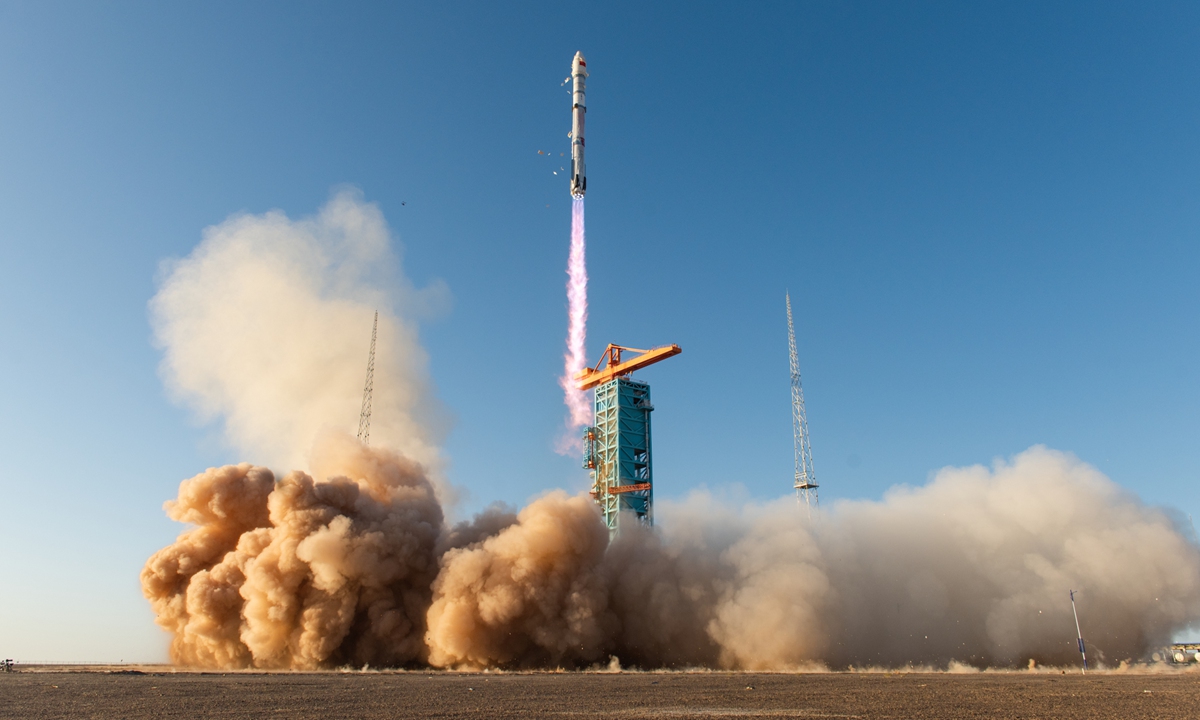
Photo: VCG
The first "Xiong'an made" satellite was successfully launched into orbit from the Dongfeng commercial space innovation pilot zone in Jiuquan, Northwest China's Gansu Province on Wednesday, marking a milestone for the Xiong'an New Area's aerospace information industry as it advances from research and manufacturing to in-orbit applications.The successful launch also signals that Xiong'an's satellite industrial chain is taking shape, laying the groundwork for future mass production and large-scale deployment of satellites, an industry analyst said.
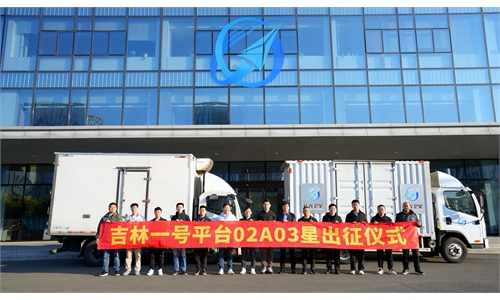
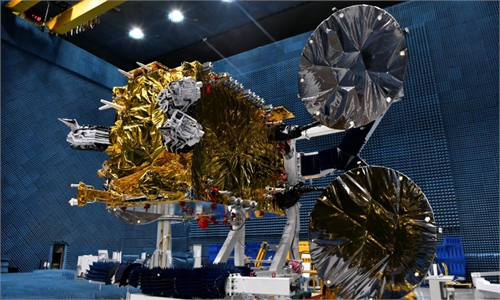
The satellite, which is also known as Xiong'an-1, was independently developed by the Beijing LandSpace Hongqing Technology Company. It rolled off China's first automated satellite mass production assembly line at Hongqing Technology's pilot production center in Xiong'an, according to the official government website of the Xiong'an New Area.
The 541-kilogram flat panel satellite measures 3 meters long, 2 meters wide and just 0.4 meters thick. It will operate in an orbit of about 500 kilometers above Earth.
After entering orbit, the satellite successfully deployed its solar arrays and reported normal telemetry data, according to the official WeChat account of Hongqing Technology.
The satellite will also conduct in orbit verification of several technological innovations, including an argon propellant electric propulsion system, an active fluid loop combined with a deployable radiator for thermal control, and a spaceborne router with single unit processing capacity at the Tbps level, according to the company.
Wednesday's mission also marked another milestone for China's commercial space sector, as the rocket carrying the satellite, the reusable Zhuque 3, successfully achieved its first land recovery of the rocket's first stage, the Xinhua News Agency reported.
The significance of the successful launch goes beyond putting a satellite manufactured in Xiong'an into orbit, as it means that the industrial chain from research and development and manufacturing to launch and in-orbit applications has been further connected, Ye Tanglin, a city planning expert with the Capital University of Economics and Business, told the Global Times on Wednesday, noting that it also lays a foundation for the subsequent mass production and large scale application of satellites in Xiong'an.
The milestone comes less than a year after Xiong'an's first locally manufactured satellite rolled off the production line on October 22, 2025, 10 months after Hongqing Technology was officially registered and established in the Xiong'an New Area in January 2025.
Registered, constructed and put into operation in 2025, with its first satellite also rolling off the line that same year, the project reflects what has been dubbed "Xiong'an efficiency." The independently developed production line, China's first automated satellite production line to use an assembly line model, had the capacity to deliver 100 flat panel satellites annually as of April, according to information from the Xiong'an government website.
"Xiong'an has developed advantages in the sector through the clustering of major companies and different parts of the industrial chain. Commercial space and satellite industries are entering a period of rapid development, with emerging sectors such as low Earth orbit satellite internet opening up considerable room for further growth," Ye said.
The China Satellite Network Group, or China SatNet, was established in Xiong'an in April 2021 and formally moved its headquarters there in October 2024, becoming the first centrally administered state-owned enterprise to fully move to the new area.
The arrival of China SatNet has helped attract companies and innovation platforms across the satellite internet industrial chain. So far, the Xiong'an New Area has gathered nearly 70 upstream and downstream aerospace information companies, covering satellite design, component manufacturing, in-orbit operations and space time applications, forming a well-developed industrial ecosystem, according to the local government.
The successful launch is only a beginning. "As the industrial chain becomes more mature, more satellites could move toward mass production and enter space in the future," Ye said.
Currently, Xiong'an is home to 69 aerospace information companies and nine innovation platforms, with a complete aerospace information and satellite internet industrial chain rapidly taking shape, according to media reports.
As a primary destination for functions relocated from Beijing that are not essential to its role as the capital, Xiong'an can draw on Beijing's technological, talent and innovation resources while fostering new industrial clusters, Xiang Ligang, director-general of the Zhongguancun Modern Information Consumer Application Industry Technology Alliance, told the Global Times on Wednesday.
Xiong'an is accelerating the development of emerging industries, including aerospace information and satellite internet, artificial intelligence and new materials, Xiang said, noting that the clustering of leading companies and upstream and downstream enterprises is strengthening the regional industrial ecosystem.
As the industrial chain expands, the aerospace information industry has the potential to become one of Xiong'an's most recognizable industries nationwide and strengthen its role as an emerging commercial space hub, Xiang said.
RELATED ARTICLES