China leading in global robotics race, but opportunities for China-US cooperation exist: US industry rep

Jeff Burnstein, president of the US-based Association for Advancing Automation (A3) Photo: Zhang Yiyi/GT
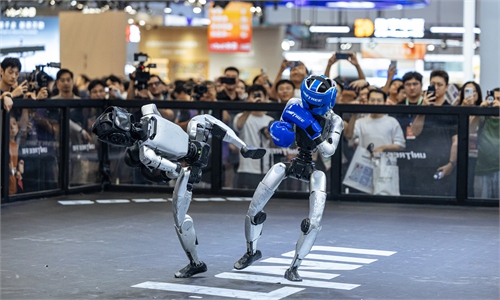
China is currently leading the global robotics race, supported by a national strategy, strong manufacturing capabilities and the large-scale deployment of robots, but there are opportunities for China-US cooperation, Jeff Burnstein, president of the US-based Association for Advancing Automation (A3), said at the 2026 World Robot Conference in Beijing.
In an interview with the Global Times and other media outlets, Burnstein, who has attended the World Robot Conference in China several times, described the evolution of China's robotics industry as "pretty amazing," citing strong government support and long-term planning as key drivers of its rapid growth.
"China is ahead because it has a national strategy that goes back more than a decade. China saw robots and AI as the future," he said. "They have five-year plans that they keep implementing, and they're achieving it."
By comparison, the US has never had a national robotics strategy, although policymakers have recently begun to recognize robotics as a key technology and the need to regain leadership in the sector, according to Burnstein.
Embodied intelligence is positioned as a strategic pillar of China's future industries. The 2025 proposal for the 15th Five-Year Plan included embodied intelligence in the country's medium and long-term industrial roadmap for the first time, followed by the 2026 outline that identified it as a new growth driver. Government work reports for two consecutive years have also mandated concrete actions for its development, according to the Xinhua News Agency.
Burnstein added that China's manufacturing strength and broad availability of components provide another major advantage that many other countries do not possess.
Global humanoid robot shipments reached about 19,100 units in the first half of 2026, nearly quadrupling year-on-year, with Chinese manufacturers accounting for more than 97 percent of the total, according to market research firm Smart Analytics Global.
China's Ministry of Industry and Information Technology said in July that, as large models and AI agents continue to advance rapidly, the country's humanoid robot output is expected to exceed 100,000 units this year.
Burnstein said that China is deploying more humanoid robots than any other country. Beyond immediate sales, deployment itself can accelerate technological progress by giving robots opportunities to collect data and learn in real environments, he added.
"One advantage of simply getting them out there and doing work is that they learn," he said. "New models can then be introduced that are smarter and understand the real world better. That's an advantage China has."
Burnstein also said competition in the robotics industry remains wide open. China has clear strengths in hardware, manufacturing and component availability, while the US retains advantages in artificial intelligence and software.
"China is leading now. Do I think North America will catch up? I assume so," he said. "It's still wide open as to who is going to lead the world in that technology."
Despite intensifying competition, Burnstein said cooperation remains possible, particularly in the development of global safety standards. Such standards are crucial for both humanoid robots and AI as the technologies move into factories, warehouses, logistics networks and other real-world environments.
"Countries working together on standards development is important. I think all these advances can help people around the world. This isn't just about industry. It's about making people's lives better," Burnstein said.
"I certainly think there are opportunities," he said when asked whether common challenges faced by the US and China create opportunities for cooperation.
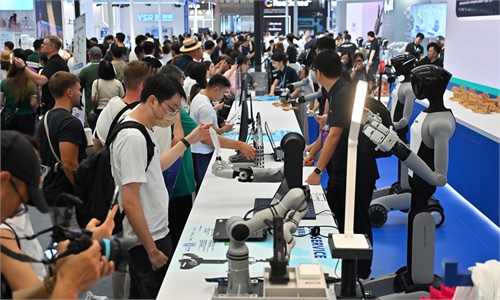
The conference, held in Beijing from August 19 to 23, brought together more than 300 companies displaying over 2,000 exhibits and launching more than 150 new products. A3, one of the world's largest automation industry associations, has nearly 1,500 member companies. Burnstein estimated that about 40 to 50 Chinese companies are currently members.
RELATED ARTICLES