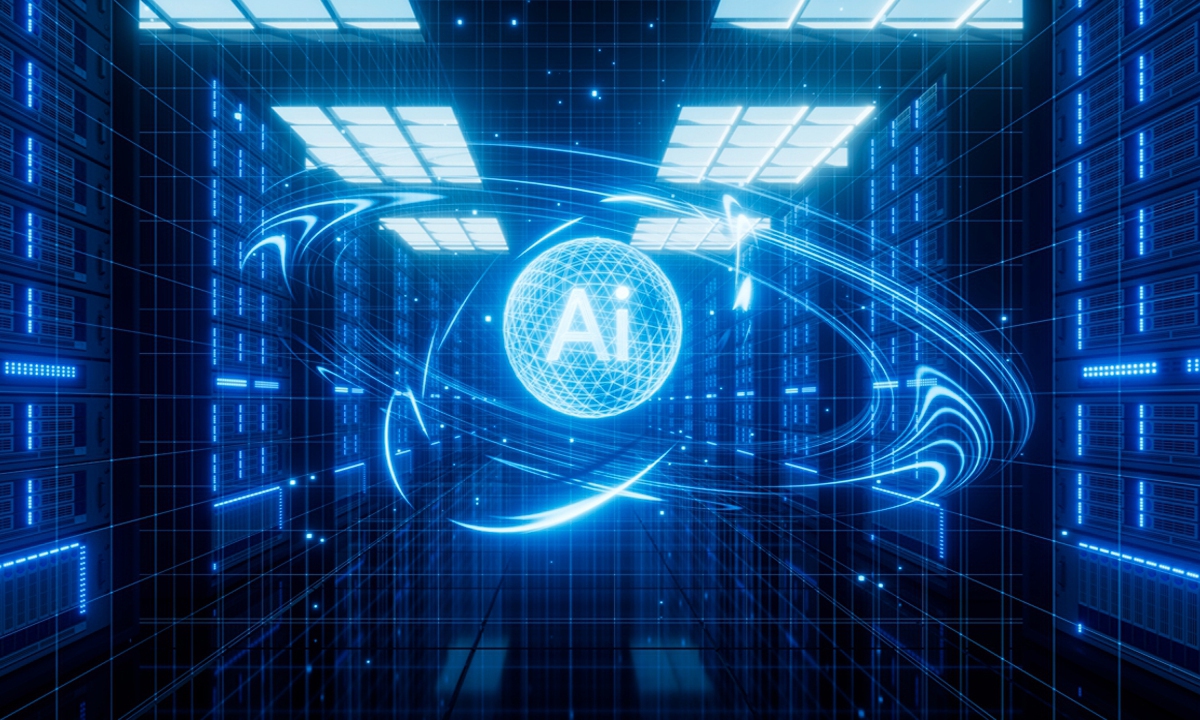
Conceptual diagram of AI Photo: VCG
Alibaba Cloud has announced the launch of its third data center in South Korea, a move designed to meet the surging local demand for artificial intelligence (AI) and cloud computing services while further improving its regional digital infrastructure layout, the Yonhap News Agency reported.
The development comes as South Korea's government and its leading conglomerates double down on AI and semiconductor investments. At the end of last month, South Korea unveiled plans for at least $880 billion of investments to build out the country's chip manufacturing and AI capabilities in the coming years, laying bare a strong ambition to seize the dividends of global AI and elevate its digital competitiveness. It is part of the country's so-called Three Mega Projects to develop new chip production hubs, data centers and robotics technology.
Yet, for such ambitions to translate into tangible industrial development, solid support from computing power, cloud services and engineering capabilities is indispensable. This naturally raises a question: within South Korea's grand digital blueprint, what role can Chinese companies play?
Many tend to regard the South Korean cloud sector as a mature market for global cloud service providers. From a conventional commercial perspective, Alibaba Cloud's launch of its third local data center is clearly aimed at strengthening its local infrastructure foundation to support South Korean businesses in running AI and cloud-based services. Yet the broader industrial signals embedded in this expansion are equally worth noting.
Unlike emerging markets starting from scratch, South Korea boasts decades of technological accumulation and numerous industrial advantages in memory chip manufacturing, semiconductor hardware innovation and terminal scenario digitalization. These are precisely the foundations upon which its ambitious AI vision is built.
Despite these impressive hardware strengths, South Korea's AI infrastructure also faces notable structural problems. A report released in April by South Korea's National Assembly Futures Institute noted that the nation's AI investments mostly focused on the first and second layers of the AI value chain - semiconductors and hardware infrastructure, while investment in the third and fourth layers - foundation models, application software, services, and platforms, which generate the highest profits and market dominance - remained relatively inadequate.
In other words, South Korea's industrial prowess remains heavily concentrated in hardware manufacturing, leaving a visible gap in the value chain that stretches from raw computing power to end-user applications. Domestic resources alone may not be sufficient to sustain an AI industry blueprint, and this gap creates a natural opening for external partners.
While South Korea's semiconductor and AI sectors have been subject to certain influence from the US, this does not mean that it cannot diversify foreign cooperation in AI infrastructure. China's internet and digital economy boom over the past decade has given rise to cloud computing application of unparalleled complexity and scale, sharpening the country's cloud service infrastructure and engineering expertise beyond what laboratory-based technological research could achieve.
Furthermore, Chinese companies have accumulated rich practical experience in landing AI technologies in vertical industries ranging from manufacturing and logistics to finance. These are precisely the competencies that South Korea needs to complement its hardware prowess. The two countries' capabilities are naturally complementary: South Korea's cutting-edge chips, combined with China's engineering expertise and scenario-based experience, could build a complete industrial chain covering hardware manufacturing, computing infrastructure and intelligent application implementation.
Looking beyond the bilateral dimension to the broader global landscape, from Southeast Asia to the Middle East, numerous countries are drafting their own AI blueprints - yet nearly all of them are grappling with exorbitant computing costs, talent shortages, and a host of implementation hurdles. In this light, close China South Korea cooperation in AI infrastructure could send a clear signal to the world: China is not merely a massive market for AI applications, but also a reliable source of engineering expertise for building global AI infrastructure.
Of course, challenges are inevitable. Geopolitical dynamics, disparities in technical standards, and data security and cross-border compliance are all issues that demand wisdom and sincerity from both sides. Yet, precisely because AI infrastructure requires massive investment and entails long construction cycles, establishing a durable and mutually advantageous cooperative framework would not only unlock greater development potential for both countries but also set a valuable reference for global AI infrastructure cooperation.
RELATED ARTICLES