Chinese mainland visitors to Japan plunge 56.1% in July despite summer travel peak
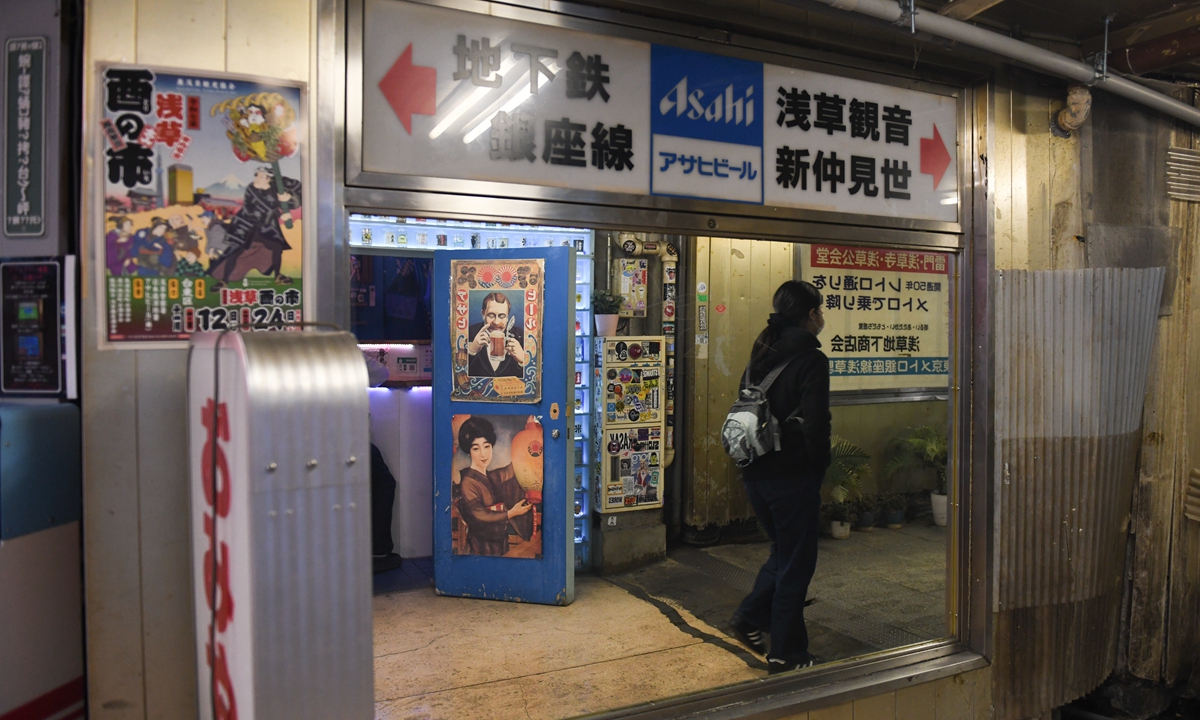
A pedestrian in the underground shopping center in the Asakusa district in Tokyo, Japan, on November 16, 2025. Photo: VCG
Despite the summer holiday peak, the number of visitors from the Chinese mainland to Japan plunged 56.1 percent year-on-year in July, extending the decline to an eighth straight month. Chinese analysts said the sustained slump points to a deeper loss of travel demand as strained China-Japan ties, driven by a series of erroneous moves by the Japanese side, continue to weigh on people-to-people exchanges.
The latest figures also reinforce that the downturn is neither temporary nor seasonal. Analysts said that they further undercut attempts by some Japanese media outlets to play down the impact of the sharp contraction in Chinese visitors by pointing to growth from other markets.
Japan received an estimated 428,200 visitors from the Chinese mainland in July, down from 974,564 a year earlier, according to data released Wednesday by the Japan National Tourism Organization (JNTO).
In the first seven months of 2026, arrivals from the Chinese mainland totaled 2.4865 million, down 56.3 percent year-on-year, said JNTO.
The Chinese mainland market has now declined for eight straight months. JNTO data show arrivals fell 60.7 percent in January, 45.2 percent in February, 55.9 percent in March, 56.8 percent in April, 60.4 percent in May and 57.3 percent in June before another steep fall in July.
JNTO itself has acknowledged the factors weighing on the Chinese market. While school holidays provided some support for travel demand, the number remained below the level of a year earlier amid China's advisory to avoid travel to Japan and reductions in air services, according to JNTO's report.
China first issued an advisory in November 2025 urging its citizens to avoid traveling to Japan, citing safety concerns and saying erroneous remarks concerning Taiwan by the Japanese leader had "seriously worsened the atmosphere for people-to-people exchanges between China and Japan."
Lü Chao, an expert on East Asian studies at the Liaoning Academy of Social Sciences, said Japan has traditionally been a major outbound destination for Chinese tourists, but arrivals have now fallen sharply for several consecutive months. He said the prolonged decline points above all to the deterioration in China-Japan relations.
"Japan had hoped that the summer holidays and the upcoming Aichi-Nagoya Asian Games would help revive travel demand, but the latest figures show that this has not happened," Lü told the Global Times on Thursday. "The continued decline shows that strained China-Japan relations are already weighing clearly on tourism and broader people-to-people exchanges."
The latest figures also undercut claims in some Japanese media that growth from other markets could offset the decline in Chinese visitors. A Toyo Keizai Online article in July acknowledged that the sharp fall in Chinese arrivals was a major drag on Japan's inbound tourism in the first half, but argued that a more diversified visitor base could make the industry more resilient.
Meanwhile, Japan's tourism authorities have continued to stress the importance of the Chinese market. At a July 15 press conference, an official for Japan Tourism Agency said that China remained "one of the important markets" for Japan, given its leading position in both visitor numbers and tourism spending.
Chinese tourists represent a large and important source market for many destinations and tend to make a significant contribution to inbound tourism spending. Their strong consumption power also means that a sustained decline in Chinese visitor numbers can have a broader impact on tourism-related sectors, analysts said.
Lü said Japan's negative moves on historical, Taiwan and security issues have further eroded political trust and the atmosphere for people-to-people exchanges. "Tourism is meant to be relaxing and enjoyable, so prolonged political tensions will naturally affect people's willingness to choose Japan as a destination," he said.
On Saturday, Japanese Prime Minister Sanae Takaichi made a monetary offering to the Yasukuni war shrine, which China has denounced as a symbol of Japanese militarism that honors 14 convicted Class-A war criminals. China's Foreign Ministry has lodged serious protests against Japan. China urged the Japanese side to do serious soul-searching on its history of aggression, make a clean break with militarism, and earn trust from its Asian neighbors and the rest of the world with concrete actions, a Chinese Foreign Ministry spokesperson said.
"If Japan does not genuinely improve its approach toward China and take steps to rebuild political trust and public goodwill, not only will tourism exchanges struggle to return to previous levels, but the fallout could spread more broadly to people-to-people exchanges and economic ties, inflicting further losses on Japan's tourism and related industries," Lü said.
RELATED ARTICLES