Japan’s tourism industry enters a deep winter chill after Takaichi's erroneous remarks on Taiwan
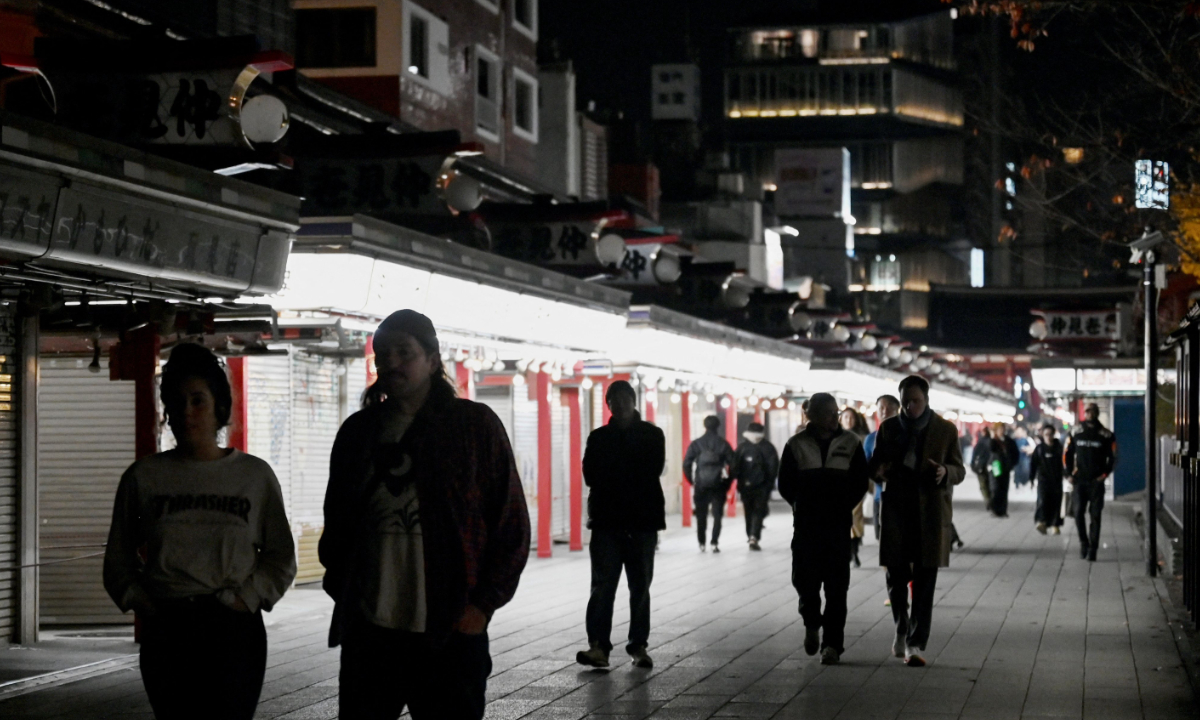
People walk at the Sensoji temple in the Asakusa district in Tokyo on December 1, 2025. Photo: VCG
Since early December, multiple regions across Japan have begun to feel a noticeable shift in the tourism market, as the number of visitors from the Chinese mainland drops sharply. The turning point, industry insiders say, was Japanese Prime Minister Sanae Takaichi's erroneous remarks regarding the Taiwan question. The political shockwaves quickly spilled over into one of the most sensitive sectors – tourism.
Market research firm China Trading Desk reported that bookings by Chinese travelers to Osaka for this winter and next spring have plunged by 55 to 65 percent, with Kansai International Airport seeing the highest cancellation rate nationwide. The Japan Research Institute estimates that if the situation persists into next year, the economic loss could reach 1.2 trillion yen (about $7.8 billion).
Beyond the numbers, the strain on tourism businesses offers a more telling picture. In Kyoto, a kimono rental shop that relies heavily on independent Chinese travelers said its monthly revenue has dropped by roughly 3 million yen since December. The owner noted that while Chinese tourists used to account for about half of all customers, the proportion has collapsed, and formerly full reservation slots now sit empty.
In Osaka, a popular rice-ball shop long favored by foreign tourists saw 24 people lining up one afternoon – yet none were from the Chinese mainland. The show owner said Chinese travelers once made up around 20 percent of customers, but now they are almost gone. Such specific shifts are creating a palpable sense of anxiety among tourism industry practitioners.
Daily life observations in Japan by the reporter reinforces the trend. In Yokohama’s Minato Mirai and Sakuragicho – areas traditionally filled with Chinese visitors – Chinese voices have become rare this month. The Yokohama Red Brick Warehouse, one of the city’s most popular cultural and shopping destinations, has already entered its Christmas season, but Chinese tour groups are now nearly absent.
A friend in Nagoya told the reporter that the international arrivals hall at the local airport is now “unusually quiet,” a stark contrast with previous months. Another friend in Osaka, who works in commercial passenger transport, said the impact has been more direct. Having expanded his green-plate fleet to 12 vehicles in October to prepare for China’s 2026 Spring Festival peak, he now receives only one-third of his usual daily bookings.
After Chinese airlines extended free cancellation policies, more than half of the previously confirmed year-end and Spring Festival charters were canceled. “There are plenty of places to travel,” one longtime customer told him. “We just don’t want to visit Japan for the new year during a period of tension.”
These examples do not reflect problems within the market itself, but rather the spillover effects of the Japanese government’s diplomatic messaging. Tourism is highly sensitive to political signals. Once negative expectations emerge, travelers adjust immediately, while small and medium-sized enterprises lack the capability to absorb external shocks.
Japanese media have reached similar conclusions: cancellation surges in Osaka, Kyoto, Nagoya and other cities. Some industry practitioners in lodging, retail and transport said the situation feels more difficult than during the pandemic, because there are no government subsidies this time, and there is no way to predict how long the situation will last. While local governments and industry associations remain restraint in tone, they have begun to warn businesses to "be aware of the uncertainties brought about by diplomatic tensions."
The currently cooling tourism sector in Japan is not a simple shift in consumer behavior — it is the economic cost of the Japanese government’s hardline statements on a highly sensitive issue. These costs fall first on local industries and ordinary workers, and will soon ripple through regional economies. However the situation develops going forward, the chain reaction already unfolding underscores a sobering reality: when national-level political rhetoric crosses boundaries it should not, the one who pays the price is not the government itself, but countless ordinary people whose livelihoods depend on tourism and services.
RELATED ARTICLES