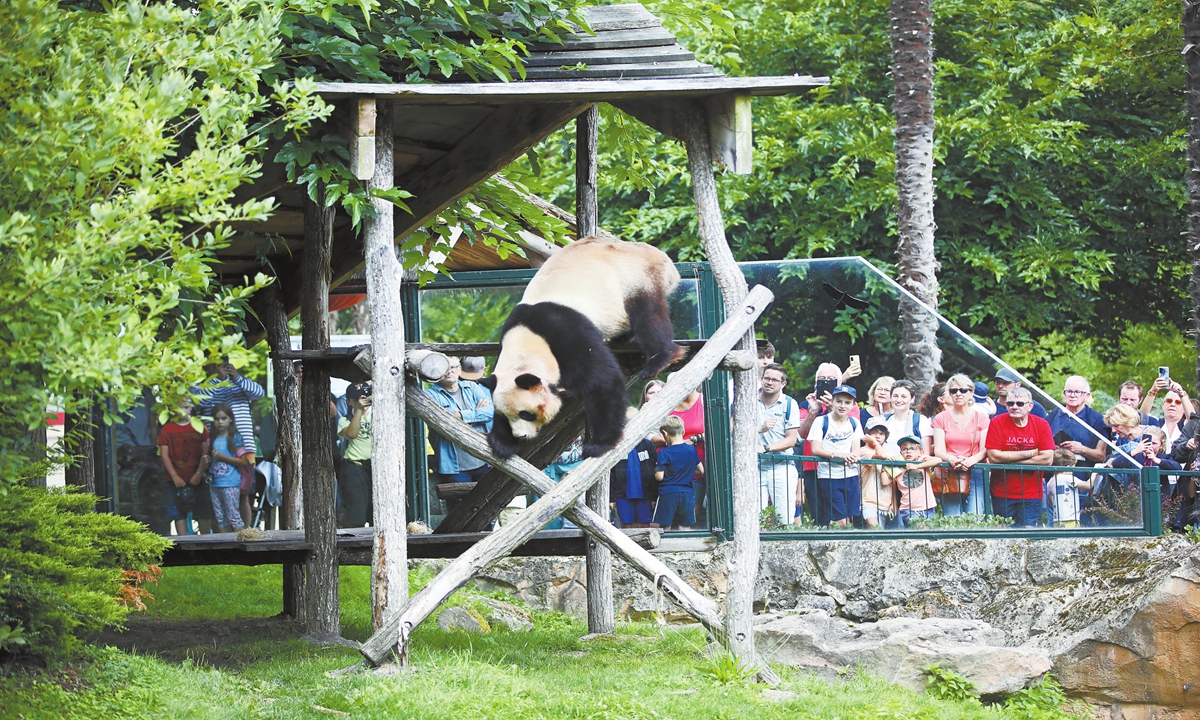
Visitors watch Yuan Meng, the first giant panda born in France, at Beauval Zoo in France, on July 24, 2023. Photo: VCG
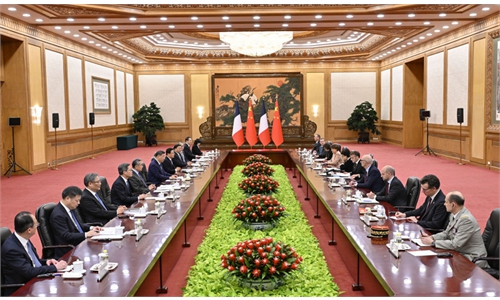
Editor's Note:This year marks the 50th anniversary of the establishment of diplomatic relations between China and the EU. President Xi Jinping noted that over the past 50 years, China and the EU have achieved fruitful outcomes in exchanges and cooperation, delivering mutual success and worldwide benefits. An important understanding and insight is that the two sides should respect each other, seek commonality while reserving differences, uphold openness and cooperation, and pursue mutual benefit. To explore the future trajectory of China-EU relations, the Global Times is launching a column titled "China-Europe Resonance." In the second article, we invite scholars from both China and Europe to share their insights on how pandas can help China and Europe deepen people-to-people exchanges and emotional bonds, thereby strengthening the ties between the two sides. It is noteworthy that the wife of French President Emmanuel Macron visited the China Conservation and Research Center for the Giant Panda in Chengdu during their China visit in early December.
The 'panda connection' is growing stronger among the people of China and Europe
Wang Shuo (professor at the School of International Relations, Beijing Foreign Studies University): Pandas represent a continuation of memories and emotions. In 1973, France received its first pair of pandas, Li Li and Yan Yan, which became symbols of the thawing of China-France relations at that time. In 2012, after pandas Huan Huan and Yuan Zai arrived in France, their son Yuan Meng was born there. The affection of the French people toward pandas transcends age, class and even political stance.
Pandas are symbols of trust and friendship. Without deep friendship and sufficient trust, panda leasing would clearly be impossible. Pandas also signify respect and dialogue. In Europe, they have become symbols of China's soft image and a paradigm that transcends ideology, representing a creative fusion of Eastern ecological civilization and Western humanistic spirit. They embody a consensus of mutual respect more effectively than any political declaration, which is especially precious in today's complex world.
Ding Chun (director of the Center for European Studies at Fudan University): Giant pandas possess a natural, depoliticized appeal. In the eyes of the general public worldwide and in Europe, they represent cuteness, gentleness and endangerment, thus requiring protection. As partners of two great civilizations, both China and Europe highly value the protection of humanity's shared heritage and our planet. The vulnerable status of pandas provides a solid foundation for both sides to collaborate on biodiversity conservation, from individual breeding to habitat ecosystem protection.
Currently, China and Europe have established stable research teams, zoo networks, logistics and medical systems related to giant pandas. In China-Europe diplomatic exchanges, giant pandas can be regarded as "messengers of friendship." Their significance is not inherently tied to ideology, historical grievances, or security threats. The image of pandas allows people from different positions, generations and regions to reach an emotional consensus.
Pierre Picquart (an expert in geopolitics and human geography from the University of Paris-VIII): In Europe, the fascination with giant pandas has deep roots. Today, pandas stand at the intersection of science, culture and diplomacy. Their conservation success, achieved through close cooperation between China and international partners, has elevated them to the status of "natural ambassadors." The recent announcement during President Macron's visit to Chengdu that new pandas will be welcomed in France by 2027 reinforces this symbolic dimension. In a world marked by tensions, the panda remains a universal reminder of our shared hopes - a quiet but enduring link between China and Europe.
How to deepen China-Europe people-to-people exchanges and emotional connections in the new context
Ding Chun: Against the backdrop of rising populism, unilateralism, and ideological confrontation, it is essential to ensure that people-to-people friendship continues to serve as the cornerstone. For example, Chengdu and Montpellier have been sister cities for over 40 years. From early collaborations on pandas and city exhibitions to daily cooperative projects in healthcare, education, and sports, they have now developed a comprehensive "citizen-to-citizen" network.
Second, relations at the national level are inevitably subject to fluctuations. It is crucial to proactively ground cooperation topics in concrete daily life and embed people-to-people exchanges into shared concerns such as climate change, aging populations, urban renewal, AI ethics, and public health. Joint courses, collaborative documentary productions, and youth policy workshops can be organized around these issues, allowing young people from China and Europe to understand each other's values as they "solve problems" together, rather than being forced to "take sides" within an ideological framework.
Pierre Picquart: While geopolitical dynamics are increasingly complex - influenced by populism, unilateralism and ideological divisions - people-to-people connections remain a fundamental pillar of China-Europe relations. The panda plays a unique role in this context: It creates an emotional, cultural and scientific common ground where cooperation can flourish even in difficult times.
Academic exchanges reinforce this dynamic. France currently hosts around 30,000 Chinese students, while an increasing number of French and European students are choosing China for their studies. This trend has not fully returned to previous levels, but the willingness to revive and expand these exchanges is strong on both sides. Pandas, as symbols of environmental responsibility and scientific innovation, offer a fertile platform for new programs in ecology, climate studies and biodiversity preservation.
Wang Shuo: First, we should continue to expand people-to-people exchanges. The visa-free policy for some European countries is a positive and effective measure. Second, we should make flexible use of new digital media. In today's digital age, the internet and social media have fundamentally changed the way information is disseminated and exchanged. If more digital elements can be introduced into China-EU people-to-people exchanges, it will be easier to break down communication barriers between different groups, allowing elements like pandas to be understood, accepted, and recognized by a wider audience, thus building an "information" foundation for China-EU relations.
Third, we should encourage exchanges and interactions among knowledge and cultural communities. On the one hand, we can promote more cooperation between think tanks and non-governmental organizations, and establish joint research projects across different disciplines. On the other hand, we should advocate for the spirit of Marco Polo in the new era and support entrepreneurs, scholars, artists and other individuals from both sides in forming cross-border exchange groups to promote mutual learning between civilizations and science, thereby building a "knowledge" foundation for China-EU relations.
How to pass on the China-Europe friendship to the next generation
Pierre Picquart: Several initiatives can strengthen this intergenerational bond. First, joint educational programs on environmental protection can connect Chinese and European schools through shared projects. Second, academic exchanges must be expanded in both directions. Third, educational visits to conservation bases in Sichuan provide immersive experiences that leave lasting impressions on students and young researchers. Fourth, collaborative scientific projects involving universities, research institutes and environmental organizations can create new communities of young experts committed to protecting vulnerable species. These initiatives go beyond simple knowledge-sharing; they allow young people to experience cooperation in action.
Wang Shuo: On the one hand, we must excel in our efforts regarding people, especially in valuing and cultivating young individuals. When young people personally participate in co-creation, the bond with pandas will no longer be a distant memory, but a real experience belonging to them.
On the other hand, it is essential to focus on the national level, which is the responsibility of the state and government. The core of this work is to advocate for and practice the concept of mutual learning among civilizations. In today's world, there are too many conflicts. People need peaceful and beautiful things like pandas more than ever, allowing everyone to temporarily set aside disputes and build a bridge of respect and understanding to better resolve differences and conflicts.
Ding Chun: From a global perspective, the friendship between the people of China and Europe, exemplified by the bond with pandas, offers valuable insights. First, even amid intense competition among major powers, there is a need to preserve a non-confrontational space: issues such as vulnerable species protection, climate action, public health, and youth education can maintain a minimum level of cooperation and trust. The China-Europe cultural dialogue serves as one such institutional platform for this space. Second, in any regional relationship, what truly transcends ideological shifts is not abstract slogans, but concrete stories. These stories will constitute a solid "global public sentiment asset." In an era of increasing division, maintaining gentle and concrete cross-cultural connections is itself an important global public good.
RELATED ARTICLES